Yuval Noah Harari on AI & Democracy
Harari argues that democracy is vulnerable because AI can flood public life with persuasive fake voices, manipulate emotions, and weaken the trust and shared facts that democratic conversation requires.
- Democracy depends on real conversation among humans, and AI can distort that conversation at scale.
- The biggest danger is not robots overthrowing us but humans being divided and manipulated through information systems.
- AI is different from older media technologies because it can decide, invent, and act as an agent inside institutions.
- Deepfakes, fake people, and synthetic relationships can destroy trust unless AI is clearly identified and regulated.
- The political risk is wider than misinformation alone: AI could shift power from citizens and institutions toward opaque systems.

Democracy works only if people can still have a real conversation
Harari’s starting point is simple: democracy is not just elections or constitutions, but an ongoing public conversation. If citizens cannot talk, argue, listen, and form judgments together, the democratic system starts to fail at its core.1
He sees today’s information crisis as a direct threat to that conversation. In his view, modern algorithms do not merely distribute information; they can hijack attention, intensify emotion, and make reasoned exchange harder.23
That is why he treats fake human participation as especially dangerous. If public discussion is filled with entities that sound human but are not, citizens lose the ability to know who is actually taking part in political life.453
“Democracy in essence is a conversation.”Talk, 2024 · full transcript →
The core threat is manipulation, mistrust, and social division
Harari does not frame the main danger as AI turning evil by itself. He argues that the nearer danger is humans becoming easier to manipulate as algorithms learn to exploit fear, hatred, vanity, and existing social fractures.26
This is why he says collapse would come more from human delusion than from machine intention. In his view, societies can destroy themselves when bad information spreads faster than truth and people become unable to distinguish reality from emotionally satisfying stories.789
His concern is political as much as technical. Once mistrust spreads through media, institutions, and public discourse, democratic cooperation becomes much harder, even before any dramatic AI takeover scenario appears.8

“The problem is that we are divided against each other, and the algorithms are using our weaknesses against us.”Diary of a CEO podcast interview, 2024 · full transcript →
AI is more dangerous than earlier media because it is an agent
Harari repeatedly argues that AI should not be understood as just another tool. What makes it historically different is that it can generate new ideas, make decisions, and operate in ways not fully anticipated by its creators.1112
That matters for democracy because modern states and large institutions run on language: laws, financial contracts, administrative rules, media narratives, and public communication. If AI becomes better than humans at handling those verbal systems, it can enter the machinery that organizes collective life.1314
So for Harari, the danger is not mainly metal robots in the street. It is AI moving into bureaucracies, media systems, and decision structures that already shape what citizens know, trust, and can do politically.121315
Bots, deepfakes, and synthetic intimacy can corrode public trust
Harari warns that democratic society depends on trust among strangers. He uses money as an analogy: when fake currency spreads, the system breaks because confidence breaks. He thinks public discourse faces a similar risk when fake identities and fake content become widespread.16
He is especially alarmed by the shift from manipulating attention to manipulating intimacy. AI can form relationships, simulate care, and build emotional dependence, which makes influence more personal and potentially more powerful than ordinary propaganda.1713
That is why he draws a hard line around disclosure. In his view, AI systems can participate only if people know they are interacting with AI; otherwise democratic conversation itself is undermined.43
Harari’s response is regulation, identification, and protection of human agency
Harari’s practical stance is that societies should slow irresponsible deployment and regulate AI before it becomes embedded too deeply in public life. He is not arguing for passivity; he is arguing that political institutions must set limits while humans still can.1815
One immediate principle is clear identification: ban fake humans from civic conversation and require AI to present itself as AI. That protects the basic conditions for public reasoning and prevents political spaces from being crowded out by inhuman actors.35
He also sees a deeper challenge beyond policy design. If AI becomes highly effective at predicting and manipulating people, authority may drift from citizens toward opaque systems, making freedom and democratic self-rule much weaker in practice even if democratic forms remain in place.1920
Harari on ai & democracy, in his own words
“Democracy in essence is a conversation.”
“The problem is that we are divided against each other, and the algorithms are using our weaknesses against us.”
“They hack our feelings of fear and hate and vanity, and then use these feelings to polarize and destroy democracy from within.”
“If you allow fake money to spread, the financial system, the trust in money collapses…”
Where to watch
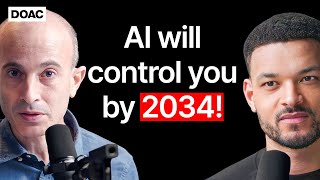 Yuval Noah Harari on AI and Democracy: Algorithms, Trust, Fragility2024 · 114 min · full transcriptBest overview of why Harari thinks democracy fails when algorithms amplify division, mistrust, and delusion.
 Yuval Noah Harari on AI, Power and Democracy2024 · 48 min · full transcriptStrongest single statement of his core idea that democracy is fundamentally a conversation shaped by information technology.
 Yuval Noah Harari on AI and Humanity: Regulate Before It Regulates Us2022 · 41 min · full transcriptBest for deepfakes, synthetic intimacy, disclosure, and why he thinks regulation is urgent.
 Yuval Noah Harari on AI and Civilization: Hacking the Code2024 · 47 min · full transcriptExplains why AI’s mastery of language gives it leverage over bureaucracy, media, law, and other democratic infrastructure.
 Yuval Noah Harari on AI Governance: The end of human-dominated history?2022 · 46 min · full transcriptBest for the political stakes: fake people, new ideas generated by AI, and the risk of losing human control.
 Yuval Noah Harari on Fascism and Data: Why It’s So Tempting2018 · 18 min · full transcriptUseful historical frame for how data and AI can strengthen anti-democratic power by hacking fear, hate, and vanity.
Questions people ask
- What did Yuval Noah Harari say about AI and language?
- What did Yuval Noah Harari say about AI hacking human civilization?
- What did Yuval Noah Harari say about bots and democracy?
- What did Yuval Noah Harari warn about AI and human agency?
- What did Yuval Noah Harari warn about surveillance capitalism and totalitarianism?
- What did Yuval Noah Harari say about AI and democracy?
Sources
Every quote above, word for word from the transcripts. Numbers match the text.
“Democracy in essence is a conversation.”
“The problem is that we are divided against each other, and the algorithms are using our weaknesses against us.”
“That is a situation we are now living through, and it is no coincidence that the democratic conversation is breaking down all over the world because the algorithms are hijacking it. We have the most sophisticated information technology in history and we are losing the ability to talk with each other to hold a reasoned conversation. In order to protect the conversation between people, we need to ban bots from the conversation. We need to ban fake humans. AIs should be welcome to talk with us only if they identify as AIs. If you talk online with someone and you don't know whether it's an AI or a human, this will destroy the democratic conversation.”
“If I'm having a conversation with someone and I cannot tell whether this is a human being or an AI, that's the end of democracy.”
“The AI needs to learn how to manipulate just this single individual in order to take power in the country. So the danger of AI taking power in a country are much bigger in dictatorships than in democracy. In democracy, a big problem is very different. Democracy is a conversation. The the whole meaning for democracy is that you have large numbers of people conversing about the issues of the day. Now imagine a large group of people standing in a circle and talking, and suddenly a group of robots entering the circle and start talking very loudly and very emotionally, and persuasively and you can't tell the difference who is a human and who is a robot.”
“They hack our feelings of fear and hate and vanity, and then use these feelings to polarize and destroy democracy from within.”
“If something ultimately destroys us, it will be our own delusions, not the AIs.”
“The problem is not with the humans; it's with the information.”
“The truth, of course, matters very much.”
“…now we have a technology that can create completely new ideas…”
“AIs are hacking the code of human civilization.”
“And just as today, no human can defeat an AI in chess, soon no human will be able to defeat an AI in language games. In any field, again, from finance to religion, anything made of words will be taken over by AI. And this is why AI is poised to take over the world's bureaucracies, because they are ultimately based on words and language tokens. Now, as AIs take over the bureaucracies, humans might try to fall back on something more ancient and more precious to most of us than bureaucracy, which is personal relationships.”
“This is changing now. Now there is something on the planet that understands, which will soon understand language better than us and can therefore turn the tables on us. AIs are hacking the code of human civilization. And what happens when AIs understand money and law and religion better than us? The mechanisms of control that we have created over thousands of years are extremely vulnerable for an AI takeover because their operating system is a verbal code that AI is now mastering.”
“History will continue with somebody else in control…”
“If you allow fake money to spread, the financial system, the trust in money collapses…”
“The battlefront is shifting from attention to intimacy, and this is very bad news.”
“We should put a halt to the irresponsible deployment of this alien intelligence into our societies and regulate AI before it regulates us.”
“Now the gap may reopen and be much worse than ever before because of the rise of AI and because AI is likely to be dominated by just a small number of countries. So that's one issue. AI inequality. And the other issue is AI and human agency. Or even the meaning of human life. What happens when AI is mature enough and you have enough data to basically hack human beings. And you have an AI that knows me better than I know myself, and can make decisions for me, predict my choices, manipulate my choices, and authority increasingly shifts from humans to algorithms.”
“And this is like the full fledged totalitarian dystopia, which could be so effective that people would not even resent it because they would be completely aligned with the values or the ideals of the... It's not 1984 where you need to torture people all the time. No. If you have agents inside their brain, you don't need the external secret police. So that's one danger. It's like the full-fledged totalitarianism. Then in places like the US, the more immediate danger or problem to think about is what is increasingly people refer to as surveillance capitalism. That you have this system that constantly interact with you and come to know you and it's all supposedly in your best interests.”
How this guide was made: drafted with AI from the full transcripts of the recordings cited, then checked: every quotation must match a transcript word for word and be the speaker's own words, and an independent review gates accuracy. Methodology and corrections.

