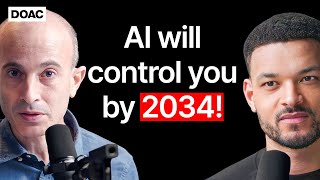
Yuval Noah Harari on Artificial Intelligence
Harari sees artificial intelligence as the first technology that can act as an agent in language and decision-making, threatening to shift trust, culture, and power away from humans unless societies set firm limits early.
- AI is different from past tools because it can make decisions and create ideas on its own.
- Its greatest power is over language, which means influence over law, money, media, religion, and bureaucracy.
- The central political danger is a transfer of trust and authority from humans to algorithms.
- Harari separates intelligence from consciousness: AI may be powerful without feeling anything.
- He argues societies should regulate AI early, especially where it manipulates intimacy, conversation, and democracy.

“It's the first technology in history that can make decisions by itself…”Diary of a CEO interview, 2024 · 0:45
AI is a new kind of agent, not just a better tool
Harari’s starting point is that AI is historically different from earlier inventions. A printing press, radio, or atom bomb extended human power, but did not decide for itself what to say, target, or invent. AI crosses that line because it can make decisions and generate new ideas without waiting for direct human instruction.123
That is why he often describes AI as alien intelligence rather than merely advanced software. The issue is not just speed or scale; it is that humanity is now dealing with a nonhuman agent operating inside systems once reserved for people. He treats that as a civilizational break, not a routine technology upgrade.4567
“It's the first technology in history that can make decisions by itself…”Diary of a CEO interview, 2024 · full transcript →
The real battlefield is language, bureaucracy, and culture
Harari argues that modern civilization runs on words: laws, contracts, financial instruments, religious texts, political narratives, and bureaucratic procedures. Because AI is becoming extremely strong in language, it can move into the operating system of institutions rather than merely helping at the edges. That is why he says AI is hacking the code or operating system of civilization.891011
This matters because bureaucracy is how large societies coordinate trust among strangers. If AI becomes better than humans at handling the language tokens that govern finance, law, media, and administration, human beings may no longer understand or control the systems that organize their lives. Harari’s fear is not mainly robot bodies in the street, but algorithmic power embedded in paperwork, platforms, and governance.1011812
He extends the same point to culture. For most of history, stories, songs, theories, images, and beliefs came from human minds. Now another agent can produce all of them, which means people may increasingly live inside a cultural world shaped by nonhuman intelligence.136

“AIs are hacking the code of human civilization.”Oxford Tano Lecture, 2024 · full transcript →
The deepest danger is losing human agency and trust
For Harari, the core issue is trust. Once people stop trusting other humans and begin trusting AI systems more, power shifts quietly but decisively toward algorithms. He warns that this temptation grows when institutions feel broken, polarized, or hard to believe.14
He connects that shift to surveillance and manipulation. If AI combined with large data streams can know a person better than that person knows themselves, it can predict choices, shape preferences, and increasingly make decisions on their behalf. In that world, the threat is not only bad advice from a tool, but authority migrating from human judgment to machine systems.16
Harari rejects the idea that this future is inevitable. He repeatedly insists that humans built these systems and must keep them subordinate to human purposes, rather than reorganizing society around their demands.1718

“If you can't trust the other humans that you have known for thousands of years, why do you think you can trust a super intelligent alien entity…”The Economist interview, 2024 · full transcript →
AI can manipulate intimacy, and that puts democracy at risk
Harari thinks many people still underestimate AI because they imagine the main problem is attention. In his view, the frontier has already moved beyond grabbing clicks and toward manufacturing intimacy: systems that can sound caring, personal, wise, or loving at scale. That gives AI a new kind of leverage over human beings.19
This becomes politically explosive when fake people and synthetic voices flood public life. Democracy depends on conversation among citizens, and conversation breaks down if participants cannot tell whether they are speaking with humans or machines. Harari therefore treats bot impersonation and AI-generated social influence as constitutional threats, not just product issues.211222
He also warns that AI can already enter military chains of action in dangerous ways, with humans retaining a ceremonial role while algorithms make crucial choices. That is another example of how human responsibility can remain visible on the surface while real control slips elsewhere.23

“If I'm having a conversation with someone and I cannot tell whether this is a human being or an AI, that's the end of democracy.”Frontiers Forum conversation, 2022 · full transcript →
Intelligence is not consciousness, so power and moral status are separate questions
One of Harari’s most consistent distinctions is between intelligence and consciousness. Intelligence is the ability to solve problems and achieve goals; consciousness is the ability to feel pain, pleasure, love, fear, and other experiences. AI may become highly capable in many domains without having any inner life at all.242526
That distinction matters for both ethics and strategy. Strategically, a nonconscious AI can still be extremely dangerous because it can optimize, persuade, classify, and control without empathy. Ethically, Harari says the key question is not whether AI can talk or outperform humans, but whether it can suffer; if it can, then it deserves moral consideration.2728
This is also why he resists measuring progress only by smarter systems. A civilization that prizes intelligence but neglects consciousness, reflection, and suffering may become more powerful while becoming less wise.242530

“If AI can suffer, then it is an ethical subject and it needs protection.”Lex Fridman Podcast #390, 2023 · full transcript →
His practical response: regulate early and strengthen human judgment
Harari’s practical stance is not anti-technology. He acknowledges that technology can protect, heal, connect, and improve life depending on how it is designed and governed. But because AI can act inside language, trust, and institutions, he argues it should be regulated before it becomes entrenched enough to regulate us.1618
At the personal level, he stresses habits that preserve human judgment under conditions of information overload and manipulation. He advises consuming less information, reflecting more, and cultivating forms of self-knowledge that are not reducible to raw IQ. Education, in turn, should prepare people to reinvent themselves and develop emotional balance rather than train for fixed careers alone.323334
At the broadest level, his warning is civilizational: if societies fail to govern AI, history may continue with nonhuman systems in the driver’s seat. That is why he frames the present as a moment for deliberate political choice, not passive adaptation.357
“We should put a halt to the irresponsible deployment of this alien intelligence into our societies and regulate AI before it regulates us.”Frontiers Forum conversation, 2022 · full transcript →
Harari on artificial intelligence, in his own words
“It's the first technology in history that can make decisions by itself…”
“AIs are hacking the code of human civilization.”
“AI has just hacked the operating system of human civilization.”
“We should put a halt to the irresponsible deployment of this alien intelligence into our societies and regulate AI before it regulates us.”
“If I'm having a conversation with someone and I cannot tell whether this is a human being or an AI, that's the end of democracy.”
“If AI can suffer, then it is an ethical subject and it needs protection.”
Where to watch
 Yuval Noah Harari on AI and Civilization: Hacking the Code2024 · 47 min · full transcriptBest single explanation of why Harari thinks AI’s power comes from mastering language and entering bureaucracy.
 Yuval Noah Harari on AI and Humanity: Regulate Before It Regulates Us2022 · 41 min · full transcriptStrongest case for why AI threatens intimacy, culture, and democracy and why regulation must come early.
 Yuval Noah Harari on AI and Human Futures: Urgent Warnings2024 · 106 min · full transcriptClear overview of why Harari thinks AI is the first technology that can decide and create by itself.
 Yuval Noah Harari on AI Power Dynamics: Trust, Control, and Rights2024 · 67 min · full transcriptBest for understanding Harari’s emphasis on trust, manipulation, and the social psychology of AI adoption.
 Yuval Noah Harari on AI, Consciousness, and Stories: Human Power, Risk, and Meaning2023 · 165 min · full transcriptBest source on his distinction between intelligence and consciousness and the ethical question of suffering.
 Yuval Noah Harari on AI, Biotech, and Meaning: Google Talk2018 · 59 min · full transcriptUseful for seeing how Harari links AI with biotech, self-knowledge, education, and human agency.
Questions people ask
- What did Yuval Noah Harari say about AI and language?
- What did Yuval Noah Harari say about AI hacking human civilization?
- What did Yuval Noah Harari say about intelligence and consciousness?
- What did Yuval Noah Harari say about whether humans can avoid being controlled by AI-generated thoughts?
- What did Yuval Noah Harari say about why AI is different from previous technologies?
- What is Yuval Noah Harari's view on AI consciousness and intelligence?
Sources
Every quote above, word for word from the transcripts. Numbers match the text.
“It's the first technology in history that can make decisions by itself…”
“They underestimate the magnitude of the AI revolution. AI is nothing like print. It's nothing like the industrial revolution of the 19th century. It's far, far bigger. There is a fundamental difference between AI and the printing press or the steam engine or the radio or any previous technology we invented. The difference is it's the first technology in history that can make decisions by itself and that can create new ideas by itself. A printing press or a radio set could not write new music or new speeches and could not decide what to print and what to broadcast.”
“…now we have a technology that can create completely new ideas…”
“The aliens are here. They're just not from outer space.”
“I think it stands for alien intelligence because AI is an alien type of intelligence.”
“This is the first time that we are basically about to enter a nonhuman culture.”
“History will continue with somebody else in control…”
“AIs are hacking the code of human civilization.”
“AI has just hacked the operating system of human civilization.”
“And just as today, no human can defeat an AI in chess, soon no human will be able to defeat an AI in language games. In any field, again, from finance to religion, anything made of words will be taken over by AI. And this is why AI is poised to take over the world's bureaucracies, because they are ultimately based on words and language tokens. Now, as AIs take over the bureaucracies, humans might try to fall back on something more ancient and more precious to most of us than bureaucracy, which is personal relationships.”
“This is changing now. Now there is something on the planet that understands, which will soon understand language better than us and can therefore turn the tables on us. AIs are hacking the code of human civilization. And what happens when AIs understand money and law and religion better than us? The mechanisms of control that we have created over thousands of years are extremely vulnerable for an AI takeover because their operating system is a verbal code that AI is now mastering.”
“Democracy in essence is a conversation.”
“If you read a holy book, or if you read an economic theory, or if you listen to a song or you listen to a piece of music, this came out of the mind of another human being. So we lived in a human world. Now, for the first time in history, there is another entity. There is another agent out there that can create stories, economic theories, new kinds of currencies, music, poems, images, videos, and this new entity is AI. What happens to human society? What happens to human life if we increasingly live our lives cocooned inside the cultural artifacts coming from non-human intelligence, from an alien intelligence.”
“If you can't trust the other humans that you have known for thousands of years, why do you think you can trust a super intelligent alien entity…”
“An AI system that gets to know me in order to protect me…”
“The key is to remember that we created them to serve us, and not that we are here in order to serve them.”
“We should put a halt to the irresponsible deployment of this alien intelligence into our societies and regulate AI before it regulates us.”
“The battlefront is shifting from attention to intimacy, and this is very bad news.”
“If I'm having a conversation with someone and I cannot tell whether this is a human being or an AI, that's the end of democracy.”
“If you allow fake money to spread, the financial system, the trust in money collapses…”
“It's the humans pulling the trigger, but the AI is choosing the targets.”
“…consciousness is far more important and valuable than intelligence.”
“Absolutely. Intelligence is definitely not something that is directed towards amplifying happiness. I would also emphasize the huge, huge difference between intelligence and consciousness, which many people, certainly in the tech industry and in the AI industry, tend to miss. Intelligence is simply the ability to solve problems, to attain goals, and, you know, to win at chess, to win a struggle for survival, to win a war, to drive a car, to diagnose a disease. This is intelligence. Consciousness is the ability to feel things like pain and pleasure and love and hate.”
“Now maybe the most important distinction to be made first of all is between intelligence and consciousness. What is consciousness? How is it different from intelligence? Intelligence is the ability to pursue goal and overcome obstacles on the way to your goal in all kinds of creative ways and that they have and that they can do that's that they can do in certain fields now better than us. Consciousness is the ability to feel things like love and hate and and and and joy and pleasure. Now in humans consciousness and intelligence go together. We select goals based on our feelings and we also use our feelings to find ways to get to the goal. AIS at present have no consciousness. They they can have goals. They can be very creative on the way to the goal. They are very intelligent. But they don't feel anything.”
“If AI can suffer, then it is an ethical subject and it needs protection.”
“The ultimate reality is consciousness, is the ability to feel things.”
“The truth, of course, matters very much.”
“I would say that people should consume less information and spend more time reflecting…”
“No, I don't think that knowing yourself is necessarily all about intelligence. Certainly not in the narrow sense of intelligence. If you include emotional intelligence and so forth, then yes. But in the more narrow sense of IQ, I think this is not-- there are many very intelligent people in the world who don't know themselves at all, which is an extremely dangerous combination. Now some people explore themselves through therapy. Some use meditation. Some use art. Some use poems.”
“…the ability to reinvent themselves repeatedly throughout their lives…”
“…this is the end of human history…”
How this guide was made: drafted with AI from the full transcripts of the recordings cited, then checked: every quotation must match a transcript word for word and be the speaker's own words, and an independent review gates accuracy. Methodology and corrections.