Yuval Noah Harari on Human Cooperation
Harari argues that Homo sapiens dominate the world because they can build trust and cooperate flexibly at massive scale through shared stories, but that same system is fragile and now must expand to global problems.
- Humans rule the world through flexible cooperation in huge numbers, not individual superiority.
- Large-scale cooperation works because people share imagined orders such as money, nations, laws, and corporations.
- Power depends more on trust and cooperation than on force alone.
- Human societies live in both objective reality and a second layer of shared fiction.
- Today the central challenge is building cooperation for global threats like climate change and AI without being torn apart by manipulation and fragmentation.
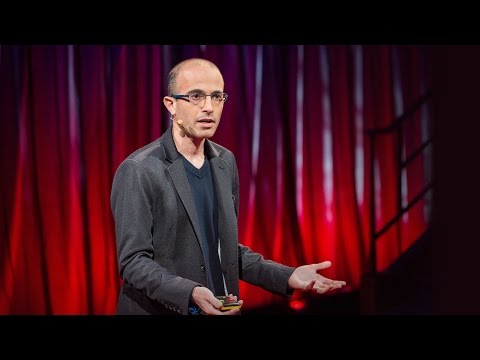
“Humans control the planet because they are the only animals that can cooperate both flexibly and in very large numbers.”TED talk, 2015 · 1:51
Human dominance is a collective achievement, not an individual one
Harari’s basic claim is that the reason humans run the world is not that any one person is physically stronger or mentally superior to other animals. The decisive difference appears at the collective level: humans can organize together in ways no other species can. That is why he treats cooperation, not intelligence in isolation, as the main engine of human history.12
He repeatedly narrows the point to a specific combination: flexibility plus scale. Many animals can cooperate, but not both flexibly and in very large numbers at once. Harari says humans are unique in combining those two abilities, which is what lets millions of strangers align around common projects.23
“Humans control the planet because they are the only animals that can cooperate both flexibly and in very large numbers.”TED talk, 2015 · full transcript →
Cooperation rests on trust, not just coercion
Harari pushes back against the cynical idea that history is only about domination. He argues that even power itself ultimately depends on cooperation, and cooperation depends on some degree of trust. A ruler, army, market, or institution cannot function by force alone if people stop coordinating with one another.1112
This is why he describes the whole of human history as a problem of getting more people to cooperate and trust each other. Even political forms that look hard or impersonal are sustained by beliefs and expectations shared across large populations. For Harari, the real question is not whether stories shape politics, but which stories can hold cooperation together.1314
He also treats nationalism in this framework. At its core, he says, nationalism can mean caring for large numbers of strangers you do not know personally, which shows again that modern solidarity depends on extending trust beyond face-to-face bonds.15
The same stories that empower civilization also make it fragile
Harari does not present human cooperation as automatically wise or stable. If societies are built on shared stories, they can also be disrupted when trust breaks down, when rival stories harden into conflict, or when people are manipulated more effectively than before. Civilization is powerful precisely because it is densely coordinated, and that also makes it brittle.1617
He warns that connection alone does not solve this problem. Digital networks can link people more tightly, but connectivity does not necessarily produce harmony. In practice, the easiest way to mobilize attention is often through hatred, greed, and fear, which can corrode the trust that large-scale cooperation requires.1819
He is especially concerned about systems that can shape people’s choices from the inside. If algorithms increasingly know people better than they know themselves, authority can shift from human judgment to machine-driven recommendation and manipulation, undermining the conditions for free and trustworthy cooperation.20212223

“…we are extremely powerful, and we are extremely fragile at one and the same time…”StarTalk interview, 2023 · full transcript →
Human cooperation now has to become global
Harari’s older story about why humans became powerful turns into a practical argument about the present: our biggest dangers now cross borders. Climate change and AI cannot be handled by isolated states acting alone. He says humanity needs global cooperation on a new scale because the problems themselves are global.2425
This does not mean mere connectivity or vague optimism. He stresses that the challenge is to create enough social cohesion at the level of countries and increasingly at the level of the whole planet. In other words, modern technology has increased our power, but without better shared stories and institutions, it may outpace our ability to coordinate responsibly.2526
Seen this way, cooperation is both Harari’s explanation of the human past and his test for the human future. Our species succeeded by building shared fictions that enabled trust among strangers, and now survival may depend on building forms of trust broad enough to govern technologies and crises that affect everyone.132426

“…we need global cooperation like never before…”Conversation with Mark Zuckerberg, 2017 · full transcript →
Harari on human cooperation, in his own words
“Humans control the planet because they are the only animals that can cooperate both flexibly and in very large numbers.”
“…the whole of human history is about how do you get more people to cooperate and to trust each other…”
“…we need global cooperation like never before…”
“…we are extremely powerful, and we are extremely fragile at one and the same time…”
Where to watch
 Yuval Noah Harari on Human Cooperation: Why We Run the World2015 · 17 min · full transcriptBest short statement of Harari’s core thesis that human rule comes from flexible cooperation among huge numbers of strangers.
 Yuval Noah Harari on Human Stories and Cooperation: Sapiens Talk2015 · 79 min · full transcriptExpands the idea with more detail on fictional stories, dual reality, and the challenge of finding better stories for new technology.
 Yuval Noah Harari on Liberalism and Cooperation: Stories, Truth, and AI2025 · 116 min · full transcriptShows how Harari connects cooperation to trust, nationalism, liberalism, and the politics of truth in the AI age.
 Yuval Noah Harari on Internet and Society: Global Cooperation vs Fragmentation2017 · 94 min · full transcriptApplies the cooperation framework to climate change, AI, internet fragmentation, and the need for global coordination.
 Yuval Noah Harari on Fictional Stories: Civilization Is Fragile2023 · 42 min · full transcriptHighlights the fragility of modern civilization and why the same systems that make us powerful can also make us vulnerable.
Questions people ask
- What did Yuval Noah Harari say about global cooperation and climate change?
- What did Yuval Noah Harari say about human rights?
- What did Yuval Noah Harari say about imagination and human cooperation?
- What did Yuval Noah Harari say about whether we can trust our inner voice in the age of algorithms?
- What did Yuval Noah Harari warn about AI and human agency?
- What did Yuval Noah Harari warn about surveillance capitalism and totalitarianism?
Sources
Every quote above, word for word from the transcripts. Numbers match the text.
“The real difference between humans and all other animals is not on the individual level; it's on the collective level.”
“Humans control the planet because they are the only animals that can cooperate both flexibly and in very large numbers.”
“Humans are the only animals that can combine the two abilities.”
“We can cooperate flexibly with countless numbers of strangers, because we alone, of all the animals on the planet, can create and believe fictions, fictional stories.”
“What enables us alone, of all the animals, to cooperate in such a way? The answer is our imagination. We can cooperate flexibly with countless numbers of strangers, because we alone, of all the animals on the planet, can create and believe fictions, fictional stories. And as long as everybody believes in the same fiction, everybody obeys and follows the same rules, the same norms, the same values.”
“Money, in fact, is the most successful story ever invented and told by humans, because it is the only story everybody believes.”
“Most legal systems today in the world are based on a belief in human rights. But what are human rights? Human rights, just like God and heaven, are just a story that we've invented. They are not an objective reality; they are not some biological effect about homo sapiens. Take a human being, cut him open, look inside, you will find the heart, the kidneys, neurons, hormones, DNA, but you won't find any rights.”
“We humans, we also live in an objective reality. In our world, too, there are rivers and trees and lions and elephants. But over the centuries, we have constructed on top of this objective reality a second layer of fictional reality, a reality made of fictional entities, like nations, like gods, like money, like corporations. And what is amazing is that as history unfolded, this fictional reality became more and more powerful so that today, the most powerful forces in the world are these fictional entities.”
“We humans control the world because we live in a dual reality.”
“…we live in a dual reality.”
“…ultimately human power is based on cooperation, not on force.”
“Don't believe people who tell you that all reality is just power…”
“…the whole of human history is about how do you get more people to cooperate and to trust each other…”
“…history is shaped by the human imagination, by fiction and not just by truth.”
“Nationalism at its core is about loving and caring about a a a large number of strangers that you do not know personally…”
“…we are extremely powerful, and we are extremely fragile at one and the same time…”
“…the laws governing our society, they are not eternal…”
“…connectivity doesn't necessarily mean harmony…”
“…the easiest way to make people engaged is to press the hate button or the greed button or the fear button in their mind…”
“…what does it mean to live in a world in which increasingly, we rely on the recommendations of algorithms…”
“I agree that more people have more voice than ever before, both in the US and globally. I think you're absolutely right. My concern is, to what extent we can trust the voice of people... To what extent I can trust my voice? Like, I'm... We have this picture of the world that I have this voice inside me, which tells me what is right and what is wrong. And the more I'm able to express this voice in the outside world and influence what's happening, the more people can express their voices, it's better, it's more democratic. But what happens if at the same time that more people can express their voices, it's also easier to manipulate your inner voice? To what extent you can really trust that the thought that just popped up in your mind is the result of some free will, and not the result of an extremely powerful algorithm that understands what's happening inside you and knows how to push the buttons and press the levers, and is serving some external entity and it has planted this thought or this desire that you now express?”
“Now the gap may reopen and be much worse than ever before because of the rise of AI and because AI is likely to be dominated by just a small number of countries. So that's one issue. AI inequality. And the other issue is AI and human agency. Or even the meaning of human life. What happens when AI is mature enough and you have enough data to basically hack human beings. And you have an AI that knows me better than I know myself, and can make decisions for me, predict my choices, manipulate my choices, and authority increasingly shifts from humans to algorithms.”
“And this is like the full fledged totalitarian dystopia, which could be so effective that people would not even resent it because they would be completely aligned with the values or the ideals of the... It's not 1984 where you need to torture people all the time. No. If you have agents inside their brain, you don't need the external secret police. So that's one danger. It's like the full-fledged totalitarianism. Then in places like the US, the more immediate danger or problem to think about is what is increasingly people refer to as surveillance capitalism. That you have this system that constantly interact with you and come to know you and it's all supposedly in your best interests.”
“…we need global cooperation like never before…”
“The key question is how do you still create enough social cohesion on a level of a country, and increasingly also on the level of the entire globe in order to tackle our main problems. I mean, we need global cooperation like never before because we are facing unprecedented global problems. We just had Earth Day, and should be obvious to everybody, we cannot deal with the problems of the environment, of climate change, except through global cooperation. Similarly, if you think about the potential disruption caused by new technologies like artificial intelligence, we need to find a mechanism for global cooperation around issues like how to prevent an AI arms-race.”
“…the really big and interesting question is whether we'll be able to produce good stories to match this wonderful technology.”
How this guide was made: drafted with AI from the full transcripts of the recordings cited, then checked: every quotation must match a transcript word for word and be the speaker's own words, and an independent review gates accuracy. Methodology and corrections.

