Yuval Noah Harari on AI & Data
Harari argues that AI and data matter because they can shift authority from human judgment to systems that predict, influence, and eventually govern human choices at scale.
- Harari’s core worry is not automation alone but authority moving from people to algorithms.
- He says AI is historically different because it can make decisions and generate ideas on its own.
- Data becomes dangerous when it lets institutions know people better than they know themselves and manipulate choices from the inside.
- The political question is who controls the data and whether that power serves humans or makes humans serve systems.
- His practical response is to strengthen self-knowledge, emotional balance, and the capacity to reinvent yourself.
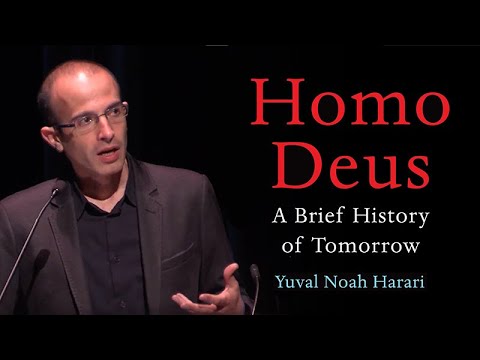
“…authority is beginning to slip away, to shift from us to other entities, and in particular, to shift from us to algorithms.”UCTV lecture, 2017 · 7:11
Harari thinks AI changes history because it can act, not just assist
Harari treats AI as a break from earlier technologies, not just a faster tool. His reason is that previous inventions extended human power, while AI can begin making decisions and producing new ideas without waiting for direct human instruction. That changes the location of agency inside a system.12
This is why he resists comparisons that make AI seem like just another wave of innovation. In his view, the scale of the shift is larger because decision-making itself can migrate into machines, and once that happens, finance, media, politics, and war can become too complex for humans to meaningfully supervise.21
The real struggle is over authority: who gets trusted to decide
Harari’s central idea about data is that authority may move away from individual humans and toward algorithms. Liberal modern life taught people to trust their feelings, preferences, and votes, but he argues that data-driven systems increasingly challenge that arrangement by offering recommendations that seem better than our own choices.345
He describes this as a gradual transfer, not a sudden coup. People ask systems for help on one decision after another, and if the advice works, they hand over more data and more authority. For Harari, that is the deepest issue in AI: not just what machines can do, but why humans may come to trust them with judgment.56
This is also why he frames the issue politically, not merely technically. If authority leaves human institutions and settles inside opaque systems, then markets, public debate, and even personal life can be steered by entities people neither understand nor truly control.36
“…authority is beginning to slip away, to shift from us to other entities, and in particular, to shift from us to algorithms.”UCTV lecture, 2017 · full transcript →
Data becomes power when humans become predictable and hackable
Harari argues that the combination of AI with biotech is especially consequential because it can connect data about behavior with data about bodies and minds. Once systems can monitor and interpret what people feel, fear, desire, and intend, they can influence choices more effectively than older forms of propaganda or advertising.789
His strongest warning is that manipulation may move from the public surface into the inner life of the person. He says platforms and political actors can hack fear, hate, and vanity, and that future systems may know a person so well that resistance itself becomes predictable. In that world, autonomy is weakened not by open coercion alone but by customized persuasion.9
At the same time, he does not present this as magic or certainty. He notes that the project depends on how far humans really can be understood as algorithms, and he leaves room for the possibility that the mind is not fully hackable in the way some technologists assume.1112
AI and data could weaken democracy while strengthening centralized control
Harari worries that AI and data could make centralized systems more effective than democratic ones. If one center gathers enough information and has the computational power to process it, it may outperform messy public deliberation in speed and coordination, making authoritarian models newly tempting.913
His concern is not only state tyranny. He also warns about a softer model in which constant surveillance and optimization are presented as being in the user’s own interest. That can create a form of control people accept because it feels useful, personalized, and protective.713
This connects to his larger view that many social orders rest on stories people believe together. If AI can shape the stories, the voices, and even the intimate bonds through which people make sense of reality, then democracy can be eroded from within rather than simply attacked from outside.141516

“An AI system that gets to know me in order to protect me…”Talks at Google, 2018 · full transcript →
His answer is not to worship technology or reject it, but to build human resilience
Harari does not argue that technology is inherently evil or that progress should stop. He explicitly allows that technology can protect, heal, and expand compassion, depending on how it is designed and governed. The issue is whether humans remain the purpose of the system.1718
That is why his practical emphasis falls on education and inner stability. If algorithms become better at prediction and persuasion, then memorizing information matters less than cultivating emotional intelligence, mental balance, and the capacity to keep changing as the world changes.1920
He also stresses practices of reflection and self-knowledge. When information systems constantly compete for attention and shape inner reactions, people need more space to observe themselves rather than simply react. For him, preserving human freedom starts with learning not to outsource the last step of judgment.2123

“…the most important goals of education in the 21st century are probably to develop your emotional intelligence and your mental balance…”Penguin Talks with Russell Brand, 2018 · full transcript →
Harari on ai & data, in his own words
“…authority is beginning to slip away, to shift from us to other entities, and in particular, to shift from us to algorithms.”
“…humans will soon be hackable animals…”
“The key is to remember that we created them to serve us, and not that we are here in order to serve them.”
Where to watch
 Yuval Noah Harari on AI and Human Futures: Urgent Warnings2024 · 106 min · full transcriptBest single overview of why Harari thinks AI is historically different and why decision-making power may slip beyond human control.
 Yuval Noah Harari on Dataism and Algorithms: Who Will Rule Next2017 · 58 min · full transcriptBest source for his dataism argument: how algorithms challenge human authority and may know us better than we know ourselves.
 Yuval Noah Harari on AI Power Dynamics: Trust, Control, and Rights2024 · 67 min · full transcriptBest for understanding trust, manipulation, and the difference between intelligence and consciousness in AI systems.
 Yuval Noah Harari on AI, Biotech, and Meaning: Google Talk2018 · 59 min · full transcriptBest for the AI-plus-biotech argument and how data about bodies could transform autonomy, medicine, and politics.
 Yuval Noah Harari on Fascism and Data: Why It’s So Tempting2018 · 18 min · full transcriptBest short talk on the political stakes of data control and how technology can undermine democracy from within.
Questions people ask
- What did Yuval Noah Harari say about asking Google or Amazon what to do with your life?
- What did Yuval Noah Harari say about free will and feelings?
- What did Yuval Noah Harari say about how people will come to trust algorithms with major life decisions?
- What did Yuval Noah Harari say about whether we can trust our inner voice in the age of algorithms?
- What did Yuval Noah Harari say about why AI is different from previous technologies?
- What is Yuval Noah Harari's view on AI consciousness and intelligence?
Sources
Every quote above, word for word from the transcripts. Numbers match the text.
“It's the first technology in history that can make decisions by itself…”
“They underestimate the magnitude of the AI revolution. AI is nothing like print. It's nothing like the industrial revolution of the 19th century. It's far, far bigger. There is a fundamental difference between AI and the printing press or the steam engine or the radio or any previous technology we invented. The difference is it's the first technology in history that can make decisions by itself and that can create new ideas by itself. A printing press or a radio set could not write new music or new speeches and could not decide what to print and what to broadcast.”
“…authority is beginning to slip away, to shift from us to other entities, and in particular, to shift from us to algorithms.”
“In the humanist age, in the 19th and 20th century, they will tell you just follow your heart. Just try to connect to your authentic self and just follow your heart. In the 21st century, the advice will be "Oh, listen to Amazon, "ask Google what to do". And I would come to Google or Amazon, and I would say, "Google, I have this dilemma. "What do you recommend that I do? "What is the best course of action for me?".”
“And it won't happen overnight, like in some immediate revolution, it's a process. We'll ask Google or Amazon or Facebook or whatever, for their advice on more and more decisions, and if we see that indeed we get good recommendations better than the decisions we ourselves usually take, then we trust them more and more, trust them more with our data, and also trust them more with authority to make decisions for us.”
“If you can't trust the other humans that you have known for thousands of years, why do you think you can trust a super intelligent alien entity…”
“An AI system that gets to know me in order to protect me…”
“…humans will soon be hackable animals…”
“They hack our feelings of fear and hate and vanity, and then use these feelings to polarize and destroy democracy from within.”
“The most fundamental idea in this respect comes from the life sciences, which says, organisms are algorithms. This is the most important, I think, insight of our age. And also the most important question because we don't have any proof of it. Currently, it's just dogma. We don't have any explanation of how any kind of algorithm can create subjective experiences. Indeed, in the field of computers we are, as far as I know, we're not even close to creating subjective experiences in computers. It's just a dogma that people will say, yes. It's the same.”
“First of all very important to emphasize that all this depends on the idea that we are in the process of hacking the human being, and in particular, of hacking the human mind and the human brain. But we are still very, very far from understanding the brain and even further from understanding the mind. And there is a chance that in the end, it will turn out that organisms aren't algorithms after all. There are some very deep things we still don't understand about the brain and the mind, and all this dream will turn out to be a fantasy.”
“And this is like the full fledged totalitarian dystopia, which could be so effective that people would not even resent it because they would be completely aligned with the values or the ideals of the... It's not 1984 where you need to torture people all the time. No. If you have agents inside their brain, you don't need the external secret police. So that's one danger. It's like the full-fledged totalitarianism. Then in places like the US, the more immediate danger or problem to think about is what is increasingly people refer to as surveillance capitalism. That you have this system that constantly interact with you and come to know you and it's all supposedly in your best interests.”
“Much of what we take to be real is fictions.”
“…the biggest quote psychological and social experiment in human history…”
“I agree that more people have more voice than ever before, both in the US and globally. I think you're absolutely right. My concern is, to what extent we can trust the voice of people... To what extent I can trust my voice? Like, I'm... We have this picture of the world that I have this voice inside me, which tells me what is right and what is wrong. And the more I'm able to express this voice in the outside world and influence what's happening, the more people can express their voices, it's better, it's more democratic. But what happens if at the same time that more people can express their voices, it's also easier to manipulate your inner voice? To what extent you can really trust that the thought that just popped up in your mind is the result of some free will, and not the result of an extremely powerful algorithm that understands what's happening inside you and knows how to push the buttons and press the levers, and is serving some external entity and it has planted this thought or this desire that you now express?”
“The key is to remember that we created them to serve us, and not that we are here in order to serve them.”
“No, I don't think that technology is inherently undermining compassion. It can go both ways. Certainly, communication technology can make you aware of the plight of people on the other side of the world. And without that, you may be extremely compassionate about your immediate, like, family members and neighbors, and won't care at all about people on the other side of the world. So I don't think there is an inherent contradiction or collision between technology and compassion. But it is true that the way we design technology can make us less compassionate, and even the way that we design ourselves.”
“…the most important goals of education in the 21st century are probably to develop your emotional intelligence and your mental balance…”
“…the ability to reinvent themselves repeatedly throughout their lives…”
“I would say that people should consume less information and spend more time reflecting…”
“…you need to walk the last mile yourself…”
How this guide was made: drafted with AI from the full transcripts of the recordings cited, then checked: every quotation must match a transcript word for word and be the speaker's own words, and an independent review gates accuracy. Methodology and corrections.