Yuval Noah Harari on Politics & Government
Harari sees politics as a struggle to preserve cooperation and truthful institutions in a world where technology, nationalism, war, and global crises all outrun the nation-state.
- Politics now turns on a global-versus-national divide more than a left-versus-right one.
- Democracy depends on trusted information and real human conversation, both now threatened by algorithms and AI.
- Nationalism can support solidarity, but it becomes dangerous when it denies other peoples or demands exclusive loyalty.
- Global problems like pandemics, climate change, AI, and economic disruption cannot be solved by national politics alone.
- The deepest political task is building institutions that expand trust and cooperation rather than fear, hatred, and delusion.
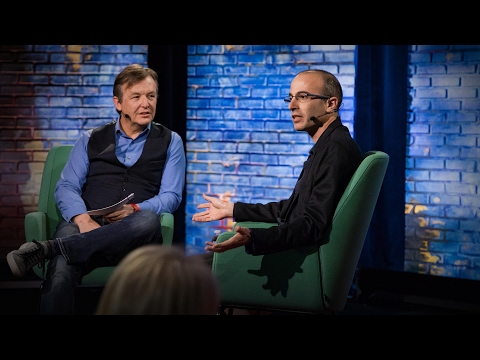
The main political divide is now global cooperation versus national politics
Harari argues that the old map of politics is no longer enough. The decisive divide is increasingly between forces trying to solve problems through global cooperation and forces insisting on national frameworks, even when the problems themselves are global. His core point is that humanity has already built a global economy and a shared ecological system, but still relies on political institutions that stop at the border.12
That mismatch matters because the biggest threats now ignore borders. Climate change, AI, migration, pandemics, and technological disruption cannot be managed by one country acting alone, however strong its identity or government may be. Harari does not say local identities should disappear; he says wider coordination must be added on top of them if politics is to match reality.234
“…the real divide today is between global and national…”TED Dialogues in New York, 2016 · full transcript →
Government succeeds when it builds trust and large-scale cooperation
For Harari, the foundation of politics is not domination but cooperation. Human history advances when institutions allow many strangers to trust one another enough to work together, and governments are among the most important of those institutions. Politics at its best creates the rules, stories, and public confidence that make cooperation possible at scale.5
This is why he treats nationalism in a more nuanced way than many critics expect. He says nationalism can be constructive when it means caring for people you do not know personally and widening solidarity beyond family or tribe. But it turns destructive when that solidarity depends on denying the reality, rights, or existence of others.67
His liberalism also fits this view of politics. He presents liberal government less as a promise of perfection than as a framework for balancing interests, tolerating disagreement, and correcting mistakes over time. That makes institutions of truth, accountability, and self-correction more important than any dream of final political redemption.
Democracy is an information system before it is a voting system
Harari's view of democracy starts with communication. He describes democracy as a conversation, which means it depends on citizens being able to share facts, argue, listen, and revise their views within institutions they broadly trust. Once that conversation breaks down, the formal mechanisms of elections and representation become much weaker.910
This is why he focuses so much on information rather than only on ideology or leadership. He warns that the danger is not just bad people doing bad things, but degraded information environments that make reasoned self-government harder. In that setting, mistrust spreads, delusions deepen, and politics becomes easier to manipulate.1112
AI intensifies the danger because it can enter the public sphere as a persuasive nonhuman participant. Harari warns that if people can no longer tell whether they are interacting with a human or a bot, democratic conversation itself is threatened. His practical implication is that politics now has to regulate not only speech and media institutions in the old sense, but also the architecture of digital conversation.1314
The danger is not technology alone, but power fused with fear, hate, and data
Harari does not treat AI and data as neutral upgrades to existing government. He argues that they can shift authority away from humans and toward opaque systems, while also giving states and movements new tools for surveillance, persuasion, and control. That creates a new political question: who governs the data, the algorithms, and the institutions that deploy them.3
He is especially worried about forms of politics that feed on emotional manipulation. He says both old fascist temptations and new algorithmic systems work by flattering identity, amplifying fear and hatred, and using those emotions to polarize society. In that environment, democracy can be hollowed out from within rather than overthrown from outside.161718
So Harari's warning about government is double-edged. Centralized technological power could make authoritarian systems more effective, while democratic societies could sabotage themselves if they let algorithms hijack public attention and trust. The key political challenge is preserving human oversight and truthful institutions before manipulation becomes too cheap and too powerful.171920
War and crisis reveal what politics is really for
Harari's comments on Ukraine and the pandemic show how he tests political ideas against real emergencies. In Ukraine, he frames the war as a challenge not only to one country but to the norm that peoples and borders cannot simply be erased by imperial fantasy. A functioning international order depends on governments recognizing reality, including the reality of other nations and the limits of conquest.212223
He also stresses that military victory is not the same as political legitimacy. A country can be invaded, but holding it against the will of its population is another matter, which is why politics cannot be reduced to force alone. The resistance of Ukrainians matters to him because it demonstrates that collective identity and political will are real forces in history.24
During the pandemic, Harari makes a parallel point from another angle. COVID was not just a medical event but a political crisis that exposed weak coordination, poor leadership, and low trust. When governments and publics do not share credible information or cooperate across borders, even solvable problems become catastrophic.262728
Harari on politics & government, in his own words
“…the real divide today is between global and national…”
“…we now have global ecology, we have a global economy but we have national politics…”
Where to watch
 Yuval Noah Harari on AI and Democracy: Algorithms, Trust, Fragility2024 · 114 min · full transcriptBest overview of how democracy depends on information, trust, and resilience against algorithmic manipulation.
 Yuval Noah Harari on Nationalism and Global Governance: The New Divide2016 · 60 min · full transcriptBest statement of Harari's big political frame: global problems versus national politics.
 Yuval Noah Harari on AI, Power and Democracy2024 · 48 min · full transcriptBest for understanding why AI changes government, bureaucracy, media, and democratic conversation.
 Yuval Noah Harari on Fascism and Data: Why It’s So Tempting2018 · 18 min · full transcriptBest short talk on fascism, emotional manipulation, and the political stakes of data power.
 Yuval Noah Harari on Pandemic, Politics & Society: Making Sense of Crisis2020 · 71 min · full transcriptBest case study of how crisis exposes the strengths and failures of governments and international coordination.
 Yuval Noah Harari on Ukraine and Geopolitics: Why This War Matters2022 · 50 min · full transcriptBest for seeing how Harari connects war, sovereignty, borders, and the future of world order.
Questions people ask
- What did Yuval Noah Harari say about bots and democracy?
- What did Yuval Noah Harari say about strong leaders and war?
- What did Yuval Noah Harari say about the Ukraine war and climate action?
- What did Yuval Noah Harari say about why the war in Ukraine matters globally?
- How does Yuval Noah Harari explain optimism and realism?
- What did Yuval Noah Harari say about global governance and catastrophe?
Sources
Every quote above, word for word from the transcripts. Numbers match the text.
“…the real divide today is between global and national…”
“…we now have global ecology, we have a global economy but we have national politics…”
“What we see now in the world is authority shifting away from humans to algorithms.”
“One option that some people talk about is that only a catastrophe can shake humankind and open the path to a real system of global governance, and they say that we can't do it before the catastrophe, but we need to start laying the foundations so that when the disaster strikes, we can react quickly. But people will just not have the motivation to do such a thing before the disaster strikes. Another thing that I would emphasize is that anybody who is really interested in global governance should always make it very, very clear that it doesn't replace or abolish local identities and communities, that it should come both as -- It should be part of a single package.”
“…the whole of human history is about how do you get more people to cooperate and to trust each other…”
“Nationalism at its core is about loving and caring about a a a large number of strangers that you do not know personally…”
“And again, sorry for going back to that, but this is also the war. Like, what is war? It's trying to disappear a part of reality that you don't like. In this case, an entire people. I don't like these people; I don't think they should be in reality, so I try to make them disappear. And people say, oh, he's a very strong leader. It's not. He's a very weak leader. A strong leader would be able to acknowledge, no, these people exist. They are part of reality. Let's now find out how do we live with them.”
“Democracy in essence is a conversation.”
“The truth, of course, matters very much.”
“The problem is not with the humans; it's with the information.”
“If something ultimately destroys us, it will be our own delusions, not the AIs.”
“That is a situation we are now living through, and it is no coincidence that the democratic conversation is breaking down all over the world because the algorithms are hijacking it. We have the most sophisticated information technology in history and we are losing the ability to talk with each other to hold a reasoned conversation. In order to protect the conversation between people, we need to ban bots from the conversation. We need to ban fake humans. AIs should be welcome to talk with us only if they identify as AIs. If you talk online with someone and you don't know whether it's an AI or a human, this will destroy the democratic conversation.”
“The AI needs to learn how to manipulate just this single individual in order to take power in the country. So the danger of AI taking power in a country are much bigger in dictatorships than in democracy. In democracy, a big problem is very different. Democracy is a conversation. The the whole meaning for democracy is that you have large numbers of people conversing about the issues of the day. Now imagine a large group of people standing in a circle and talking, and suddenly a group of robots entering the circle and start talking very loudly and very emotionally, and persuasively and you can't tell the difference who is a human and who is a robot.”
“Fascism makes people see themselves as belonging to the most beautiful and most important thing in the world -- the nation.”
“They hack our feelings of fear and hate and vanity, and then use these feelings to polarize and destroy democracy from within.”
“…the easiest way to make people engaged is to press the hate button or the greed button or the fear button in their mind…”
“The problem is that we are divided against each other, and the algorithms are using our weaknesses against us.”
“Um, I try to be a realist. I mean, the last few—I mean, I just came from Israel and I saw a country destroying itself for no good reason whatsoever. I—it's a country that just pressed the self-destruct button and for no good reason and it can happen on a global scale.”
“…this is really what is at stake in this war…”
“The borders are sacred because if we start invading neighboring countries because, "Hey, this is part of our countries, these people are part of our nation," there will not be an end to it. And if this now happens in Ukraine, it will be a blueprint for copycats all over the world. The other thing which is different is that we are talking about superpowers. This is not a war between Israel and Hezbollah.”
“You will not be able to absorb Ukraine into Russia. They don't want it, they don't want you. If you continue, the only thing you will achieve is to create terrible hatred between Ukrainians and Russians for generations. It doesn't have to be like that.”
“You can conquer a country, But as the Russians learned in Afghanistan, as the Americans learned also in Afghanistan, also in Iraq, it's much harder to hold a country.”
“COVID-nineteen crisis, it's not a health crisis, It's above all a political crisis.”
“There is no global plan of action…”
“…the economic and political consequences could be really catastrophic if we don't get a handle on it.”
How this guide was made: drafted with AI from the full transcripts of the recordings cited, then checked: every quotation must match a transcript word for word and be the speaker's own words, and an independent review gates accuracy. Methodology and corrections.