Yuval Noah Harari on Religion & Meaning
Harari sees religion and ideology as shared stories that create large-scale meaning and cooperation, but he thinks the deepest guide for life is not cosmic purpose but understanding suffering and reducing it.
- Religion, nations, money, and rights are shared stories that let strangers cooperate at scale.
- Science gives power, but religions and ideologies tell people what to value and why.
- He treats modern liberalism as a dominant faith centered on the authority of individual feelings.
- For personal meaning, he shifts attention away from grand stories and toward consciousness, suffering, and compassion.
- The future depends on whether humanity can create better stories to guide powerful new technologies.

Religion is one of the stories that makes human civilization possible
Harari’s basic starting point is that humans became powerful not mainly because each individual is stronger or smarter than other animals, but because humans can cooperate flexibly in very large numbers. He ties that ability to imagination: people can organize around shared stories that exist between them rather than in nature itself. Religion is one of the clearest examples of this kind of large-scale coordinating story.1234
In his view, religion belongs to the same broad family as money, nations, corporations, and human rights. These are not objective objects like trees or rivers, yet they shape behavior, institutions, and sacrifice on a massive scale. That is why fictional entities can become some of the most powerful forces in history.5678
“…we live in a dual reality.”University of Oslo lecture and discussion, 2015 · full transcript →
Meaning systems matter because power rests on trust and cooperation
Harari does not reduce history to brute force. He argues that durable power depends on people believing, trusting, and coordinating with one another. Religions and ideologies matter because they supply common meaning, justify rules, and hold cooperation together across huge populations.9104
This is also why clashes between societies are often conflicts between stories, not just fights over material resources. When people live by incompatible sacred narratives, the disagreement is not merely technical. It concerns what the world means and what people owe one another.48
Science gives us power, but it does not tell us what is worth doing
A central theme in Harari’s view is the division between capability and value. Science increases human power, but it does not by itself answer what goals should matter. Religion and ideology step into that gap by telling people what is good, what is sacred, and what should be done with new powers.11
That gap becomes more urgent as technology grows stronger. Harari worries less about tools in the abstract than about the stories directing them. The problem is not only whether we can build powerful systems, but whether we have good enough moral and political narratives to guide their use.121314
He also rejects the cynical idea that everything is merely a power struggle. Truth matters because without some contact with reality, societies cannot identify the real causes of suffering or respond wisely to new dangers.1510
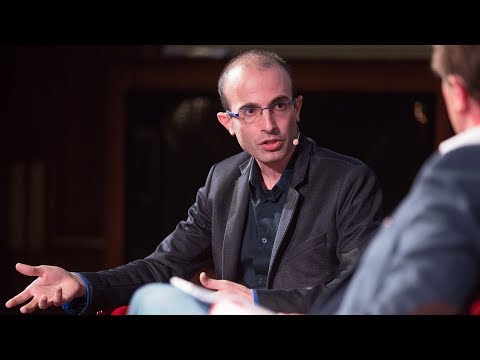
“Science provides the power; religion tells us what to do with it…”Intelligence Squared talk, 2014 · full transcript →
Modern liberalism functions like a new faith centered on the inner voice
Harari argues that the leading worldview in the modern world is liberal humanism. Its core commitment is that authority ultimately resides in the individual and especially in individual feelings. In politics this becomes democracy, in economics consumer choice, and in ethics the idea that the person should listen to the self within.16
He sees this as a historical successor to older religious frameworks, not as a complete escape from meaning-making. It is still a story about where authority comes from and how humans should live. His concern is that advances in life science and computing may undermine this faith by challenging free will and by enabling outside systems to know people better than they know themselves.17181920
For personal meaning, Harari turns from cosmic purpose to suffering and consciousness
When Harari moves from history to personal philosophy, he becomes skeptical of the question of life’s ultimate meaning. He warns that asking for a grand story of what life is for can lead people into fantasy. Instead, he urges attention to direct experience and to the concrete question of what suffering is and where it comes from.2122
This shift explains why consciousness matters so much in his ethics. He sharply separates intelligence from consciousness and treats the capacity to feel as more important than the capacity to solve problems. What matters most is not whether an entity is smart, but whether it can suffer.23242526
This way of thinking changes meaning from finding a role in a cosmic drama to reducing suffering in oneself and others. It also supports compassion, because moral attention should follow sentience and vulnerability rather than status, dogma, or technological prowess.2227

“To really understand life, life is not a story. The universe does not function like a story. So I think to really understand life, you need to observe it directly in a nonverbal way. Don't turn it into a story. And the question to start with is what is suffering? What is causing suffering? You know, the question, what is the meaning of life? It'll take you to fantasies and delusions. We want to stay with the reality of life. And the most important question about the reality of life is what is suffering and where is it coming from?”Lex Fridman Podcast #390, 2023 · full transcript →
Escaping bad stories takes self-knowledge, relationships, and practice
Harari does not think people easily free themselves from the dominant stories of their age. He says doing so requires serious personal work, and he is doubtful that whole populations can manage it on a large scale. That makes self-knowledge an ethical and political necessity, not a luxury.28
But self-knowledge is not just high IQ or abstract analysis. He points to practices like meditation, therapy, art, and poetry as ways people can learn about themselves more deeply. He also emphasizes that the fantasy of complete autonomy fails; people need help, mentors, friends, and intimate relationships.29303132
Applied to religion and meaning, this suggests a practical test: do your beliefs help you see reality more clearly, become less captured by inherited stories, and reduce suffering with others rather than in isolation.212232

“No, I don't think that knowing yourself is necessarily all about intelligence. Certainly not in the narrow sense of intelligence. If you include emotional intelligence and so forth, then yes. But in the more narrow sense of IQ, I think this is not-- there are many very intelligent people in the world who don't know themselves at all, which is an extremely dangerous combination. Now some people explore themselves through therapy. Some use meditation. Some use art. Some use poems.”Talks at Google, 2018 · full transcript →
Harari on religion & meaning, in his own words
“Science provides the power; religion tells us what to do with it…”
“…we live in a dual reality.”
“To really understand life, life is not a story. The universe does not function like a story. So I think to really understand life, you need to observe it directly in a nonverbal way. Don't turn it into a story. And the question to start with is what is suffering? What is causing suffering? You know, the question, what is the meaning of life? It'll take you to fantasies and delusions. We want to stay with the reality of life. And the most important question about the reality of life is what is suffering and where is it coming from?”
Where to watch
 Yuval Noah Harari on AI, Consciousness, and Stories: Human Power, Risk, and Meaning2023 · 165 min · full transcriptBest for Harari’s deepest personal view: meaning should be grounded in consciousness and suffering, not grand stories.
 Yuval Noah Harari on Human Stories and Cooperation: Sapiens Talk2015 · 79 min · full transcriptBest overview of why religion and other shared fictions make mass human cooperation possible.
 Yuval Noah Harari on Myths and Civilization: Why Stories Hold Societies Together2014 · 87 min · full transcriptBest single talk on myths, civilization, and the different roles of science and religion.
 Yuval Noah Harari on New Religions: Data Will Replace Faith2015 · 83 min · full transcriptBest for his argument that liberal humanism is the modern world’s dominant faith.
 Yuval Noah Harari on Truth, Power & AI2025 · 84 min · full transcriptBest for his mature account of truth, fiction, trust, and why meaning cannot collapse into pure power.
Questions people ask
- What did Yuval Noah Harari say about how to know yourself better?
- What did Yuval Noah Harari say about human rights?
- What did Yuval Noah Harari say about humans being algorithms?
- What did Yuval Noah Harari say about stories and the meaning of life?
- What did Yuval Noah Harari say about suffering and the meaning of life?
- What did Yuval Noah Harari say about technology and compassion?
Sources
Every quote above, word for word from the transcripts. Numbers match the text.
“…history begins about 70,000 years ago with the Cognitive Revolution…”
“…history is shaped by the human imagination, by fiction and not just by truth.”
“Humans are the only animals that can combine the two abilities.”
“…we live in a dual reality.”
“…money is probably the most successful story ever told…”
“…human rights are a fiction, just like God and heaven.”
“Most legal systems today in the world are based on a belief in human rights. But what are human rights? Human rights, just like God and heaven, are just a story that we've invented. They are not an objective reality; they are not some biological effect about homo sapiens. Take a human being, cut him open, look inside, you will find the heart, the kidneys, neurons, hormones, DNA, but you won't find any rights.”
“We humans, we also live in an objective reality. In our world, too, there are rivers and trees and lions and elephants. But over the centuries, we have constructed on top of this objective reality a second layer of fictional reality, a reality made of fictional entities, like nations, like gods, like money, like corporations. And what is amazing is that as history unfolded, this fictional reality became more and more powerful so that today, the most powerful forces in the world are these fictional entities.”
“…ultimately human power is based on cooperation, not on force.”
“Don't believe people who tell you that all reality is just power…”
“Science provides the power; religion tells us what to do with it…”
“We haven't seen nothing yet.”
“The key is to remember that we created them to serve us, and not that we are here in order to serve them.”
“…the really big and interesting question is whether we'll be able to produce good stories to match this wonderful technology.”
“The truth ultimately is one because reality is one.”
“…the dominant ideology of the world at present is liberal humanism, or in short, liberalism.”
“An AI system that gets to know me in order to protect me…”
“There is no such thing as freedom according to the life sciences.”
“We are on the verge of the collapse of liberalism.”
“The most fundamental idea in this respect comes from the life sciences, which says, organisms are algorithms. This is the most important, I think, insight of our age. And also the most important question because we don't have any proof of it. Currently, it's just dogma. We don't have any explanation of how any kind of algorithm can create subjective experiences. Indeed, in the field of computers we are, as far as I know, we're not even close to creating subjective experiences in computers. It's just a dogma that people will say, yes. It's the same.”
“To really understand life, life is not a story. The universe does not function like a story. So I think to really understand life, you need to observe it directly in a nonverbal way. Don't turn it into a story. And the question to start with is what is suffering? What is causing suffering? You know, the question, what is the meaning of life? It'll take you to fantasies and delusions. We want to stay with the reality of life. And the most important question about the reality of life is what is suffering and where is it coming from?”
“And then the second question of what is it for, I would reverse it and I would say that I don't think sentience is for anything. I think we don't need to find our role in the universe. The really important thing is to liberate ourselves from suffering. What characterizes sentient beings in contrast to robots, to stones, to whatever, is that sentient beings suffer, can suffer, and what they should focus on is not finding their place in some mysterious cosmic drama. They should focus on understanding what suffering is, what causes it and how to be liberated from it.”
“…consciousness is far more important and valuable than intelligence.”
“If AI can suffer, then it is an ethical subject and it needs protection.”
“The ultimate reality is consciousness, is the ability to feel things.”
“Absolutely. Intelligence is definitely not something that is directed towards amplifying happiness. I would also emphasize the huge, huge difference between intelligence and consciousness, which many people, certainly in the tech industry and in the AI industry, tend to miss. Intelligence is simply the ability to solve problems, to attain goals, and, you know, to win at chess, to win a struggle for survival, to win a war, to drive a car, to diagnose a disease. This is intelligence. Consciousness is the ability to feel things like pain and pleasure and love and hate.”
“No, I don't think that technology is inherently undermining compassion. It can go both ways. Certainly, communication technology can make you aware of the plight of people on the other side of the world. And without that, you may be extremely compassionate about your immediate, like, family members and neighbors, and won't care at all about people on the other side of the world. So I don't think there is an inherent contradiction or collision between technology and compassion. But it is true that the way we design technology can make us less compassionate, and even the way that we design ourselves.”
“Demands a really tremendous amount of work, of personal work, to free yourself even a little bit from the dominant stories of the age. Um, I'm not familiar with any example from history that large scale populations have managed to do it and, uh, therefore I, again, I, I'll use the scientific way method and say that I don't know the answer to that one.”
“No, I don't think that knowing yourself is necessarily all about intelligence. Certainly not in the narrow sense of intelligence. If you include emotional intelligence and so forth, then yes. But in the more narrow sense of IQ, I think this is not-- there are many very intelligent people in the world who don't know themselves at all, which is an extremely dangerous combination. Now some people explore themselves through therapy. Some use meditation. Some use art. Some use poems.”
“And maybe the two most important influences is that first it enabled me to have more clarity and more focus. And certainly when you write about such big subjects like trying to summarize the whole of history in 400 pages. So having a very, very focused mind is very important, because the great difficulty is that everything kind of distracts you. You start writing about the Roman Empire and you say, well, I have to explain this and this and this and this, and you end up with 4,000 pages. So we have to be very-- what is really important, and what can be left outside? And the other thing is that at least the meditation that I practice, which is with passive meditation, it's all about really knowing the difference between the fictions and stories generated by our mind and the reality.”
“- It takes a lot of work, a lot of courage and a lot of help from other people. This kind of, again, heroic idea, I can do it all by myself, it doesn't work. Certainly with love, you need at least one more person. And I'm very happy that I found Itzik. We lived in the same small Israeli town. We lived on two adjacent streets for years. Probably went to school on the same bus for years without really encountering each other. In the end, we met on one of the first dating sites on the internet for gay people in Israel in 2002. - You're saying the internet works? - Yes.”
“That this fantasy of complete autonomy, of complete self-sufficiency, it doesn't work. You hear, it tends to be a very kind of male macho fantasy. I don't need anybody. I can be so strong and so brave that I'll do everything by myself. It never works. - You need friends, you need a mentor. You need the very thing that makes us human is other humans. - Absolutely.”
How this guide was made: drafted with AI from the full transcripts of the recordings cited, then checked: every quotation must match a transcript word for word and be the speaker's own words, and an independent review gates accuracy. Methodology and corrections.
