Yuval Noah Harari on Myths and Civilization: Why Stories Hold Societies Together

What Harari talks about
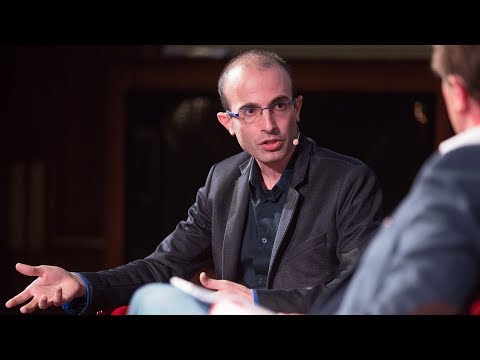
Yuval Noah Harari gave this Intelligence Squared talk in 2014 on how shared myths about money, religion, nations, and social order hold large human societies together.
Also known as: the myths we need to survive; Yuval Noah Harari on the myths we need to survive; Intelligence Squared talk on myths and civilization.
Harari argues that large human societies run on shared fictions: myths about money, religion, nations, and social order. He says these stories are not necessarily false in a simple sense; they are the agreements that make mass cooperation possible.
He frames human history as three revolutions — cognitive, agricultural, and scientific — and says the scientific era is giving humans godlike power to redesign life. That power, he warns, demands new thinking about ethics, politics, and the future.
Across the discussion, Harari returns to the same tension: the stories that unite people also divide them, and the future will likely be shaped by new technologies, new ideologies, and continuing clashes between growth, climate, and social change.
An interviewer moderates the talk and audience Q&A; Harari answers throughout.
In his words
“History begins about 70,000 years ago with the Cognitive Revolution”
“Money is probably the most successful story ever told”
“Science provides the power; religion tells us what to do with it”
“The main products of the 21st century are likely to be bodies and brains and minds”
Key points
- Human history begins, for Harari, with the Cognitive Revolution and our ability to create and spread fictions.
- Large-scale societies require common myths; without them, millions of strangers could not cooperate.
- Money is one of the most successful stories ever told because it is built on human trust.
- Religion and ideology provide meaning and justification, while science provides power but not values.
- He argues that the Scientific Revolution may let humans redesign bodies, brains, and minds.
- Gender relations have changed dramatically in the last century, but the future may blur traditional gender categories.
- Climate change remains hard to address because the capitalist story of growth keeps winning.
Full transcript: Yuval Noah Harari, Intelligence Squared talk on myths (2014)
Good evening, ladies and gentlemen. It's a great pleasure to be here this evening, and these chairs move quite a lot. Um, if I go sliding away, don't take any offense at any point. Um, it's my pleasure to introduce Yuval Noah Harari, who is a lecturer at the Hebrew University of Jerusalem, where his online course A Brief History of Humankind attracted over 65,000 signups. These are the sort of attendance numbers that any lecture at any university can normally only dream of. Um, and his book Sapiens, which we're here this evening to discuss, has been a worldwide success, translated into over 30 languages, and we are very lucky to have him here this evening. He's in the UK for, I think, 48 hours, 48 hours only, so you saw him here and perhaps heard him
on Radio 4 this morning before he moved smoothly to discuss the book, also on Absolute Radio. So, the difference between those two, I think, is quite an extraordinary mental leap, if nothing else. Um, and he has been described by the Sunday Times, uh, and his book has been described as the sort of book that sweeps the cobwebs out of your mind. Its author is an intellectual acrobat whose logical leaps will have you gasping with admiration. His writing radiates power and clarity, making the world strange and new. Well, he's not going to be doing acrobatics in front of us this evening, at least not physically, but mentally, we're hoping very much to see the best on display. Ladies and gentlemen, please welcome once again Yuval Noah
(applause) Harari. And I must just echo Robert's comments earlier that there will be a book signing afterwards, so if you head out of the doors on the right-hand side of the stage afterwards, uh, we will, you will be able to get your copy if you haven't read it already signed. Um, as well, from one Sapiens to another, um, can we begin just with outlining what you see as the, the phrase framework of the book itself and, and to me, it's, it's all posited around three key revolutions. Tell us a little bit about each of those. Well, um, 70,000 years ago, human beings, Homo
Sapiens, were basically just insignificant apes in a corner of Africa, uh, not very different in their impact on the ecosystem from many other animals. Uh, before that, our prehistory, what is called, is really just biology. Uh, history begins about 70,000 years ago with the Cognitive Revolution, uh, during which we don't exactly know how and why, uh, we've gained remarkable cognitive abilities, above all abilities to communicate, to use language, and to create and spread fictions which we'll speak about a lot later on. Uh, these new cognitive abilities turned our
species from this insignificant ape into the most powerful force on the planet, uh, and led to the very quick spread of Sapiens from East Africa all over the world, uh, the extinction of all the other species of humans that back then populated the planet, and the colonization of the entire planet by our species. Then you have the Agricultural Revolution about 10,000 years ago, which kind of sped up, uh, the historical process. It again gave our species immense new powers, uh, enabling us to create trade networks, kingdoms, cities, empires, and so
forth. And then the last, uh, revolution, which began about 500 years ago and which we are still really just in the beginning of it, is the Scientific Revolution. H again, humankind gains immense new powers, uh, such big powers that you can say they might really transform us not only from just apes into the rulers of the planet; they might transform us into gods. And this is meant literally, not as some kind of metaphor, but humankind are now in the process of acquiring divine abilities through scientific research and technological development. If in the
Bible God creates animals and plants and humans according to his wishes, so now you, humankind, is gaining the ability to start redesigning and creating other animals and plants and also ourselves according to our wishes. So this is the third and potentially biggest revolution of all, the Scientific Revolution. Can I take you to the first one, to the Cognitive Revolution? There's a, there's a short passage, um, page 12, very soon into the book, which jumped out at me in which I think speaks to when the newspapers say that you chase the cobwebs out of the mind. It's this that you posit when, when Homo sapiens jump to the top of the food chain. Uh, your
your comparison is to a Banana Republic dictator where suddenly, as a result of that very quick jump, not through evolutionary process, uh, that left Homo sapiens full of, uh, anxieties over their position. Um, and you go on to claim that, you know, many historical calamities, from wars to ecological catastrophe, have resulted from that overhasty jump very early on in the Homo sapiens story. Tell us a little bit more about that. I mean, how can we really claim that, you know, the terrible things we see in our world today could in some way be linked back to a sudden jump to the top
of a food chain? Well, if you look at the other animals at the top of the food chain in the world, like, uh, lions or sharks or alligators, they have evolved to fill this position for millions upon millions of years. They didn't get there very fast or by accident, and both they themselves and the entire ecosystem had time to adjust to it. Um, therefore, you have many checks and balances, both internal and external, to make sure that, uh, they don't destroy the entire food chain. With Homo sapiens, the situation is very different. H humans have appeared on
Earth, about two and a half million years ago, evolving from previous species. But for most of this period, for two and a half million years, they were quite similar to us. They walked on two legs, they had relatively big brains, they had relatively sophisticated social systems, they used tools, and we tend to think that this must have made them the most powerful and important creatures on Earth. But this was not the case. For more than 2 million years, you had humans with big brains, sophisticated societies, tools, working on two legs, and not doing much, or at least not having much of an impact on the rest of the ecological system. You had a few, very few million humans spread
over Africa and Eurasia, and they were not the top predators. They were somewhere in the middle. They hunted small animals, they ate carcasses left behind by the big predators, and they themselves were prey to the big predators like the lions or like the tigers or whatever. And then quite quickly, in the last 100,000 years, which is a very short time in evolutionary terms, you have Homo sapiens, one of these human species, jumping very quickly to the top of the food chain. Not thanks to a long process of biological evolution by natural selection, but thanks to a much quicker process of cultural
evolution. And both we ourselves and the entire ecological system simply didn't have enough time to adjust to it. You see it most clearly when the first humans arrived in Australia about 45 or 50,000 years ago. You have the first humans arrive, Homo sapiens. No previous species could reach Australia because of the ocean. Sapiens arrive about 45,000 years ago, and within a few thousand years, more than 90% of all the big animals of Australia become extinct. And 15,000 years ago, you see the same thing happening in America with the first humans, the first Homo sapiens crossing over the Bering Straits to Alaska and
then spreading down, and within something like 2,000 years, more than 70% of the big mammals of America become extinct. So there are no checks and balances there, and you see the process continuing, of course, today with the destruction of the ecological system today on the, on planet Earth. More than 90% of all big animals are either we Homo sapiens or the domesticated animals that we have enslaved to our needs and desires. And we're the Banana Republic dictators, and yeah, this is like the Banana Republic dictator in the sense that we are very insecure in our position. You look at a lion in the
Savannah, he's very secure in his position. Homo sapiens is basically a bunch of sheep that got nuclear weapons and atomic power. And sheep with nuclear weapons are far more dangerous than wolves with nuclear weapons because they are not accustomed to such kind of power. They are, and they are much more frightened. And to have somebody who is afraid with nuclear weapons is much more dangerous than to have somebody who feels very secure with nuclear weapons. Well, I'll never look at President Obama or Putin again in the same light: sheep with nuclear weapons is how we can think of them going forward. But once we get to the cognitive revolution, you
start to talk about gossip theory, and this is where your, your, your idea about the myths that we need to survive really starts to kick in, I think, in your narrative. And you talk about it simply from the point of view of how communities cooperate with one another as they grow larger, that as they get beyond the size where people can know everyone and know everyone's business and sort of self-regulate, if you want to grow beyond that, you need structures, you need the myths, you need the common stories. How, how do you think? You talk a little bit about the importance of getting others to believe those stories for them to work, but how does that really happen? You know, I can tell a story, and you can tell a
story, but how are we going to get this group to believe your story or my story? Well, the basic method is to get everybody in our community telling the same story and doing it, doing it again and again and again and again from early on. If you grow up in a society and you hear everybody telling you the same story, even people who hate each other telling you the same story from a very early age, there is very little chance that you will doubt this story. So this is the basic method that has been used throughout history. Of course, there are occasions when you have conflicting stories, and then you have big problems. But underneath, for a stable society, you need
to have at least some stories about which everybody agrees. So, like you have today very tolerant and liberal society, but basically, almost everybody, at least say in the UK, believe, accept the basic myth of humanism, about human rights, and the basic, basic myth of capitalism about the economy, which we may discuss later on. What are these basic myths? Can I push you a little further on that? I mean, I can understand how after generations and generations of people telling the same story within a community, you accept it as tradition, as fact, as whatever it may be. But at the very outset, how do those myths gain credence, do you think? How, how do they gather
their first generation of believers? Well, the crucial thing is, in most cases, at least in the most successful cases, it is not a matter of cheating or manipulating people. If you want to convince people to believe something, usually you have to believe it yourself. And most, I think, most Christian priests, they really believe in their stories, just the same. Most capitalist bankers, they really believe in the stories that they are telling us. They are not going behind in the back room and then laughing about us that we believe their stories. I mean, really believe. I think we might think they do sometimes, to be perfectly honest, but
Carry on. This is the basic thing: you really believe the story. Also, usually you find that there are several stories that people keep in their mind at the same time, and when one story fails, they immediately grasp another story. This is again one of the things that differentiates us from other animals, that because so much of our behavior depends on believing in these fictional stories, we can change our behavior extremely rapidly simply by switching from one story to the other. And we usually keep several stories in our heads, and when one fails, we just reach out for the other. And you see it happening in history very quickly how.
This is again, it's amazing. You think, for example, about German history in the 20th century, and you see the same people with the same DNA, the same geography, the same class, climate, and during a hundred years they switch between five completely different stories just like that: from the Second Reich to the Weimar Republic, to the Nazi regime, to communist East Germany, at least if you lived, say, in Leipzig, and then to a reunited and liberal democratic Germany. And it's the same people, and they somehow manage to very quickly switch the stories in which they believe. And again, as a historian, I tend to think that most of the time it's not... it's
Not a trick. People really believe the story, and they completely forget the story in which they believed five years ago or ten years ago. And we also know it from our own personal lives. Usually people hold several narratives of themselves, of their own lives, and they switch between them. And when they switch, they can shut down something, and they completely forget that they ever believed something else about themselves. And the other point you make about the myths that communities tell to enable themselves to exist as communities also has a downside, which is that in the creation of those communities around a shared myth, you create different communities with
Different myths. And thus those myths that bring people together also simultaneously are dividing people at the same time. I mean, is there a way out of that dissonance, or do you think that is just the nature of the myths themselves? There is a way out in the long run, and you see that as history progresses, there are basically fewer and fewer stories which more and more people believe. If you go back 2,000 years or 4,000 years, you find that almost every little tribe has its own mythology, has its own set of beliefs about the world. You go about the world today, and today at least in some respects,
Humans on the planet have a set of beliefs, of stories which they all share, whether it's again capitalism is maybe the best example, money is probably the most successful story ever told. Not everybody believes in the same God or in the same political myth, but almost everybody on the planet believes in the same economic stories about money. Even say Osama bin Laden — he may not have believed in American politics or American culture, American religion, but he had nothing against American dollars. I mean, if you gave him American dollars, he would not throw them away. I don't believe that. And I was learning recently, and I
Wonder here whether again we can bring science back into our historical story. I mean, I think one of the great things about the story you tell is its interdisciplinary nature, isn't it? That you're moving from science, you're moving to history and back again, bring the two together. And I was hearing that a recent test has been done in America with the congregation in a Baptist church, and they've been examining their brain patterns as they are listening to their charismatic preacher, MH. And what people were expecting to see was affirmation, enjoyment, excitement around the message, kind of endorphins jumping, going crazy, all these sorts of things. But what instead they saw was that the prefrontal cortex, the sort of the critical thinking area at the front of the brain,
Completely shut down. Now, this was shown later in this particular congregation, and what the scientists are now thinking is that when faced with or listening to a charismatic leader, however you define that, the alpha male of the pack, etc., what's happening is that our brain is actually hardwired to stop questioning what we're hearing from them, MH, and just accept it. And I wonder how that kind of idea might play into your world in which, you know, the common belief in myths is absolutely essential for community function, for the dispersion of myths amongst the community, and for the ability to change those myths as you've
Been outlining. Yeah, because society is based on these beliefs in common stories, and it also involves, you know, even marking that I believe in the same story by wearing a particular kind of hat or having a big beard or wearing a suit. So you just need to see the person, you know, ah, he believes in the same story that I believe. So it's extremely important. So I think it's very, very reasonable that we have something very deep in the way that our bodies, that our brain functions, that enables us to just accept the common stories of society without thinking about them too much, because if all the time we went about
Thinking about these stories, then society would collapse. I mean, I don't want to give the impression that all these fictions are bad. The basic message is that without these fictions no society could function, at least not any large-scale society. If you look at a band of 100 people, it can function without any mythology or any common fictions just on the basis of knowing everybody else and I know who you are and so I can trust you or not and cooperate with you or not. But if you try to build a society with thousands of people or millions of people, you must have some unifying stories in which
Everybody believes, and if we didn't have this mechanism, maybe for shutting down the prefrontal cortex, then it wouldn't work and you go beyond. I mean, in your book, it's not just stories. I mean, I think we can understand if they're folk stories told around the fire or, as you say, a story we can all happily buy into like money. But you also talk about make-believe groups, you know, entire hierarchies of society that would come under the title of a story, a myth for you as well. And I wondered there whether, again, calling them a make-believe group, you know, we may presume that the people believe them when they're making them up, but to call them that, isn't that taking away a little bit from certain
realities? Nature, nurture, for instance, as part of the debate. I mean, one of the examples was how do elites come about in societies, in, you know, early societies say in the medieval period or something like that? And there, one could argue, say, look, well, you know, if you've got someone who can afford a horse and afford some armor to be on the top of that horse, then they can defend the people. And as a result of being able to defend the people, they as a result occupy an elite position in society and make decisions about what that society should do. Now, I'm struggling with seeing that as a completely make-believe group as opposed to it being a very obvious, common-sensical kind of "well, they're able to do that, so that's why they get the position that they do." How would you kind of square those two? No, definitely what
usually happens is that some accidental process leads to a particular group of people, say the people who had horses, finding themselves on top. But then the crucial thing is, how do you maintain your position? How do you establish not just a temporary hierarchy, but a long-lasting hierarchy? And then, after 300 years, coming to the peasants and saying, "Look, 300 years ago my great-great-great-grandfather had a horse, so now you must all obey me." It wouldn't convince anybody. And I'd love to see people try, though. That would be well worth it. And similarly, if you take like a modern example, if in the 19th
century, I don't know, in the Southern United States, the white plantation owner would come to the slave on the plantation and say, "Okay, 300 years ago this and this happened. This is why you are now a slave on my plantation." Not only would it be very difficult for these people to accept it, even for himself to explain it to himself: what justifies my position, my privileges, my power? People need some kind of much deeper justification than some accident of history that happened 300 years ago. So, they invent all kinds of stories, for instance, of racial superiority or of religious justifications. Like in India, you have this basic creation myth that you had
the original beings, the Poras and the Brahmins, the upper castes. They came out of its head, and the Sudras, or at the bottom of the hip, they came out of his legs. So this is why they must obey the Brahmins. Now, this sounds much more acceptable if you put it in the right religious context than saying that 2,000 years ago some tribes from Central Asia invaded the Ganges valley and subjugated the local population, and this is why we have now this caste system. Move on to another disparity which I know I was, I was primed to definitively ask you about this this
evening, and that's gender. You, in your book, show that so many cultures, geographically spread around the world, temporally spread across history, have prioritized men over women. And you struggle to offer, as everyone does, a convincing explanation for why that is and why such communities have been so stable. Can you talk us through that? Have you got any more insights since writing the book as to how we might explain and understand that and quite why it's been such an incredible phenomenon? Well, it's one of the biggest riddles of history because it's obvious that in this case it's not just the result of some one accidental event and
it's not just the result of one accidental story because you see the same structure in different ways in almost all societies. There are exceptions, but in most societies known to science for thousands of years now, the simplest explanation that comes to the mind of many people is that men are physically stronger than women, so it's obvious why they have dominated society. But this doesn't really fit in with a lot of other things known about human beings and about apes in general, and that is that social power in most cases is the result of social skills, not of physical strength. If you look at the
hierarchies of most human organizations, they do not correlate with physical strength. If you think about maybe the most long-lasting organization in the world today, it's the Christian Church. You don't become Pope by beating up all the other Cardinals, and I think that I won't be offending anybody if I say that Pope Francis is not the strongest Catholic on Earth in physical terms. So, I've got this image of sort of a weightlifting competition happening in the Sistine Chapel now or something like that. Yeah, and it's not just the Catholic Church. I mean, you look everywhere. I mean, you look even at criminal organizations. So very often the big boss is somebody in his 50s or 60s whose power is the
Ability to tell other people some thugs in of 20s to go and kill someone. He's not going and killing him himself. And even among chimpanzees, the alpha male is not the strongest male physically. He is the male that is able to construct stable coalitions of supporters. So it's social skills, and it's very often at least believed that women have better social skills than men. And if so, and if social skills are the key to social superiority, so how come men dominate society? There is another very common theory that, okay, maybe it's not physical strength, but it's the issue of childbirth and taking care of
children that women are all the time occupied with—being pregnant, taking care of children. So they don't have time to do all the important stuff, which they leave to men. But the problem with this theory is that, among other animals like elephants, like bonobos, the pygmy chimpanzees, we have cases of precisely because the females are the ones that are responsible for taking care of the young, they need more support. And because they need more support, they need to cooperate more, and they develop—this is why they develop those social skills—because they need help from other elephants or from other chimpanzees in
raising the young. And what you get is a network of females which dominates society, whereas the males, which have much fewer responsibilities with regard to raising the children, they are much more autonomous, they are much more self-centered, they have more difficulties in cooperating, and they're basically pushed aside. So even though the individual male bonobo is stronger than the individual female bonobo, you have a network of cooperating females that dominates society. If this is possible among bonobos or elephants, why not among human beings, which,
in their case—I mean, social skills are the most important skills. One of the possibilities, it still doesn't have the backing of enough empirical data, so it's not like the answer, but one of the possibilities is that maybe this common idea that women have superior social skills is not true, at least when it comes to large-scale cooperation. One possibility which is worth exploring and emphasizing—it's just a possibility, it still hasn't got enough scientific backing—is that, yes, in small-scale societies women have superior social skills, but when it comes to the big
organizations that are based on all this myth-making, and in which case you have to cooperate with complete strangers, then you have the reverse situation. Women, precisely because they need the direct social connection, they are at a disadvantage, whereas men, who are much more comfortable with an alienated situation, with an impersonal hierarchy which is based on make-belief and not on actually knowing the other person, they feel much more comfortable with this kind of situation. So when you have large-scale societies and huge impersonal
hierarchies, this is the situation where men actually have superior social skills. Now, as I said, it is just a theory worth examining. It's not the answer. I remember vividly from undergrad studies reading Herodotus, and he tells a story about a tribe where all the women of the village, for every male sexual partner, they put a bracelet on their leg. And then when all the women of a particular generation get to a certain age, they count up their bracelets, and the woman with the most bracelets becomes chieftain of the village. Herodotus looks on it with some amusement, I would say, but it's kind of— it's an interesting kind of example that there are examples that break your paradigm, as it were. But they are very few, involved between, isn't, and usually
they are from small-scale societies. We don't know of any big empire which was matriarchal. It's one of the questions of history still to be understood. Yeah, like, can we break—come on to one of your main myths that you talk about in the book: money. And we mentioned it once or twice already this evening, and one of the things you say about money is that, you know, it can bridge any cultural gap. Even Osama bin Laden is taking American dollars. And I just wondered how you felt that, if we place it against the recent economic crises that have been rocking Europe, particularly exacerbated through Greece, etc., which seem
to me to have been having a very divisive effect and opening up cultural gaps if anything. How would you say the two work together? Well, I think in the recent economic crisis all over the world, we got some amazing examples of the power of our belief in money. At the height of the economic crisis, I think two, three years ago, the Federal Reserve in the US was creating every day 3 billion dollars out of nothing. They created altogether a trillion dollars during that year simply by going into the computer and adding a few zeros somewhere. That's it. I mean, today you don't even print the money. Most money is not even printed; it's just electronic
data. The basic material from which you make money is human trust. If you have trust, you can monetize it into anything, even electronic data. So despite the recent hits that the capitalist system has had since 2008, still the amount of trust that most people in the world have in the capitalist system is incredible. And this is what enables, for example, the banks to create so much money out of nothing. You have trust in money and in the systems that
Produces money. You have also trust in the basic, uh, capitalist stories that say, first of all, maybe the most basic story of all of capitalism is the answer to all problem: the key to all the questions that bother us is economic growth. No matter what you want in the long term, the only way to achieve it is economic growth. You want equality, you want freedom, you want employment, you want democracy, you want peace, name it. It's through economic growth, and if there will not be economic growth in the long run, you won't have any of that. On the personal level, this translates into another extremely powerful myth, the myth
of consumerism, which is part of this package, that if you have any problem on the personal level, the solution is to buy something. Any problem whatsoever, you probably need to buy something, and then it will be okay. It can be, you can buy a product, or you can buy a service. You can buy a car, you can buy yoga, you can buy marriage counseling, whatever. But the answer to all the problems of humankind on the collective level, they come from economic growth; on the individual level, they come from buying more stuff. And still, the vast majority of the population, certainly in Europe and most of the world, they believe in these
stories. And if ever they stop believing in those stories, then the capitalist system will collapse. Take you on to another of your big myths: thinking about religion now, you take us through, in the book, a lot of the religions of the world today and show how there's a certain amount of cognitive dissonance in quite a few of them. But I wanted to direct your attention towards what you think about the religions of the future, uh, and you know, obviously, particularly as you pointed out right at the beginning, we're in the throes of a new revolution—the Industrial Revolution, that scientific revolution that is really going to change our world once again beyond anything that we understand now. And how do you see religion in the future? I mean, are there going to be tech-based religions? I mean, I think this morning on radio for you, we're
talking about Silicon Valley, uh, as, as, as, as some God to be worshiped, uh, perhaps now and certainly in the future. Yeah, I think the future belongs to tech religions. I mean, the big religions, the important religions of the 21st century, are more likely to emerge from Silicon Valley than they are from the Middle East or from Afghanistan or Syria or any of these places. Um, it's a bit similar to what happened in the 19th century with the Industrial Revolution. Uh, when the Industrial Revolution swept through the world, you had a lot of reaction; it created a lot of new problems, it destroyed a lot of old certainties and hierarchies. As Marx and Engels wrote in
The Communist Manifesto, "Everything solid melts into air." And when everything solid melts into air, people become very afraid and they look back to some reassuring old tradition—mythology, religion—to give them security. So back in the 19th century, the Industrial Revolution led to a wave of fundamentalism all over the world. Uh, the biggest war of the 19th century was not the Napoleonic Wars, it was not the American Civil War; it was the Taiping Rebellion in China. When in reaction to the coming of the Industrial Revolution, of British imperialism, of the collapse of the old
Chinese system, you had this failed scholar Hong Xiuquan who had a vision from God, allegedly, in which God revealed to Hong that he, Hong, is the younger brother of Jesus Christ, sent to Earth to establish the kingdom of heavenly peace. And he went around southern China with this message of heavenly peace, and millions followed him into the Taiping Rebellion, which was the most bloody war of the 19th century. According to the most, uh, moderate estimates, 20 million people died, perished in the Taiping Rebellion, which lasted 14 years until it was repressed. The biggest war, and
similarly, you had other fundamentalist movements, like you had in Sudan the Mahdi, quite similar in some respects to what we see today in the Middle East. But none of this worked. When we look back to the 19th century, we don't remember it as the age of Faith. The really important religion or ideology that came out of the Industrial Revolution in the 19th century was socialism. In 1800, you didn't have any socialists; it started very little, but then it spread like wildfire and became the most important ideological movement of the era, changing our lives completely, completely. And the key to the success of the Socialists was that they were
relevant. They looked to the future, not to the past. They didn't study ancient scriptures; they studied the technology and the economic structures created by the Industrial Revolution. Therefore, they had something relevant to say about the new problems and opportunities of the Industrial Revolution. Now we are in the midst of a Second Industrial Revolution. This time, the main engines of change are not steam and electricity; they are biotechnology and computer science, intelligent design. This time, the main products will not be textiles and vehicles and things like that; they will be bodies and brains and minds. The main
products of the 21st century are likely to be bodies and brains and minds. And the Islamic State has nothing relevant to say about the new opportunity or danger of this. For example, what will happen when artificial intelligence will replace most humans in the job market? Experts estimate that it could take as little as 30, 40 years for this to happen. You don't have any answer in the Bible what to do when humans are no longer useful to the economy. You need completely new ideologies, completely new religions, and they are likely to emerge from Silicon Valley or from Bangalore.
And not from the Middle East, and they are likely to pro to give people visions based on technology—everything that the old religions promised: happiness and justice and even eternal life, but here on Earth, with the help of technology, and not after death, with the help of some supernatural being. If we can finish up with one more question before I want to open it up to the audience for the second half of this evening. But one of the key tenets of the Scientific Revolution, you put it, is the fact that we were able to admit ignorance; that there were things that we didn't yet know, and that it was worth going out trying to find them out. MH, and how do
you feel that sits with the myths we tell—that we need to survive in communities that need to be believed, that need to be all-encompassing? How do those two things sit side by side, and how will they sit side by side in the future, do you think? Well, science doesn't provide any answers for ethical questions. Therefore, it can never stand by itself. And even, at a deeper level, science is not really—at least this is why I view, as a historian—science is not really about truth; it's about power. The real aim of science as a project, as an establishment, is not truth, it's power. Particular individuals, particular
scientists may be very interested in the truth personally, but as an institution, the real aim of science is power. And therefore it can, and it must, form alliances always with some ideology or religion. We have in our head this, again, story, this myth that science and religion are enemies, that they are fighting against each other and that hopefully, in the end, the light of science will prevail over the darkness of superstition and religion. I think this is very, very, very far from what has actually happened in the last few centuries and what will continue to
happen in the next century. Science, there are conflicts between particular scientific theories and particular religions, yes. But at basis, science and religion are friends, our allies. Science provides the power; religion tells us what to do with it. With the same technology, say, artificial intelligence or genetic engineering, you can do completely different things. With artificial—sorry, with genetic engineering, you can cure cancer or you can make designer babies. What to do with it? Scientists have no answer. There is no experiment in biology or physics which will tell you what to do with genetic engineering. For this, you need to believe
in some story, in some religion, in some ideology. And this will continue to be the case in the 21st century also. Thank you very much. So we're going to open it up now to the audience. And the way this is going to work is, we've got down on the ground floor here, we've got some four mic spotters. Yes, you—you deserve a glass of water after that—to pick up, to get a mic to you. And if you're up on the top level, there is a freestanding mic right in the center. You need to make your way to that microphone. Is it in the center? It's just to the—sorry, just to the right-hand side here. So if you've got a question in the upper level, you're actually going to have to make your way over to the microphone
to ask your question. And down here, we've got some mic spotters. So can I ask you, please, to wait until you've got a mic to you so to ask your question, so that we can all hear your question clearly? Otherwise, we won't have a chance to hear it. And I'll probably take questions a couple at a time, and then we can throw them all to Yuval at the same time. So, if we're going to start in this section here, there's a lady—just, yes, with dark hair—and then we'll go to the gentleman in the row in front, and then there's a lady in the blue here as well. We'll do this section first. Then we'll come to this section, and we'll take some in between from the top. Hi, thank you, Dr. Harari. First of all, thank you so much for expanding so many minds with your book. My question is really with the gender imbalance issue. I know
you've said that you don't have a convincing answer for it yourself, and we look forward to the day when we hear from you on that. But I wonder if you have an opinion, given what you know of different groups of people throughout history and how they've attained power. Looking at the world today, what in your opinion could be the most important thing women could be doing to address this gender imbalance, either in behavior or action? And related to that, if you have an opinion on that, why do you think it hasn't happened already? Okay, so we've got J. We'll hold that one if you don't mind, and if you pass the microphone forward to the gentleman in the row in front. Hi,
thank you for such a great talk. Jewish and Christian and Catholic religions have committed terrible genocides based on their myths. Do you think these religious leaders who've created these beliefs and pushed these myths around the world should go to prison based on their myth belief and pushing it across the world? Thank you. Okay, so we've got gender and religion—two small topics for you to deal with—and one more coming from the lady in the blue, and another easy one: climate change. I'd love to hear your thoughts on what you think Homo sapiens communities will look like over the next 50, 100 years.
Given that we're in the beginning stages of maybe the next mass extinction, and yeah, just your thoughts on how you think we're going to respond to climate change. Yeah, okay. Okay, the future, gender, religion, and climate change. Okay, so, um, two minutes. So, with regard to gender, I think that there's been a tremendous change over the last century. It may be the biggest social change in thousands of years of history. For thousands of years, you had so many different revolutions—political, social, and economic—so many different things
changed, but this basic patriarchal structure of most human societies, at least the more, the bigger human societies, didn't change. And over the last 100 years, you see a really fundamental change in the status of women and in the relation, in gender relations in general. It's still very far from being a completely egalitarian society, and it's questionable whether it will be possible ever to have a completely egalitarian society. But I wouldn't say that nothing has been done or accomplished in the last few decades. Looking to the future, and it also links to the other
question: I'm not sure there'll still be genders in 50 or 100 or 150 years. With this new ability to re-engineer, to create bodies and brains and minds as the basic products of the 21st-century economy, the most fundamental structures of the human body and mind themselves might change. So I'm not so sure that 100 years from now, people will have a clear gender of just one gender. Just to give an example, that's already starting to
happen. In virtual realities, for example, it's very easy for a person to adopt a different gender, to change genders, or to construct all kinds of alternative genders. And you have today kids, boys who play the roles of girls and vice versa as avatars in virtual worlds. Today, it's still very primitive. You sit in front of the computer, and it's a two-dimensional reality, but in 30 years, more and more of life might be transferred into a three-dimensional virtual reality which provides people with far more excitement and far more interest than
the drab life in the outside world, in an economy where they are no longer needed and a political system in which they have no power. In such a situation, I mean, I wouldn't just take it for granted that the gender structure familiar to us today and from thousands of years in the past will still be relevant in 50 or 100 years. So these are a few thoughts about gender. The other topic was religion. Religion, yes. Whether to put on trial people for propagating myth that then causes genocide and so forth. I think the big, the real question is, I don't have
like an answer for all cases, but a very obvious question to ask is what is the relation of cause and effect between the people who first invented the myth and spread them, and the people who committed the atrocities of the genocide. I wouldn't put Jesus on trial for what the Crusaders have done a thousand years after his death. At least according to the best of my understanding, there is a very, very big difference between what he preached and what the Crusaders understood from his preaching. On other occasions, for instance, in the case of, I don't know, Hitler and
the Nazis, there is a much closer link between the people who first spread their stories and the atrocities that were committed in the name of these stories. What we need to remember is that Homo sapiens has an incredible capacity to reinterpret stories. This is one of the powers of stories—that it enables them to change and to adapt. So a story can say white, and people will say, "Yes, yes, yes, this is just an allegory." When it says, when it's written white, it actually means black. And when it says that you should love your neighbor, it actually
means that you should crucify your neighbor, or you should burn him if he doesn't believe in the same version of the religion of love and compassion as your version. So from this perspective, I wouldn't blame the people who, or necessarily the people who invented the story in the first place. I would also look at the people who reinterpret the story in very creative ways sometimes. And then climate change, particularly in light of VW recently. Well, climate change is a very depressing issue because, in this case, there was a lot of talk but no fundamental change. And the
basic problem here is probably the fundamental capitalist story of economic growth, at least at present. Maybe in the future they'll find some way to make the two work together, but at least at present, there is really no way of reducing, say, the emission of greenhouse gases or stopping or slowing down even global warming without reducing, halting, or decreasing economic growth. And no government, almost no government today, is willing or able to do that. When the capitalist story clashes with this
problem of global warming, the capitalist story always wins. So maybe we'll find some new technological ways of settling the two together, but if that doesn't happen, then I don't think the chances, at least now, is that we won't do anything radical enough in time. And this is an unfolding disaster that humanity is simply walking into and will have to face the consequences in not too distant future. Okay, we're going to go up to the
Top to the standing mic, can we get the first sort of three questions, uh, from up the top please? Hi, good evening. Um, I wanted to ask a similarly, uh, small question about, uh, the relationship between these stories and what you might view as some kind of objective reality. Um, basically, is there some sort of relationship between the most successful stories that we tell in society and some kind of objective truth? Um, or is it more their ability just to bring people together? And you mentioned this, uh, interesting example of ISIS as a response to the development of humanity over the next, you know, 50 to 100 years. Does that mean that, you know, our proximity to a sort of scientific truth means that the story will be more successful than just a story which is entertaining and gives
people solace? Mhm. Okay, thank you. And the next. Hi. So the question is, what should we believe? Because I feel like I had this idea that as human beings, we tend to know the basic values like compassion and kindness, but our mind is also so weak that it is so easily interfered with. For example, Nazi and, um, now right now we're seeing ISIS that just turn normal people into killing machines. So how should we think that as normal people living in the society when somebody trying to make us believe what they want us to believe? How can we distinguish? How can we keep independence? And one more, if we hadn't
here, um, I would like to ask, um, firstly, the cognitive leap. Do you have any idea why that happened? Um, secondly, hear the cognitive leap, um, why did that happen? Okay, um, also, how aware of you, how, how aware are you of the myth that you're propagating yourself? Okay, and and do you have a belief in truth? Mhm. Uh, it seems the top row are very much more philosophical, maybe it's the quality of the air up there. So should we start with the cognitive leap first and and then answer?
Go for it. Uh, so about the, um, objectivity, there is surprisingly little connection between the objective truthfulness of a story and its historical success. Some of the most successful stories in history—and I won't name names, not to offend anybody—are the most far-fetched and, and, and strange. I mean, we are so used to them that we are, it's reasonable for somebody to believe that. But just try to think about it from the viewpoint of somebody who never heard them before and how can anybody believe that. Uh, so there
is no connection. You very often, it's accident, deal. Why one religion becomes dominant and spreads and not another religion, it very often has nothing to do with the truth value of the story. It depends more on all kinds of either organizational skills or accidents of history. Um, about the second question, what whether there is any kind of truth that can serve as a basis for ethics, for morality, uh, and what is real in in the world. So for me, ethics is not about obeying the commands of some this imaginary entity
or or that imaginary entity, but it all revolves around the question of suffering, which as far as I understand is the most real thing in the world or the thing which is most easily most easy to test. It's it's reality. Suffering is real. It can be the outcome of belief in all kinds of imaginary stories and and and entities, but the suffering itself is real. The easiest test whether something is real or not, just ask yourself: can it suffer? Uh, a nation cannot suffer. We say that the nation suffered the defeat in war. This is just a metaphor. A nation
doesn't suffer. Even if it loses a war, the people in in the nation, the civilians, the soldiers, they can suffer, but a nation doesn't suffer. Similarly, if a bank goes bankrupt, the bank doesn't suffer. If the euro loses its value, the euro doesn't suffer. And similarly, if the temple of Zeus is burned down, Zeus doesn't suffer. Uh, his believers may suffer, yes. Uh, humans are real things. They really suffer. Animals really suffer. A cow who is separated from her calf in the dairy industry, they, the cow and the calf, they really suffer. This is real. But a
nation that loses a a war doesn't suffer. So this is, I think the, the, the clearest. There are other tests, of course, but for me this is the clearest and most important test. About the cognitive leap, cognitive revolution, what what caused it? We don't really know. Um, there are all kinds of theories, but it's unclear. What happened to Homo sapiens about 70,000 years ago? I mean, before that, if you go back a 100 thousand years ago you find humans that look very much like us, with brains the same size as ours, but they behave in a completely different way. The best theory we have is that some small genetic
mutation or a few small genetic mutations occurring around 70,000 years ago led to a change in the internal structure of the sapien brain, perhaps linking together two brain areas which were previously separate or or vice versa and this resulting in new cognitive abilities. But again, this is just a hypothesis at present. Uh, I think the best thing about science is that when you don't know something, you don't have to invent some fanciful story. You can just say, I don't know. So we don't know what caused the cognitive
Revolution. There was another question, I think linked to it: how aware are you of of the myths you're spinning for us? I I try to be—notice he avoided that one, get out—I I try to be as as aware as possible. Again, I try to use the same test that I mentioned earlier, uh, the test of suffering, and as some something to hold on when you see the immense power that stories have over humanity and also over myself, to keep asking myself what is really real and not just a story in my mind. And the test I keep returning to is the test.
Of suffering. What, uh, what is really—what is suffering, and what causes it? And focus on that, and that can give you at least some lead away from just immersing yourself in more and more fictions and mythologies to bring things down a little bit. I'm reminded very much of the Matrix, uh, movie where the guy says, or the computer says, you know, we tried an iteration of your world first without any suffering, and nobody bought it, right? Everyone, you had to have the suffering kind of within the Matrix world for it to be believed. Um, but you spent a lot of time in your book also talking about happiness. Yes. I just think, just to jump in with the happiness, that that happiness is not studied enough as a
subject within the historical narrative that we tell. Um, and yet suffering is your byline for your, your, your check if you like. How do you see the two? What's the use of studying happiness then? Suffering is two sides of the same coin, and at least my publishers told me that if I write about suffering, nobody would like to read it. If you write about happiness—ah yes, happiness—we want to hear about happiness. So, uh, so like in the headline you have happiness, but when you read the small print you see, oh, it's actually a lot about suffering. This sounds like the best advertising gig has ever been put together. We're going to come to this part of the audience for questions. Uh, first we've got some mics coming too.
We've got a gentleman in the second row, we've got a gentleman in the first row, and, uh, we've got a lady right next to him as well—that kind of thing. We'll go through those first and then come to the back after that. Just picking up on the genetics point: do you believe that humanity genetically can all believe the same myth? And I give the slight sort of facile example of the white and gold dress or the blue and black dress, and therefore is genetic manipulation in the future the way in which those that are truly seeking to influence humanity can get them to bond around a powerful myth? Mhm, okay. That's
one. Come to you next. Um, it's kind of the same ballpark, but I was wondering: you've spoken a lot about how we change stories and our ability to change one, pick up another one, and how we might do that with religion in the future, and it might become something that looks completely different. And I wondered if, on the flip side, there are any stories that run all the way through that humanity has had kind of from the beginning and might have changed, but there's a kind of immutable core, or are we just creatures that constantly move on? Mhm, okay. And we have one more from the front row and then take those three together. Thank you. There's a mic there. Hi there. Yeah. We've spoken a lot about money being the biggest story that humanity's created and with religion and capitalism, uh, as
you know, kind of the second ones under that. What, uh, do you think will be the next biggest story in humanity's next leap forward? And/or is there even a bigger story than money, in your opinion? Mhm. Okay, should we take those? So, sort of, uh, genetically manipulating everyone to the same myth, the successful ones, and what's going to be the next big story? Well, um, it is possible for everybody to believe in the same story at the same time. We have examples again like money, uh, which has been the most successful story probably, and it's a very good story. I'm not implying that there is something bad about it. It has done humanity a lot of good in, in, in many ways. Uh, both money and capitalism
um, it's very common today—not only today, today—to blame them for all the evils in the world, but you have to say that they are also responsible for some very good developments. Uh, today in the world, more people die each year from eating too much than from eating too little; more people die each year, um, from old age diseases than from infectious diseases and childhood diseases; and more people commit suicide each year than all the people killed by war and crime put together. And all three are wonderful news. It may not sound like it, but if you think about it again, this is wonderful news. And the capitalist system has a lot of
credit for all these three achievements: reducing famine, reducing disease, and reducing violence in the world. Uh, so I felt I just had to say it to counterbalance maybe the wrong impression. So, it is possible for all people to believe in the same myth even without, uh, genetic engineering or biological engineering. Um, we can't really say what will be the next stage. Um, the most probable thing is that the next stage of history will involve fundamental changes in humanity itself. Um, for thousands of years of
history, we had social and political and technological revolutions, but humanity itself stayed the same. We still have the same bodies, the same brains, the same minds as hunter-gatherers 20 or 30,000 years ago. It's very likely that the next stage will involve, uh, changes and manipulations on the most fundamental features of Homo sapiens: on the body, the brain, and the mind, and it could be, uh, used also to make people believe all in the same story or in different stories. I don't know. Uh, but it's certainly a, a possibility. Uh, the second question was
most successful myth to date—I mean that might be money for you, it sounds like—and then what's the next, uh, kind of myth? Um, about the most successful—what? The question—the most successful—oh, oh, yeah, whether something has—not changed. Well, again, the, the, the power of stories as against genetics is that they are extremely adaptable and malleable. For a beehive to change its social structure would take probably thousands of generations of natural selection. The bees cannot wake up one morning and have a revolution execute.
The queen and establish a republic of bees or a Communist dictatorship. Worker bees of the world unite! Let's have a Communist dictatorship of bees. It won't work. Humans can do it because we don't need to change our DNA, we change the story, and this can be done very, very quickly. So you don't—people sometimes believe that you have stories that remain the same for thousands of years. This is especially the case in religions, that people convince themselves that I believe in the same thing and follow the same Commandments as people did thousands of years ago. But when you look deeper,
into it, in almost all cases you find that there are enormous changes, like again, like favorite example: the pope is always good when you need something. Some example like this. So you now have the pope saying to people in Europe, "Open the churches to the Muslim refugees coming from Syria. This is the Christian thing to do, is to welcome these Muslim refugees into your churches." Go back a thousand years, and the Pope says, "Go to Syria and kill these infidels." And still, the pope would say, "No, it's the same Christianity, it's the same—it's the same basic story." So people tell
themselves that nothing changes, but in reality, changes all the time in quite drastic ways. What was the third, the next big myth? The next big myth, um, well, it will be complicated to explain in two or three minutes, but, um, I think the next big story is data. If you tell the story of history in a nutshell, first people believed in God, and humans were important simply because God created them and gave them special privileges and whatever. And then you had the humanist revolution and people stopped believing in God and started to believe
in themselves, in humans. Human beings became sacred in their own right. This is the faith in human rights, that Homo sapiens is sacred. Why? Just because we are sacred. We are the most important thing in the universe. We are the source of all meaning and authority. The next big thing, I, my guess, is that we'll move from, as we moved from a theocentric to a homocentric worldview, we'll move from a homocentric to a data-centric viewpoint. The basic myth which you see starting to emerge from Silicon Valley is that the
entire universe is a flow of data. Everything in the universe is just different patterns of data flow. All organisms are algorithms. All organisms: giraffes, tomatoes, humans, and flu viruses are just different data-processing systems. Up till now, the most successful, the most advanced algorithms in the universe were humans, which was why it was a good reason to sanctify humans. They are the best data-processing systems in the world, but we are now creating better data systems than humans,
and humans will move aside, and the future will belong to completely different kinds of algorithms. This is my personal guess, where we are heading to in the 21st, 22nd century: data replacing humanism as the central myth of history. Suddenly, everyone starts cutting up their Tesco Club cards and... "You can we head to the back section on this side, and then we'll come over here. After that, there was a gentleman with his hand up high, with the paper in his hand. There's a lady row or so behind him, and there's a gentleman in the front row of the center. Oh, sorry, we'll go for the lady in the front row as well. We'll take
those three, and then we'll come round to the left. Is there a mic? Thank you. You mentioned that myths are necessary for large societies to organize themselves, and the nation state really very much relied on myths during the 20th century and was the construct that we used to organize ourselves politically in the 19th century, 20th century. What do you think, going forwards, is going to be the organizing principle for political states in the 21st, 22nd century? I mean, where are we going? Mh? Okay. And then there was a lady in the front row? Yeah, there. I want to ask, um, do you think love
is a myth now? That's the kind of question. And there's a lady in the back row on that section as well. Thank you. Um, um, I have a question regarding, um—well, it seems, it seems um that we're kind of between stories at the moment and, uh, a lot of the questions here today seem to um pin their hopes for new stories, and so is the case with mine. I'm just wondering if you have, um, or what your view is on the dissonance between, um, the stories we tell children
about nature and animals, and the abysmal way in which we allow animals to be treated. Mhm. Yeah. Okay. Uh, okay, so first about the nation state in politics: for the last 200 years, the nation, nationalism was one of the most important stories and myths in the world, but we are now seeing the decline in the importance of nationalism despite all the talk about the revival of nationalism, say, say in Europe. When you compare the strength of nationalism in Europe today to what it was a century ago, there is absolutely no
comparison. Just 100 years ago, in the First World War, Italy, for example, joined the war—the First World War in 1915. Nobody forced it to join the war, nobody invaded it. It joined the war of its own volition in order to gain a few little territories, mainly Trieste and the Trentino that they claim is sacred Italian soil, illegally occupied by the Austro-Hungarian Empire. Italy lost in the war something like 650,000 soldiers killed and more than a million soldiers injured for Trieste and the Trentino. No Italian
Government today would risk even 5,000 soldiers to get some territory from Slovenia or from Austria? It's almost unthinkable. Similarly, if you think about all the independence movements in Scotland, if you compare that to what you had say 200, 300 years ago, there is no comparison. Almost nobody was willing to be killed or to kill somebody for or against Scottish independence compared to the situation two, 300 years ago, when the government in London was willing to basically send its army to the Highlands and then practice a sort of ethnic cleansing after Culloden after
1745. So it's a totally different kind of story. You can maybe talk today in Europe about boutique nationalism, which is kind of nice to have under this big protective umbrella of the European Union, but nobody's going to be killed for this boutique nationalism. And it makes good historical sense for nationalism to be waning because the big problems of humankind in the 21st century are all global in nature and there is no country that can solve these problems on its own. It's not the right level, whether it's global warming, whether it's the global
economic crisis, whether it's the opportunities and dangers of new technologies like artificial intelligence, what will happen when artificial intelligence will outperform humans in cognition, in intelligence. This is not the kind of thing that a single government of a single country can solve by itself. So in this sense, the future hopefully would belong to a more global sort of politics. If humankind cannot move to this level of more a global political system, not necessarily
global government, but some kind of more effective global political system, we will not be able to face effectively the really important problems and dangers of the 21st century. So this is about politics. What about love? About love: my husband is in the audience, so I have to be careful, very careful about what I'm saying now. Love is certainly real, but there are many, many, many myths that have (music) (applause) been. Love is both a biological and a personal subjective
reality, but there are a tremendous amount of mythologies and stories woven around it. Like you see a Hollywood science fiction movie and you have the aliens conquering the galaxy and invading Earth, or you have The Matrix: this all-knowing, all-powerful system that enslaves humankind and you have the hero being manipulated right and left by this system and you have the evil robots or aliens riddled with bullets from these aliens or robots or whatever. And then in the very last moment when everything seems hopeless and humanity
is going to be destroyed or conquered by the aliens, suddenly something happens and the hero wakes up and turns the table, and the aliens don't know what happened and The Matrix cannot understand what is happening. And this is all because of love. This is the best that most Hollywood screenwriters can come up with and it's not even some, you know, it's not even some cosmic compassion or something like that. It's usually a very carnal type of love between two
mammals. And my personal viewpoint is that it's extremely unlikely that aliens that have managed to conquer the entire galaxy or a super intelligent computer that rules this entire reality cannot fathom, cannot understand a hormonal rush. So I don't think that this kind of myth works. That was the most diplomatic mentioning of Piggate I've heard so far in the last, and—but moving on to animals, the final question was about the very poor treatment of animals that we seem very comfortable with in the 20th and 21st century. Yeah, so here we
have a huge difference between the kind of stories that you open in a children's book and it's all full of nice stories about cuddly animals, both farm animals and wild animals, and it's miles and miles away from how we, from the actual lives of these animals and how we treat them. So it's about compartmentalizing our minds. Again, Homo sapiens, humans have an amazing capacity for cognitive dissonance: of knowing something and not knowing it at the same time, believing something and believing just the
opposite at the same time. If we did not have this capacity, we probably would have been unable to form any functioning society, any functioning culture because all societies and cultures are based on contradictions, like you believe in an all-powerful, all-knowing God, and at the same time you exempt this God from all the suffering in the world and blame, say, the devil. Now, it cannot work together either you believe in a single God who is all-powerful and controls everything and creates everything, and if there is a devil then the devil must also be the creation of
that same God. And then that God is responsible for whatever the devil is doing, or the devil is independent of God and then he's not a single creator, he's not all-powerful, he's not all-knowing. You have at least two gods fighting each other, but somehow people manage to reconcile it in their minds to be both monotheists and dualists and to take out the right story at the right time. So it's the same with the attitude to animals. We can tell a bedtime story to a child about this cow, its adventures, and then we feed it a steak and demand it finishes
everything on the plate without making the connection between the story and the fact. We're going to have to move to super fast snap questions in our five minutes. I want to come back up to the top, so if we can have two questions from up the top, and then we'll come to two questions here in the center back if you can put your hands up and we'll get some mics to you very quickly, and it will have to be 30-second answers. Go for it. Okay, do you think that today's world can function successfully without money? Without money? H-no. Brilliant. My son turned six yesterday. What advice would you give him as he prepares for a world of robotics and artificial intelligence? Is that nothing they?
Teach him in the educational system today is really relevant to the, to the world in which he, he will actually live. He, uh, the most important capacity he will need to have is to all throughout life learn. There will be no ending to learning and to reinventing ourselves again and again and again because the situation in which you learn things until you are 20 or 25 and then most of life you just work in whatever you learned or use whatever wisdom you've gained, it's not going to work anymore. The pace of change is so fast.
That, uh, you'll have to learn all your life. Okay, we've got someone in the center. We had, uh, someone on the front row. Yes, gentlemen there. Those who can make man believe absurdities can make man commit atrocities. How on Earth? That was said by Voltaire, by the way, very wise man. How does one inoculate society against the toxic, the orthodox toxic myth takes that abound today? The future generations, how do we inoculate them against such myth takes? And can we have the lady just next to you as well? One at times? Yeah, yeah, sure, sure, sure. Um, it's extremely, uh, again, I don't know the answer. Um, it
Demands a really tremendous amount of work, of personal work, to free yourself even a little bit from the dominant stories of the age. Um, I'm not familiar with any example from history that large scale populations have managed to do it and, uh, therefore I, again, I, I'll use the scientific way method and say that I don't know the answer to that one. And the lady next to hi, um, it was interesting to hear your thoughts on consumerism and the idea that we buy things or in the book you say that we travel, for example, because we're driven by, um, a consumerism lifestyle. Do you
Think it's also possible that we would travel because we, um, we want to explore the world? We are people who are driven to a higher intelligence or experiences, cultural experiences? Mh? Yeah, we often tell ourselves that we want, we travel to the other side of the world because we want to explore the world, but all the airports and all the resorts look exactly the same and, uh, there is less and less exploring to do in this geographical sense of really going to the other side of the world. And even when, not all of course, not all travelers, but very often when people do go to the other side of the world, they still want
To have all the things that they had back home. They, in a deep sense, they don't really want to explore the world again. They, they believe in these stories that they see on the commercials and and so forth, that by traveling to Thailand or to Mexico I will explore a different reality and I'll get in touch with a different part of myself. But in reality, I, I don't think there is kind of inside yourself there is a box of emotions and sensations with the label, open only when you're in Mexico, and then you get to Mexico and wonderful things come out.
Basically, I think that everything you can hope to know about yourself you probably can know it even here in London. That's not something the plane companies want to hear, said. Um, I'm very sorry to you who we haven't managed to get to for questions. I think we're going to have to wrap things up now, and one thought that, that, that struck my mind, that we've been painting a picture which is potentially not that happy, uh, about the future, and you know the way you end your book describing us as dissatisfied and irresponsible gods who who don't know what they want, um, I think sets of a question mark by where that future's going but to be honest I
Comfort myself with the fact that, um, if you remember back to Back to the Future Part Two when they, when they went to the future and imagined it, the year they actually went to was 2015, uh, and here we are, and I still don't have my flying car and, uh, the self-tying laces of the Nike trainers, um, haven't turned up, although apparently Nike have promised something of that sort by the end of the year. So perhaps, you know, give even our best intentions we can't predict the future with any accuracy, um, and I throw that last thought to you for the final word. Yeah, definitely there is no way we can predict the future today less than ever before in history, uh, nobody
Really has a clue how the economy or society or gender relations would look like in 2050. What we can do is, uh, explore some of the possibilities. Uh, I think that the, for historians, for academics, the task with regard to the future is not to make predictions, it is to explore different possibilities, to prepare ourselves for different possibilities. And in this sense, it's often said that you study history in order to kind of predict the future and learn lessons from the mistakes of the past and so forth. I think that the main reason to study history is to free
Ourselves from the past. The past controls us through all these stories, institutions. The past controls our hopes, our thoughts, our dreams, our fears and shapes them. And this really limits the horizon of possibilities which we can see before us. And I see my job as a historian in trying just a little bit to relax this grip of the past and enable us to envision a wider horizon of possibilities. Please. And, and gentlemen, Yuval Noah.
(music) (applause)
From YouTube captions, lightly punctuated for readability. Timestamps link to the video above. Errors are possible.
Cite this recording
Yuval Noah Harari, “Intelligence Squared talk on myths (2014)”, 2014. Transcript and video: Thinkers Archive, https://thinkersarchive.com/yuval-noah-harari/myths-civilization-intelligence-squared-2014/
Quoting a passage? Link to its exact moment: every timestamp above has its own anchor (for example https://thinkersarchive.com/yuval-noah-harari/myths-civilization-intelligence-squared-2014/#t-134).