The Human Superpower
Why a weak ape came to run the planet.
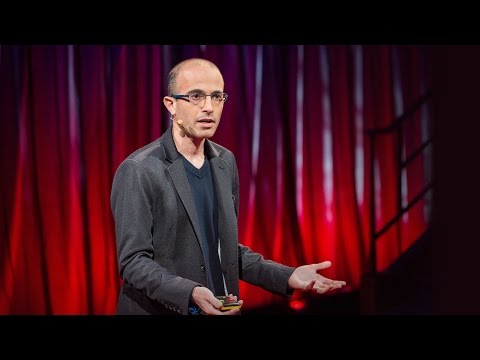
“The real difference between humans and all other animals is not on the individual level; it's on the collective level.”TED talk, 2015 · 1:51
The lesson
Harari’s core claim is that human dominance is not explained by the abilities of individual humans. The key difference appears at the collective level: humans can cooperate both flexibly and in very large numbers, unlike other animals that either scale without flexibility or cooperate flexibly only in small groups123. This is his basic answer to why a relatively weak ape came to run the planet.
The mechanism behind this unusual cooperation is shared imagination. Harari argues that humans can create and believe common stories, and this lets strangers follow the same rules, norms, and goals even when they have never met456. In his framing, this ability took off with the Cognitive Revolution, which made history as we know it possible7.
These stories form a second layer on top of physical reality. Humans still live among rivers, trees, and animals, but they also live inside imagined systems such as nations, gods, money, corporations, laws, and rights8910. Harari’s point is not that these things are meaningless; it is that they exist because many people believe in them together, and that shared belief creates real coordination power.
Money is one of his clearest examples because it allows trust and exchange across huge networks of strangers. Harari presents it as an especially successful shared story, not because the paper or code has intrinsic value, but because people collectively accept it1112. The same logic applies more broadly to legal and moral orders: they shape behavior at scale because societies treat them as authoritative, even though they are not biological facts waiting to be discovered inside the human body1314.
This human superpower is also a source of fragility. If civilization depends on shared stories, then conflict can emerge when groups believe incompatible stories, and modern systems can become brittle because so much rests on trust in abstract institutions15. Harari therefore pushes the question beyond how humans gained power to whether we can create good stories to guide that power responsibly, especially as technology grows stronger1617.
5 principles from Yuval Noah Harari
Look for the collective explanation
When trying to understand human success, do not start with individual intelligence or strength. Start with the unusual human ability to organize many strangers around common rules and goals.
“The real difference between humans and all other animals is not on the individual level; it's on the collective level.”
Treat shared stories as social infrastructure
Institutions work because enough people believe in the same ideas at the same time. To analyze a society, ask which stories make coordination possible and what happens if belief in them weakens.
“We can cooperate flexibly with countless numbers of strangers, because we alone, of all the animals on the planet, can create and believe fictions, fictional stories.”
Distinguish physical reality from imagined order
Some parts of life exist independently of human belief, while others depend on collective agreement. This distinction helps explain why nations, rights, and corporations can be powerful without being biological or physical objects.
“We humans, we also live in an objective reality. In our world, too, there are rivers and trees and lions and elephants. But over the centuries, we have constructed on top of this objective reality a second layer of fictional reality, a reality made of fictional entities, like nations, like gods, like money, like corporations. And what is amazing is that as history unfolded, this fictional reality became more and more powerful so that today, the most powerful forces in the world are these fictional entities.”
See money as trust, not substance
Money matters because people accept it as a medium of cooperation across large networks. This makes it a strong example of how an imagined system can produce real-world coordination.
“Money, in fact, is the most successful story ever invented and told by humans, because it is the only story everybody believes.”
Build stories that can guide power
Science and technology can increase what humans are able to do, but they do not by themselves decide what humans should do. Societies need compelling shared frameworks that can direct growing power toward workable goals.
“Science provides the power; religion tells us what to do with it…”
In his own words
The quotes behind the lesson, word for word from the transcripts. Numbers match the lesson above.
“The real difference between humans and all other animals is not on the individual level; it's on the collective level.”
“Humans control the planet because they are the only animals that can cooperate both flexibly and in very large numbers.”
“Humans are the only animals that can combine the two abilities.”
“We can cooperate flexibly with countless numbers of strangers, because we alone, of all the animals on the planet, can create and believe fictions, fictional stories.”
“What enables us alone, of all the animals, to cooperate in such a way? The answer is our imagination. We can cooperate flexibly with countless numbers of strangers, because we alone, of all the animals on the planet, can create and believe fictions, fictional stories. And as long as everybody believes in the same fiction, everybody obeys and follows the same rules, the same norms, the same values.”
“…the ability to invent and believe fictional stories…”
“…history begins about 70,000 years ago with the Cognitive Revolution…”
“We humans control the world because we live in a dual reality.”
“…we live in a dual reality.”
“We humans, we also live in an objective reality. In our world, too, there are rivers and trees and lions and elephants. But over the centuries, we have constructed on top of this objective reality a second layer of fictional reality, a reality made of fictional entities, like nations, like gods, like money, like corporations. And what is amazing is that as history unfolded, this fictional reality became more and more powerful so that today, the most powerful forces in the world are these fictional entities.”
“Money, in fact, is the most successful story ever invented and told by humans, because it is the only story everybody believes.”
“…money is probably the most successful story ever told…”
“Most legal systems today in the world are based on a belief in human rights. But what are human rights? Human rights, just like God and heaven, are just a story that we've invented. They are not an objective reality; they are not some biological effect about homo sapiens. Take a human being, cut him open, look inside, you will find the heart, the kidneys, neurons, hormones, DNA, but you won't find any rights.”
“…the laws governing our society, they are not eternal…”
“…we are extremely powerful, and we are extremely fragile at one and the same time…”
“Science provides the power; religion tells us what to do with it…”
“…the really big and interesting question is whether we'll be able to produce good stories to match this wonderful technology.”
Reflect
- What shared stories do you rely on every day—at work, in your country, or in your relationships—and how would your behavior change if others stopped believing them?
- Pick one institution you trust, such as money, law, a company, or a university. What collective belief keeps it functioning?
- Where in your life do you confuse an imagined social rule with an objective fact, and what changes when you separate the two?
Check your understanding
Go deeper
 Yuval Noah Harari on Human Cooperation: Why We Run the World2015 · 17 min · full transcript
 Yuval Noah Harari on Human Stories and Cooperation: Sapiens Talk2015 · 79 min · full transcript
 Yuval Noah Harari on Myths and Civilization: Why Stories Hold Societies Together2014 · 87 min · full transcript
 Yuval Noah Harari on Fictional Stories: Civilization Is Fragile2023 · 42 min · full transcript