Observing the Mind
Self-knowledge as protection in an age of manipulation.

The lesson
Harari argues that self-knowledge matters because the struggle over human behavior is becoming more intense. If algorithms can predict and influence your choices before you understand your own reactions, then ignorance about your mind becomes a political and personal vulnerability. That is why he says education should develop emotional intelligence and mental balance, not just technical skill or information recall12.
A central move in his thinking is to distinguish stories from direct experience. He repeatedly warns that much of human life is organized by fictions, and he thinks confusion begins when we mistake stories for reality3. In contrast, he treats consciousness and felt experience as the deepest reality we can study directly, which is why he emphasizes feeling over abstract narratives about meaning45.
This is where meditation, especially Vipassana, enters the picture. Harari presents it as a practice of observing the mind directly rather than turning experience into another story. The point is not to become smarter in the narrow IQ sense, because highly intelligent people can still be strangers to themselves; the point is to notice sensations, thoughts, and reactions clearly enough to understand suffering and its causes65.
For Harari, this inner observation is practical protection. He advises consuming less information and spending more time reflecting, because a flooded attention system is easier to manipulate7. Meditation helped him gain clarity and focus, and he connects that kind of attention to the broader task of knowing what is really happening in the mind instead of being dragged around by distraction, fear, or ready-made narratives8.
The deeper reason this matters is that intelligence alone does not guarantee wisdom or care. Harari sharply separates intelligence from consciousness: problem-solving power is not the same as the ability to feel pain, pleasure, love, or suffering910. So in an age of powerful AI, the human advantage is not just being clever; it is learning to understand experience from the inside, to recognize suffering, and to protect the conscious beings who can feel it—including yourself1112.
5 principles from Yuval Noah Harari
Know your mind before others learn to hack it
Harari’s warning is that systems are becoming better at predicting and shaping behavior. Self-knowledge is a form of defense: if you can see your own impulses and vulnerabilities more clearly, you are less easily manipulated.
“…humans will soon be hackable animals…”
Distinguish stories from direct experience
Harari thinks humans live through stories, but reality is not identical to the stories we tell about it. Practice asking what you are actually feeling and perceiving before building interpretations around it.
“Much of what we take to be real is fictions.”
Study suffering, not just meaning
Instead of getting lost in grand narratives about purpose, Harari recommends starting with the concrete question of suffering. In daily life, this means noticing what produces agitation, craving, fear, or pain in your own experience.
“And then the second question of what is it for, I would reverse it and I would say that I don't think sentience is for anything. I think we don't need to find our role in the universe. The really important thing is to liberate ourselves from suffering. What characterizes sentient beings in contrast to robots, to stones, to whatever, is that sentient beings suffer, can suffer, and what they should focus on is not finding their place in some mysterious cosmic drama. They should focus on understanding what suffering is, what causes it and how to be liberated from it.”
Train focus and reflection
A distracted mind is easier to steer from the outside. Harari’s advice is to reduce information overload and make room for sustained reflection so you can see more clearly what deserves attention.
“And maybe the two most important influences is that first it enabled me to have more clarity and more focus. And certainly when you write about such big subjects like trying to summarize the whole of history in 400 pages. So having a very, very focused mind is very important, because the great difficulty is that everything kind of distracts you. You start writing about the Roman Empire and you say, well, I have to explain this and this and this and this, and you end up with 4,000 pages. So we have to be very-- what is really important, and what can be left outside? And the other thing is that at least the meditation that I practice, which is with passive meditation, it's all about really knowing the difference between the fictions and stories generated by our mind and the reality.”
Do not confuse intelligence with consciousness
Being good at solving problems is not the same as being able to feel. This distinction helps you think more clearly both about your own life and about why AI raises ethical questions that are different from questions about capability.
“…consciousness is far more important and valuable than intelligence.”
In his own words
The quotes behind the lesson, word for word from the transcripts. Numbers match the lesson above.
“…humans will soon be hackable animals…”
“…the most important goals of education in the 21st century are probably to develop your emotional intelligence and your mental balance…”
“Much of what we take to be real is fictions.”
“The ultimate reality is consciousness, is the ability to feel things.”
“To really understand life, life is not a story. The universe does not function like a story. So I think to really understand life, you need to observe it directly in a nonverbal way. Don't turn it into a story. And the question to start with is what is suffering? What is causing suffering? You know, the question, what is the meaning of life? It'll take you to fantasies and delusions. We want to stay with the reality of life. And the most important question about the reality of life is what is suffering and where is it coming from?”
“No, I don't think that knowing yourself is necessarily all about intelligence. Certainly not in the narrow sense of intelligence. If you include emotional intelligence and so forth, then yes. But in the more narrow sense of IQ, I think this is not-- there are many very intelligent people in the world who don't know themselves at all, which is an extremely dangerous combination. Now some people explore themselves through therapy. Some use meditation. Some use art. Some use poems.”
“I would say that people should consume less information and spend more time reflecting…”
“And maybe the two most important influences is that first it enabled me to have more clarity and more focus. And certainly when you write about such big subjects like trying to summarize the whole of history in 400 pages. So having a very, very focused mind is very important, because the great difficulty is that everything kind of distracts you. You start writing about the Roman Empire and you say, well, I have to explain this and this and this and this, and you end up with 4,000 pages. So we have to be very-- what is really important, and what can be left outside? And the other thing is that at least the meditation that I practice, which is with passive meditation, it's all about really knowing the difference between the fictions and stories generated by our mind and the reality.”
“…consciousness is far more important and valuable than intelligence.”
“Absolutely. Intelligence is definitely not something that is directed towards amplifying happiness. I would also emphasize the huge, huge difference between intelligence and consciousness, which many people, certainly in the tech industry and in the AI industry, tend to miss. Intelligence is simply the ability to solve problems, to attain goals, and, you know, to win at chess, to win a struggle for survival, to win a war, to drive a car, to diagnose a disease. This is intelligence. Consciousness is the ability to feel things like pain and pleasure and love and hate.”
“And then the second question of what is it for, I would reverse it and I would say that I don't think sentience is for anything. I think we don't need to find our role in the universe. The really important thing is to liberate ourselves from suffering. What characterizes sentient beings in contrast to robots, to stones, to whatever, is that sentient beings suffer, can suffer, and what they should focus on is not finding their place in some mysterious cosmic drama. They should focus on understanding what suffering is, what causes it and how to be liberated from it.”
“What we need to protect is not the jobs, it's the humans…”
Reflect
- When you feel stressed or pulled toward a decision, what happens first in your direct experience: a body sensation, an emotion, a thought, or a story about what it means?
- Where in your life are you consuming so much information that you have less time to reflect on what you actually feel and value?
- What would it look like to strengthen emotional intelligence or mental balance this month, not in theory but as a daily practice?
Check your understanding
Go deeper
 Yuval Noah Harari on AI and Human Futures: Urgent Warnings2024 · 106 min · full transcript
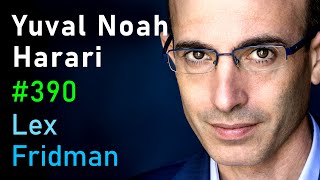 Yuval Noah Harari on AI, Consciousness, and Stories: Human Power, Risk, and Meaning2023 · 165 min · full transcript
 Yuval Noah Harari on AI and the Future: Alien Intelligence2024 · 98 min · full transcript
 Yuval Noah Harari on Future of Education: Learning to Reinvent Yourself2018 · 60 min · full transcript