Global Problems
National politics cannot solve planetary problems alone.
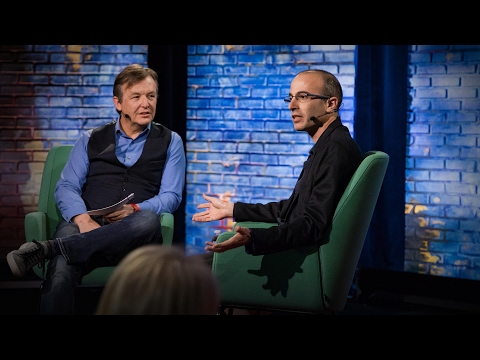
“…we now have global ecology, we have a global economy but we have national politics…”TED Dialogues in New York, 2016 · 5:18
The lesson
Harari’s starting point is that the main political divide today is no longer best understood as left versus right, but as national politics versus the need for global cooperation. His argument is simple: humanity now lives inside systems that already operate across borders, especially ecology and the economy, while political power remains mostly national12. That mismatch leaves countries trying to solve planetary problems with tools designed for smaller, separate worlds.
This matters because many of today’s biggest threats do not stop at borders. Harari points to climate change, pandemics, migration, AI, and bioengineering as problems that no nation can manage alone, however strong it is34. Nationalism can still create solidarity and motivate sacrifice, but by itself it cannot regulate the atmosphere, coordinate disease response, or prevent an AI arms race3.
He also warns that greater connectivity does not automatically produce trust or harmony. Digital networks connect people and countries more tightly, yet they can also intensify fragmentation, manipulation, and inequality56. In Harari’s view, AI sharpens this danger because it can shape language, recommendations, and even intimate relationships, which means the problem is not only technological progress but who governs it and by what shared rules789.
The pandemic made the political stakes visible. Harari argues that COVID-19 was not only a health emergency but a test of trust, coordination, and leadership, and that the absence of a common plan turned a scientific challenge into a broader political and economic crisis41011. His point is not that nations no longer matter, but that cooperation with foreigners is sometimes a condition for protecting your own citizens.
War shows the same tension from another angle. In discussing Ukraine, Harari treats the conflict as larger than one border: when powerful states deny the sovereignty of neighbors, they threaten the basic rules that make international order possible1213. At the same time, he links war back to other global problems, warning that conflict can divert attention and resources away from climate, health, and long-term cooperation, unless societies use crisis to accelerate shared solutions such as reducing dependence on oil and gas14.
4 principles from Yuval Noah Harari
Match governance to the scale of the problem
If a problem crosses borders, national policy alone will be too small for it. Ask whether the issue you are facing is local, national, or global, and support institutions or agreements that operate at the same scale.
“…we now have global ecology, we have a global economy but we have national politics…”
Do not confuse connection with cooperation
Being networked together does not mean people will trust one another or act in common. When systems become more connected, you also need deliberate rules, trust-building, and coordination or fragmentation can grow.
“…connectivity doesn't necessarily mean harmony…”
Regulate AI as a political problem, not just a technical one
Harari’s concern is not only smarter machines but systems that can influence beliefs, decisions, and social order. Treat AI governance as part of protecting democracy, human agency, and international stability.
“We should put a halt to the irresponsible deployment of this alien intelligence into our societies and regulate AI before it regulates us.”
Use crises to strengthen cooperation, not just emergency power
Pandemics and wars expose institutional weakness, but they can also clarify what kinds of coordination are missing. The key question after a shock is whether societies build better common plans or retreat into blame and improvisation.
“There is no global plan of action…”
Moments to watch
In his own words
The quotes behind the lesson, word for word from the transcripts. Numbers match the lesson above.
“…the real divide today is between global and national…”
“…we now have global ecology, we have a global economy but we have national politics…”
“The key question is how do you still create enough social cohesion on a level of a country, and increasingly also on the level of the entire globe in order to tackle our main problems. I mean, we need global cooperation like never before because we are facing unprecedented global problems. We just had Earth Day, and should be obvious to everybody, we cannot deal with the problems of the environment, of climate change, except through global cooperation. Similarly, if you think about the potential disruption caused by new technologies like artificial intelligence, we need to find a mechanism for global cooperation around issues like how to prevent an AI arms-race.”
“There is no global plan of action…”
“…connectivity doesn't necessarily mean harmony…”
“I agree that more people have more voice than ever before, both in the US and globally. I think you're absolutely right. My concern is, to what extent we can trust the voice of people... To what extent I can trust my voice? Like, I'm... We have this picture of the world that I have this voice inside me, which tells me what is right and what is wrong. And the more I'm able to express this voice in the outside world and influence what's happening, the more people can express their voices, it's better, it's more democratic. But what happens if at the same time that more people can express their voices, it's also easier to manipulate your inner voice? To what extent you can really trust that the thought that just popped up in your mind is the result of some free will, and not the result of an extremely powerful algorithm that understands what's happening inside you and knows how to push the buttons and press the levers, and is serving some external entity and it has planted this thought or this desire that you now express?”
“…what does it mean to live in a world in which increasingly, we rely on the recommendations of algorithms…”
“The battlefront is shifting from attention to intimacy, and this is very bad news.”
“We should put a halt to the irresponsible deployment of this alien intelligence into our societies and regulate AI before it regulates us.”
“COVID-nineteen crisis, it's not a health crisis, It's above all a political crisis.”
“…the economic and political consequences could be really catastrophic if we don't get a handle on it.”
“…this is really what is at stake in this war…”
“The borders are sacred because if we start invading neighboring countries because, "Hey, this is part of our countries, these people are part of our nation," there will not be an end to it. And if this now happens in Ukraine, it will be a blueprint for copycats all over the world. The other thing which is different is that we are talking about superpowers. This is not a war between Israel and Hezbollah.”
“This is the hope. That Europe now realizes the danger and starts a green Manhattan Project that kind of accelerates what already has been happening, but accelerates it, the development of better energy sources, better energy infrastructure, which would release it from its dependence on oil and gas. And it will actually undercut the dependence of the whole world on oil and gas. And this would be the best way to undermine the Putin regime and the Putin war machine, because this is what Russia has, oil and gas.”
Reflect
- What problem in your work or community looks local at first, but is actually shaped by global systems such as climate, supply chains, data, or public health?
- Where do you assume that more connection—online, organizational, or international—will naturally create alignment? What extra norms or institutions would real cooperation require?
- How would your views on AI change if you treated it primarily as a governance problem about power, trust, and human agency rather than as a tool problem?
Check your understanding
Go deeper
 Yuval Noah Harari on Nationalism and Global Governance: The New Divide2016 · 60 min · full transcript
 Yuval Noah Harari on Internet and Society: Global Cooperation vs Fragmentation2017 · 94 min · full transcript
 Yuval Noah Harari on Ukraine and Geopolitics: Why This War Matters2022 · 50 min · full transcript
 Yuval Noah Harari on Pandemic, Politics & Society: Making Sense of Crisis2020 · 71 min · full transcript
 Yuval Noah Harari on AI and Humanity: Regulate Before It Regulates Us2022 · 41 min · full transcript
- What did Yuval Noah Harari say about global cooperation and climate change?
- What did Yuval Noah Harari say about the Ukraine war and climate action?
- What did Yuval Noah Harari say about why the war in Ukraine matters globally?
- What did Yuval Noah Harari say about global governance and catastrophe?
- What did Yuval Noah Harari say could happen if Russia keeps attacking Ukraine?