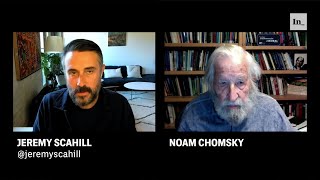
Noam Chomsky on Politics & Government
For Chomsky, democracy is real only when ordinary people can directly shape the institutions that govern their lives, instead of being overruled by concentrated state and corporate power.
- Democracy means meaningful public control, not just elections.
- Concentrated private wealth sharply distorts political life.
- He is skeptical of both state domination and corporate domination.
- A decent society should expand freedom, creative work, and participation.
- Grassroots organization is the main way to resist democratic decline.
Democracy means people controlling the conditions of their own lives
Chomsky’s basic standard is demanding: a society is democratic to the extent that people actually govern the institutions that affect them. That includes political institutions, but it also reaches into workplaces and other centers of authority. He points toward decentralized, federated forms of association as the democratic ideal rather than passive spectatorship.123
This view grows out of his picture of human beings as creative and self-directing. If people are, by nature, driven to inquire, create, and develop, then democracy cannot just mean choosing rulers every few years; it should create room for active participation and self-government. A good society therefore tries to maximize freedom, creative work, and participation.456
Capitalist democracy is narrow because wealth buys power
Chomsky repeatedly argues that modern democracies operate within tight limits when economic power is highly concentrated. In the United States, he says power is increasingly held by a narrow sector of corporate and private wealth, which means formal democratic procedures coexist with deep inequalities of influence. That turns democracy into something biased toward those who already own and manage major institutions.78
He extends the same point to policy design. Trade deals, for example, are described not as neutral market arrangements but as investor-rights systems written with heavy input from corporate lawyers and lobbyists rather than the public. More broadly, he treats rising inequality as a democratic problem because it converts economic concentration into policy capture.910
The main enemies of democracy are concentrated private power and unaccountable state power
Chomsky does not think the problem is only the state or only corporations. He criticizes the state as a deeply anti-human institution when it stands over people and rules them from above, but he is equally hostile to private hierarchies that dominate working life and politics. His preferred direction is neither state socialism nor corporate capitalism, both of which he sees as systems of elite rule.1112
That is why he often describes capitalism and democracy as fundamentally in tension. For him, private control over production creates authoritarian habits and centralized control that spill over into public life. If people spend much of their lives under autocratic institutions, democracy in the wider society becomes thinner and more passive.813
Democratic decline helps explain anger, demagoguery, and political breakdown
Chomsky reads contemporary political anger as a response to decades of stagnation, weakened unions, and declining public influence. When people see establishment politics serving investors and billionaires while ordinary life becomes more insecure, distrust grows and political life becomes vulnerable to manipulation. That helps explain why disillusionment can produce either constructive reform movements or ugly forms of reaction.14
He also warns that demagogues thrive when democratic institutions are hollowed out. A cultivated demagogue can redirect fear and resentment instead of addressing the underlying concentration of wealth and power, and a charismatic figure could push a damaged democracy into something worse. In that sense, protecting democracy requires rebuilding popular power, not only defeating individual personalities.1516
Democracy matters because the biggest human dangers demand public control
For Chomsky, democracy is not just a moral ideal; it is a practical necessity because elite-driven systems mishandle the gravest threats. He repeatedly says the overriding dangers are nuclear war and environmental catastrophe, and he judges politics by whether institutions are capable of responding to them seriously. If public attention is diverted into spectacle while these threats worsen, democratic failure becomes literally civilizational.171819
That is one reason he emphasizes concrete public-interest policy over distraction. He criticizes attacks on health care, environmental protections, diplomacy, labor, and education because these are areas where democratic institutions should serve ordinary people. He also stresses coalition-building and grassroots action as the way real gains are made.2021
Chomsky on politics & government, in his own words
“…the state is a profoundly anti-human institution…”
Where to watch
 Noam Chomsky on Libertarian Socialism: The State and Freedom1970 · 57 min · full transcriptBest single statement of why Chomsky thinks real democracy must limit both state and private domination.
 Noam Chomsky on Human Nature: Creativity, Justice, and Power1971 · 70 min · full transcriptShows how his democratic politics grows out of his view of human creativity, freedom, and participation.
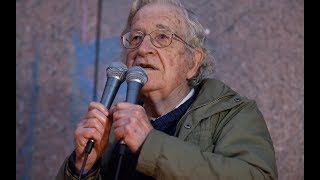 Noam Chomsky on Inequality and Democracy: Trump, Sanders, and Power2017 · 41 min · full transcriptConnects inequality, elite policy capture, and public anger to the weakening of democracy.
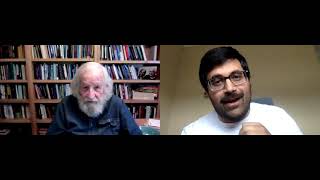 Noam Chomsky on Neoliberalism and Democracy: Power, Reform, and Decline2021 · 65 min · full transcriptExplains how neoliberalism weakened labor, education, and democratic institutions, and why organizing still matters.
 Noam Chomsky on War, Democracy, and Climate: Can We Choose?2020 · 110 min · full transcriptPlaces democracy in the context of war, climate, labor repression, and long-term institutional decline.
 Noam Chomsky on Trump, Democracy, and Nuclear Risk2017 · 72 min · full transcriptApplies his democratic critique to the Trump era and to policy agendas hidden by political spectacle.
Questions people ask
- What did Noam Chomsky say about TTIP and free trade agreements?
- What did Noam Chomsky say about capitalism and democracy?
- What did Noam Chomsky say about intellectual self-defense in education?
- What did Noam Chomsky say about libertarian socialism?
- What did Noam Chomsky say about the Trump administration and wealth in politics?
- What did Noam Chomsky say about the risk of fascism in the United States?
Sources
Every quote above, word for word from the transcripts. Numbers match the text.
“…a federated, decentralized system of free associations…”
“Now a federated, decentralized system of free associations, incorporating economic as well as social institutions, would be what I refer to as anarcho-syndicalism; and it seems to me that this is the appropriate form of social organization for an advanced technological society, in which human beings do not have to be forced into the position of tools, of cogs in the machine. In which the creative urge that I think is intrinsic to human nature, will in fact be able to realize itself in whatever way it will. I don't know all the ways in which it will.”
“Recognize a great deal of spontaneous democratic structure of a sort which never existed in Asia before, and if you want to know the truth, to some extent doesn't even exist in our society now. These things exist side by side. If you read a day in the life of Deneich, you find out that there's an extraordinary democratic structure even inside concentration camps. But it seems to—it's almost profane to make this observation. I think it's profane to make that analogy because I'm talking about true democracy in which, I think, people—the peasants who live in a village control the institutions of their lives. They control the... the organization.”
“…a fundamental element of human nature is the need for creative work…”
“…man is in his essence a free, searching, self-perfecting being…”
“…man is born to inquire and create…”
“…power is overwhelmingly and increasingly, in recent years, in the hands of a very narrow sector of corporate wealth, private wealth and power…”
“Thing: in short, the democratic system at best functions within a very narrow range in a capitalist democracy, and even within this narrow range its functioning is enormously biased by the concentrations of private power and by the authoritarian and passive modes of thinking that are induced by autocratic institutions such as industries, for example. It's a truism, but one that must be constantly stressed that capitalism and democracy are ultimately quite incompatible, and a careful look at the matter, I think, merely strengthens this conclusion. There are perfectly obvious processes of centralization of control taking place in both the political and the industrial system.”
“The so-called free trade agreements are not free trade agreements. In fact to a large extent they’re not even trade agreements. These are investor right agreements. There’s a reason why they’re kept secret from the public and as soon as you look them you see why. Notice I say secret from the public, not secret. They’re not kept secret, they’re not secret to the corporate lawyers and lobbyists who are writing the detailed regulations. Of course in the interests of their constituents, doesn’t happen to be the public of the world or their own countries. So these are highly protectionist for the benefit of private power, so-called intellectual property rights, effectively raise tariffs.”
“They’re designed for the benefit of investors.”
“…the state is a profoundly anti-human institution…”
“I'd like to make clear my own point of view in advance so you can evaluate and judge what I'm saying. I think that the libertarian socialist concepts, and by that I mean a range of thinking that extends from left-wing Marxism through anarchism, I think that these are fundamentally correct and that they are the proper and natural extension of classical liberalism into the era of advanced industrial society. In contrast, it seems to me that the ideology of state socialism—that is what has become of Bolshevism—and of state capitalism, the modern welfare state, these of course are dominant in the industrial countries and the industrial societies, but I believe that they are regressive and highly inadequate social.”
“The worker will remain a fragment of a human being…”
“It's set now. The Trump Administration is kind of a caricature of this. It's, uh, it's always pretty much true, but here they’re—it’s as if they’re kind of purposely trying to flaunt the fact that this country is run by, uh, Goldman Sachs and billionaires and nobody else counts. W.R. Ross, Betsy DeVos, all of them. I mean, it’s, it’s almost like a shocking parody, as if they’re trying to show the what we all know is true is dramatically true, and we’re going to show it to you. Uh, the interesting—an interesting question, the one you raise, is how are they maintaining support among—…”
“It takes a very cultivated demagogue to carry that off.”
“Fascism, but it's not to be dismissed, and I think we can easily see how, if there had been a charismatic figure in the United States who could mobilize fears, anger, racism, a sense of loss of the future that belongs to us, this country could be in real danger. We're lucky that there never has been an honest charismatic figure. McCarthy was too much of a thug, you know; Nixon…”
“The greatest danger is – there are two huge dangers that the human species faces.”
“Everything else fades into insignificance in comparison to them.”
“There are two huge problems: one is the growing threat of nuclear war…”
“The U.S. health care system is an international scandal.”
“If you want intellectual self-defense, that means teaching people how to think, how to think for themselves, not pass a test. I don't care if you pass a test or not. I mean, in a serious scientific university like MIT, nobody cares about test scores.”
How this guide was made: drafted with AI from the full transcripts of the recordings cited, then checked: every quotation must match a transcript word for word and be the speaker's own words, and an independent review gates accuracy. Methodology and corrections.