Noam Chomsky on Media & Journalism
Chomsky argues that mainstream journalism is not neutral in any deep sense: it often contains real reporting, but its routines, ownership, sourcing, and editorial choices tend to align coverage with state and corporate power rather than independent public understanding.
- He rejects the idea that mainstream journalism is simply neutral or independent.
- What gets called objectivity often means staying inside elite assumptions and excluding unacceptable facts or options.
- He still treats major media as necessary to read, but critically and defensively.
- Journalists and intellectuals should expose lies and hidden power, not repeat official narratives.
- War coverage is a prime case where media narrow debate and make escalation look natural while sidelining diplomacy.

“…they are simply major corporations, parts of even larger conglomerates.”TV interviews and public lectures, 1991 · 2:53
Journalism is not neutral when its institutions are tied to power
Chomsky’s basic view is that mainstream journalism does not operate as a detached public mirror. In his account, large news organizations are businesses embedded in wider systems of wealth and authority, so their output is shaped before any individual reporter sits down to write. That is why he stresses that media outlets are major corporations within even larger conglomerates, and why he connects media performance to broader systems of propaganda and social control.12
This does not mean every story is fabricated or every journalist is cynical. It means the institution has built-in pressures that narrow what counts as serious, respectable, or newsworthy. For Chomsky, journalism often helps manage public opinion in ways compatible with state and corporate interests, especially in times of war and crisis.21
“…they are simply major corporations, parts of even larger conglomerates.”TV interviews and public lectures, 1991 · full transcript →
What passes for objectivity often hides selection, omission, and ideology
Chomsky’s critique of objectivity is not mainly that journalists openly lie. It is that the strongest bias often appears in what is left out, what assumptions are treated as obvious, and which frameworks are presented as natural. He points to cases where views outside official doctrine are unlikely to appear at all, which means audiences receive a filtered picture while still being told they are seeing balanced reporting.34
In war coverage, this becomes especially stark. He argues that television news during the Gulf War largely excluded the possibility of a political settlement, so military action appeared to be the only realistic path. If peaceful alternatives are removed in advance, objectivity becomes a style of presentation rather than a genuine openness to relevant facts and options.5
He makes a similar point about Middle East coverage, where official narratives of self-defense dominated while contrary evidence and diplomatic openings were pushed aside. In that setting, the problem is not only slant in language but the structured invisibility of facts that would challenge elite policy.36
The clearest test is war reporting, where diplomacy disappears
For Chomsky, journalism reveals its deepest biases when states are mobilizing for conflict. In those moments, media often elevate patriotic framing, moral drama, and enemy images while marginalizing negotiations or compromise. His repeated point is that the public is guided toward accepting escalation because alternatives are not given equal standing.785
In discussion of Ukraine, he argues that the urgent question should be how to prevent further destruction, which requires movement toward settlement. Yet he says public debate was steered away from that priority and toward a posture that normalized prolonged war. In his view, when coverage suppresses serious diplomatic possibilities and rewards only hard-line positions, journalism is no longer informing the public objectively.97810
The same pattern appears in his earlier work on the Gulf War and the Middle East: diplomacy is made to seem naïve or irrelevant, while force is treated as realism. That framing is powerful because it does not always announce itself as propaganda; it often arrives as common sense.53
Chomsky does not say ignore mainstream media; he says read it critically
A common misunderstanding is that Chomsky wants people to dismiss established news outright. He says almost the opposite. He starts with the national press every morning and says anyone who wants to understand the world has to begin with major media.1112
But beginning there is not the same as trusting it at face value. His advice is to read defensively: pay attention to what is emphasized, what is missing, whose assumptions frame the story, and which voices are treated as authoritative. Mainstream coverage matters because it reveals both events and the boundaries that power tries to impose on public thought.412
So his standard is neither gullibility nor blanket dismissal. It is disciplined skepticism. Major outlets are indispensable precisely because they show what dominant institutions want seen, and that makes them useful if you know how to interrogate them.11124
Real journalistic responsibility is to expose lies, not launder authority
Chomsky’s positive ideal of journalism is demanding. He thinks people with access to information have a duty to tell the truth and expose lies, especially when governments conceal violence behind noble rhetoric. That is the standard he also applies to intellectuals more broadly.1314
He is sharply critical of expert culture when expertise becomes a shield for conformity. If experts and journalists merely translate official claims into respectable language, they are not serving the public; they are protecting power from scrutiny. That is why he attacks the cult of experts and the narrowing of acceptable criticism.1516
This is also why he defends adversarial journalism that reveals what authorities want hidden. On his view, the job is not to stand above conflict in a pose of neutrality, but to investigate seriously enough that deception becomes harder to sustain.1317
Chomsky on media & journalism, in his own words
“…they are simply major corporations, parts of even larger conglomerates.”
“You can, if you want to understand what's going on in the world, you have to start with the major media.”
Where to watch
 Noam Chomsky on TV News and War: Gulf War Media Critique1991 · 29 min · full transcriptBest short statement of his view that TV news can look objective while filtering out diplomacy and reproducing corporate-state priorities.
 Noam Chomsky on Russia-Ukraine War: Diplomacy or Disaster2022 · 163 min · full transcriptShows his most balanced formulation: major media matter, but they must be read critically because editorial systems shape what appears.
 Noam Chomsky on Media Propaganda: Manufacturing Consent and Power1989 · 154 min · full transcriptThe fullest overview of his propaganda model and why media institutions tend to manufacture consent rather than simply inform.
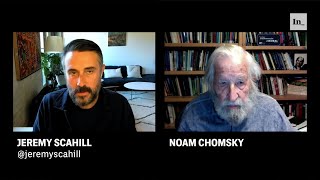 Noam Chomsky on the Russia-Ukraine War: Negotiation or Escalation2022 · 62 min · full transcriptApplies his media critique to a current war, focusing on how coverage sidelines negotiation and rewards escalation.
 Noam Chomsky on Responsibility of Intellectuals: Truth vs Power1988 · 64 min · full transcriptExplains the ethical standard behind his critique: the duty to expose lies and resist respectable apologetics for power.
Questions people ask
- What did Noam Chomsky say about Julian Assange and journalism?
- What did Noam Chomsky say about the U.S. policy toward negotiations in Ukraine?
- What did Noam Chomsky say about Russian media today?
- What did Noam Chomsky say about being accused of moral equivalence or whataboutism?
- What did Noam Chomsky say about how the media and propaganda work in a free society?
- What did Noam Chomsky say about why the UN was once praised by the media?
Sources
Every quote above, word for word from the transcripts. Numbers match the text.
“…they are simply major corporations, parts of even larger conglomerates.”
“It's an enemy. It's a domestic enemy, and you got to keep it under control, and you have to make sure that the mysteries are not revealed, uh, so that the people don't become so curious and arrogant that they refuse to submit to a civil rule, to put it in 17th-century terms, and to control that domestic enemy. Propaganda and fabrications and so on are, uh, important, and that's what the public relations industry is for, for corporate purposes, uh, and what, uh, what the media are for if they properly serve the state. Well, that's, uh, notice again we have a view that says the media should not function the way the standard rhetoric claims. There's also an academic twist to this.”
“Anything inconsistent with that official doctrine is very unlikely to see the light of day in the United States.”
“You have to read it defensively.”
“The possibility that there might be a political, peaceful political settlement was not even an option.”
“…the right of massacre and aggression…”
“The primary need to move towards a negotiated settlement…”
“Let’s fight to the last Ukrainian.”
“What is the best thing to do to save Ukraine from a grim fate, from further destruction?”
“That's the meaning of diplomacy.”
“The first thing I do in the morning is read the national press.”
“You can, if you want to understand what's going on in the world, you have to start with the major media.”
“…the responsibility of intellectuals to speak the truth and to expose lies…”
“American aggressiveness, however it may be masked in pious rhetoric, is a dominant force in world affairs…”
“…the cult of the experts is both self-serving for those who propound it and fraudulent…”
“You go to 1981: U.N. ambassador Jeane Kirkpatrick devises the notion of moral equivalence. She said: If you dare to criticize the United States, you’re guilty of moral equivalence. You’re saying we’re just like Stalin and Hitler. So you can’t talk about the United States. There’s another term that’s used now. It’s: whataboutism. If you talk about what the U.S. is doing right now, it’s whataboutism, you can’t do that. You’ve got to adhere firmly to the party line, strictly to the party line.”
“As always has been the case. We have a dramatic example of it right in front of us: Julian Assange. A perfect example of a journalist who did the job of providing the public with information that the government wants suppressed. Information, some of it about U.S. crimes but other things. So he’s been subjected to years of torture — torture — that’s the U.N. Repertory torture decision, now being held in a high-security prison, subjected to the possibility of extradition to the United States where he’ll be severely punished for daring to do what a journalist is supposed to do.”
How this guide was made: drafted with AI from the full transcripts of the recordings cited, then checked: every quotation must match a transcript word for word and be the speaker's own words, and an independent review gates accuracy. Methodology and corrections.