Noam Chomsky on Media & Propaganda
Chomsky argues that manufacturing consent is the routine shaping of public opinion by media, elites, and institutions so that power’s preferred policies appear natural, moral, and unavoidable.
- Media do not just inform; they filter reality in ways that often serve state and corporate power.
- This matters most in war, when diplomacy and history are pushed aside and force is made to seem like the only option.
- Manufacturing consent works through selection, framing, and exclusion more than outright invention.
- Chomsky does not say to ignore major media; he says to read them critically and defensively.
- Intellectuals and journalists have a duty to expose lies rather than repeat official doctrine.

Manufacturing consent means managing the public, not informing it freely
Chomsky’s basic claim is that modern media in nominally free societies often work less as neutral informers than as systems for managing opinion. In his view, powerful institutions see the public as something to be guided, contained, and kept from challenging elite rule, so propaganda and public relations become normal tools of governance.
That is why he treats manufacturing consent as a structural feature, not just a matter of a few dishonest reporters. He argues that media are expected to serve dominant power when they function “properly,” especially when the stakes are high politically or economically.
The mechanism is filtering: what gets highlighted, what gets buried, and what disappears
Chomsky’s point is not simply that the press prints falsehoods. More often, consent is manufactured by narrowing the field of acceptable thought: some facts are repeated constantly, while other facts, contexts, or proposals become hard to see at all23.
He ties that filtering to institutional pressures. Large media organizations are corporations embedded in larger concentrations of wealth and power, and that shapes what counts as responsible coverage, credible sourcing, and legitimate debate4.
This is why he urges readers to begin with major media but not stop there. If you want to know what the public is being told, you read the national press; if you want to understand reality, you read it critically, paying attention to omissions, assumptions, and the boundaries placed on discussion563.
“You have to read it defensively.”TV interviews and public lectures, 1991 · full transcript →
War is where manufactured consent becomes easiest to see
Chomsky returns again and again to wartime because he thinks crises expose the system clearly. Under war conditions, public feeling is mobilized, enemies are simplified, and the space for negotiation or historical context shrinks dramatically7.
In his Gulf War critique, he argues that peaceful settlement was effectively removed from public consideration, which made military action appear inevitable. Once diplomacy is excluded from the frame, the public is left choosing only among forms of force9.
He makes the same point about Ukraine, arguing that the urgent question should be how to save Ukraine from further destruction and move toward settlement. Instead, he says public discourse is pushed toward escalation, with negotiation marginalized or treated as weakness10111213.
“The possibility that there might be a political, peaceful political settlement was not even an option.”TV interviews and public lectures, 1991 · full transcript →
Official enemies and official allies are covered by different rules
A core part of Chomsky’s view is that media framing changes depending on who is committing violence and whether that actor is aligned with U.S. power. Actions by enemies are foregrounded as crimes; similar or worse actions by allies are softened, justified, or hidden behind moral language1415.
He illustrates this with the Middle East, where he argues that coverage repeatedly normalized Israeli force as self-defense while sidelining diplomatic initiatives that cut against official doctrine. In his view, ideas inconsistent with the approved line often remain invisible to the American public162.
He also points to institutions like the UN to show how legitimacy is reported selectively. Praise rises when outcomes align with U.S. preferences and fades when independent international opinion becomes inconvenient.

“Anything inconsistent with that official doctrine is very unlikely to see the light of day in the United States.”Berkeley lecture on the Middle East, 1984 · full transcript →
The answer is not cynicism but disciplined criticism
Chomsky’s conclusion is not that all journalism is worthless or that every claim is fake. He explicitly starts with major media because they matter, but he insists they must be read against the grain, with attention to interests, silences, and the way authority is constructed63.
He places special responsibility on intellectuals and journalists because they have unusual access and freedom. Their task is to expose lies and challenge state and elite narratives, not launder them through expertise or respectable rhetoric1819.
That is also why he defends those who reveal suppressed information and criticizes punishments aimed at warning others off. For him, manufacturing consent persists when truth-telling is stigmatized, excluded, or punished while conformity is rewarded20.

“…the responsibility of intellectuals to speak the truth and to expose lies…”University/public lecture, 1988 · full transcript →
Chomsky on media & propaganda, in his own words
“The possibility that there might be a political, peaceful political settlement was not even an option.”
“You have to read it defensively.”
“…the responsibility of intellectuals to speak the truth and to expose lies…”
“Anything inconsistent with that official doctrine is very unlikely to see the light of day in the United States.”
“The primary need to move towards a negotiated settlement…”
Where to watch
 Noam Chomsky on Media Propaganda: Manufacturing Consent and Power1989 · 154 min · full transcriptHis fullest statement of manufacturing consent as a theory of media, propaganda, elite control, and democratic myth.
 Noam Chomsky on TV News and War: Gulf War Media Critique1991 · 29 min · full transcriptA compact case study of how war coverage filters out diplomacy and makes force look inevitable.
 Noam Chomsky on Russia-Ukraine War: Diplomacy or Disaster2022 · 163 min · full transcriptShows how Chomsky reads major media critically without collapsing into blanket distrust.
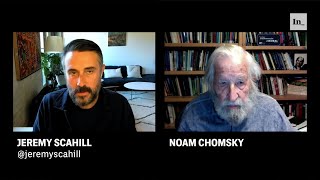 Noam Chomsky on the Russia-Ukraine War: Negotiation or Escalation2022 · 62 min · full transcriptApplies the framework to Ukraine, especially the suppression of negotiation in favor of escalation.
 Noam Chomsky on Middle East Policy: U.S.-Israel and the Peace Movement1984 · 163 min · full transcriptA long historical example of differential media treatment of allies, violence, and peace proposals.
 Noam Chomsky on Responsibility of Intellectuals: Truth vs Power1988 · 64 min · full transcriptExplains why intellectuals and journalists matter in resisting manufactured consent.
Questions people ask
- What did Noam Chomsky say about Julian Assange and journalism?
- What did Noam Chomsky say about the U.S. policy toward negotiations in Ukraine?
- What did Noam Chomsky say about Russian media today?
- What did Noam Chomsky say about being accused of moral equivalence or whataboutism?
- What did Noam Chomsky say about U.S. officials inventing enemies?
- What did Noam Chomsky say about why the UN was once praised by the media?
Sources
Every quote above, word for word from the transcripts. Numbers match the text.
“Anything inconsistent with that official doctrine is very unlikely to see the light of day in the United States.”
“You have to read it defensively.”
“…they are simply major corporations, parts of even larger conglomerates.”
“The first thing I do in the morning is read the national press.”
“You can, if you want to understand what's going on in the world, you have to start with the major media.”
“…the only thing in mind is to destroy the enemy…”
“The possibility that there might be a political, peaceful political settlement was not even an option.”
“What is the best thing to do to save Ukraine from a grim fate, from further destruction?”
“The primary need to move towards a negotiated settlement…”
“Let’s fight to the last Ukrainian.”
“That's the meaning of diplomacy.”
“American aggressiveness, however it may be masked in pious rhetoric, is a dominant force in world affairs…”
“…the right of massacre and aggression…”
“This is not the moment for sermons to Israel.”
“…the responsibility of intellectuals to speak the truth and to expose lies…”
“…the cult of the experts is both self-serving for those who propound it and fraudulent…”
“As always has been the case. We have a dramatic example of it right in front of us: Julian Assange. A perfect example of a journalist who did the job of providing the public with information that the government wants suppressed. Information, some of it about U.S. crimes but other things. So he’s been subjected to years of torture — torture — that’s the U.N. Repertory torture decision, now being held in a high-security prison, subjected to the possibility of extradition to the United States where he’ll be severely punished for daring to do what a journalist is supposed to do.”
How this guide was made: drafted with AI from the full transcripts of the recordings cited, then checked: every quotation must match a transcript word for word and be the speaker's own words, and an independent review gates accuracy. Methodology and corrections.


