Noam Chomsky on Ukraine War
Chomsky sees the Ukraine war as a criminal Russian invasion that should be ended through negotiation, not prolonged through escalation that destroys Ukraine and heightens great-power and nuclear risk.
- Russia’s invasion is criminal, but the urgent question is how to end the war
- He argues negotiation is the best way to save Ukraine from further destruction
- He says U.S. and NATO policy has often sidelined diplomacy in favor of weakening Russia
- He links the war’s origins to NATO expansion and long-running Russian security conflict, without excusing the invasion
- He warns that escalation could widen into a great-power or nuclear catastrophe
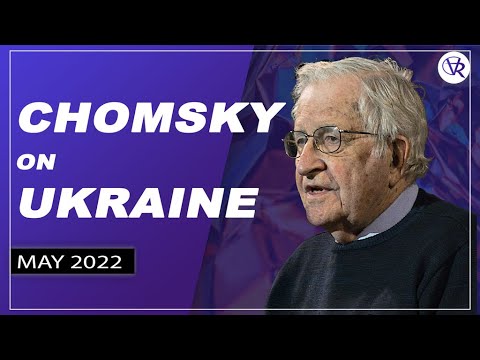
“The most important question is how to end it. It's a horrible criminal aggression, causing enormous atrocities, great dangers, and prospective dangers even up to nuclear war. So the main question is how to put it to an end. Well, there are two ways. One way is through a diplomatic settlement. If you don't want a diplomatic settlement, the second way is let them fight it out, and we'll see what happens. Horrible experiment. So if possible, we would like to pursue a diplomatic…”Online interview, 2022 · 2:11
Chomsky starts with a moral and practical distinction: condemn the invasion, then ask how to stop the war
Chomsky does not treat Russia’s invasion as justified or ambiguous. He calls aggression blameworthy in itself and places the invasion alongside other major acts of international aggression, so his view is not that the war is acceptable because it was provoked12.
But he insists that condemnation is not enough. The central political question, in his view, is how to end the war before more Ukrainians die and before the conflict creates even greater dangers, including the danger of nuclear war345.
“The most important question is how to end it. It's a horrible criminal aggression, causing enormous atrocities, great dangers, and prospective dangers even up to nuclear war. So the main question is how to put it to an end. Well, there are two ways. One way is through a diplomatic settlement. If you don't want a diplomatic settlement, the second way is let them fight it out, and we'll see what happens. Horrible experiment. So if possible, we would like to pursue a diplomatic…”Online interview, 2022 · full transcript →
His main answer is negotiation, because he thinks saving Ukraine matters more than punishing Russia through a long war
Chomsky repeatedly frames the war around one practical question: what course best saves Ukraine from further destruction. His answer is movement toward a negotiated settlement rather than an open-ended military strategy that keeps the fighting going67.
He argues that a politics of heroic resistance can become a politics of sacrificing Ukraine. That is why he warns against an approach that effectively means continuing the war regardless of the damage to Ukrainians, and he says possible diplomatic openings should be explored seriously89.
For him, diplomacy does not mean getting everything one side wants. It means accepting compromise to avoid starvation, devastation, and wider war, which he treats as the basic purpose of diplomacy in the first place10.

“What is the best thing to do to save Ukraine from a grim fate, from further destruction?”The Intercept interview, 2022 · full transcript →
He thinks U.S. policy has often blocked diplomacy and preferred a war that weakens Russia
A major part of Chomsky’s argument is that Washington did not simply respond to events after the invasion. He says U.S. policy before the invasion moved against negotiations by backing Ukraine’s path toward NATO, increasing weapons flows, military training, and joint exercises in ways that made a settlement less likely11.
After the invasion, he says the logic remained similar: the war was increasingly treated as a chance to weaken Russia. In that framework, Ukrainian suffering becomes secondary to strategic goals, which is why he says what happens to Ukrainians is treated as incidental and quotes the effective attitude as fighting to the last Ukrainian128.
He extends that claim further by calling the war a proxy conflict in the eyes of much of the world, fought over Ukrainian bodies while the United States sees strategic advantage in Russia’s degradation131415.

“The world, most of the world sees this as a proxy war between Russia and the United States fought over Ukrainian bodies…”Podcast discussion, 2022 · full transcript →
He traces the war’s background to NATO expansion and post-Cold War choices, without excusing Putin
Chomsky argues that understanding the war requires looking at structures and state behavior, not guessing about Putin’s psychology. He says he has no special access to Putin’s mind and prefers to judge motives by actions, stated objectives, and the long-run strategic setting1617.
In that setting, he points to post-Soviet choices by the United States and NATO, especially eastward expansion and the failure to build a more cooperative European order. He argues these choices were provocative and helped create the conditions in which the conflict intensified around Ukraine1819.
Still, provocation is not exoneration in his view. He insists both ideas can be true at once: the invasion was provoked by policy choices, and Russia is still responsible for carrying out criminal aggression1912.

“Any power that commits aggression is to blame.”Lex Fridman Podcast clip, 2022 · full transcript →
He warns that escalation, propaganda, and militant rhetoric make a bad war more dangerous
Chomsky sees the biggest risk not only in battlefield destruction but in the possibility of wider great-power conflict. He repeatedly connects Ukraine to the broader threat of nuclear war and treats that danger as one of the overriding facts that should discipline policy521.
That is why he is sharply critical of language and media framing that narrow debate to destroying the enemy while sidelining negotiation. He argues that militant rhetoric in the United States has been stronger than the rhetoric pushing diplomacy, and he sees public discussion as shaped in ways that reward escalation222324.
His broader point is that in wartime, propaganda can make the hardest question disappear. Instead of asking what outcome reduces destruction and existential risk, politics gets pushed toward emotional identification, moral absolutism, and the suppression of compromise26.

“There are two huge problems: one is the growing threat of nuclear war…”C-SPAN Book TV In Depth interview, 2020 · full transcript →
Chomsky on ukraine war, in his own words
“The most important question is how to end it.”
“What is the best thing to do to save Ukraine from a grim fate, from further destruction?”
“The world, most of the world sees this as a proxy war between Russia and the United States fought over Ukrainian bodies…”
“The war must continue in order to severely weaken Russia.”
“Well, who's to blame? Any power that commits aggression is to blame. So I continue to say, as I have been for many months, that the invasion, Putin's invasion of Ukraine, is on a par with such acts of aggression as the U.S. invasion of Iraq, the Stalin-Hitler invasion of Poland, other acts of supreme international crime under international law, aggression. Of course, he's to blame. You…”
Where to watch
 Noam Chomsky on the Russia-Ukraine War: Negotiation or Escalation2022 · 62 min · full transcriptBest single overview of why he puts negotiation ahead of escalation and how he thinks debate on Ukraine has been narrowed.
 Noam Chomsky on the Ukraine War: Diplomacy or Escalation?2022 · 49 min · full transcriptMost direct statement of his core question: how to end the war, plus his outline of a possible settlement.
 Noam Chomsky on Ukraine War Escalation: The Danger of Great-Power Conflict2022 · 18 min · full transcriptBest for his argument that the war became a proxy conflict and that Western policy aimed at weakening Russia.
 Noam Chomsky on Russia and Ukraine: Power, NATO, and War2022 · 14 min · full transcriptBest short explanation of how he connects the war to NATO expansion and post-Cold War strategy.
 Noam Chomsky on Russia-Ukraine War: Diplomacy or Disaster2022 · 163 min · full transcriptUseful for his wider view of diplomacy, media selection, and why compromise still matters in war.
Questions people ask
- What did Noam Chomsky say about the U.S. policy toward negotiations in Ukraine?
- What did Noam Chomsky say about who is to blame for the invasion of Ukraine?
- What did Noam Chomsky say is the most important question in the Ukraine war?
- What did Noam Chomsky say about Russian media today?
- What did Noam Chomsky say about being accused of moral equivalence or whataboutism?
- What did Noam Chomsky say about the Russia-Ukraine crisis and NATO expansion?
Sources
Every quote above, word for word from the transcripts. Numbers match the text.
“Any power that commits aggression is to blame.”
“Well, who's to blame? Any power that commits aggression is to blame. So I continue to say, as I have been for many months, that the invasion, Putin's invasion of Ukraine, is on a par with such acts of aggression as the U.S. invasion of Iraq, the Stalin-Hitler invasion of Poland, other acts of supreme international crime under international law, aggression. Of course, he's to blame. You…”
“The most important question is how to end it.”
“The most important question is how to end it. It's a horrible criminal aggression, causing enormous atrocities, great dangers, and prospective dangers even up to nuclear war. So the main question is how to put it to an end. Well, there are two ways. One way is through a diplomatic settlement. If you don't want a diplomatic settlement, the second way is let them fight it out, and we'll see what happens. Horrible experiment. So if possible, we would like to pursue a diplomatic…”
“There are two huge problems: one is the growing threat of nuclear war…”
“What is the best thing to do to save Ukraine from a grim fate, from further destruction?”
“The primary need to move towards a negotiated settlement…”
“Let’s fight to the last Ukrainian.”
“We should see, explore the possibilities for it.”
“That's the meaning of diplomacy.”
“We can, however, look at the United States and we can see that our explicit policy — explicit — is rejection of any form of negotiations. The explicit policy goes way back, but it was given a definitive form in September 2021 in the September 1 joint policy statement that was then reiterated and expanded in the November 10 charter of agreement. And if you look at what it says, it basically says no negotiations. What it says is it calls for Ukraine to move towards what they called an enhanced program for entering NATO, which kills negotiations; — this is before the invasion notice — an increase in the dispatch of advanced weapons to Ukraine, more military training, the joint military exercises, weapons placed on the border.”
“What happens to Ukrainians is incidental.”
“The world, most of the world sees this as a proxy war between Russia and the United States fought over Ukrainian bodies…”
“It's a bargain for the United States…”
“The war must continue in order to severely weaken Russia.”
“I have no particular insight into Putin's mind.”
“…what motivates him is what has been demonstrated in his actions…”
“The United States had no interest in that.”
“…the invasion of Ukraine was demonstrably provoked…”
“Everything else fades into insignificance in comparison to them.”
“…the only thing in mind is to destroy the enemy…”
“…the United States is full of militant talk…”
“Europe is trying to move towards some form of negotiations, diplomacy…”
“…language basically as a system of thought…”
How this guide was made: drafted with AI from the full transcripts of the recordings cited, then checked: every quotation must match a transcript word for word and be the speaker's own words, and an independent review gates accuracy. Methodology and corrections.


