Noam Chomsky on the Ukraine War: Diplomacy or Escalation?

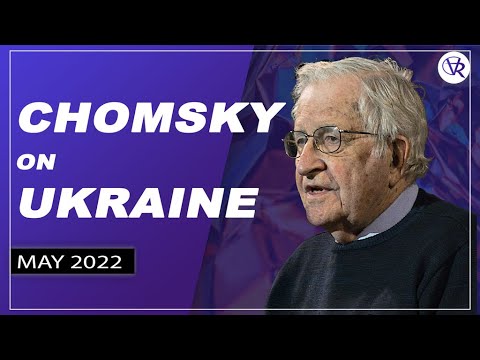
What Chomsky talks about
Noam Chomsky gave this online interview in 2022 about the Ukraine war, arguing for diplomacy over escalation and warning about the risks of great-power conflict, nuclear danger, and global fallout.
Also known as: Diplomacy or Escalation?; War in Ukraine is "an insane experiment"; Online interview on the Ukraine war.
Chomsky says the central question in the Ukraine war is how to end it, not how to intensify it. He argues that U.S. and NATO policy has prioritized weakening Russia over Ukrainian lives, making negotiations harder and raising the risk of wider war.
He lays out what he sees as the basic outline of a diplomatic settlement: Ukrainian neutrality, postponing Crimea, and an autonomy arrangement for Donbass. He warns that prolonging the war increases the chances of escalation, nuclear danger, and global fallout such as starvation.
The interview also turns to media framing, propaganda, and critical thinking. Chomsky argues that consensus can suppress alternatives, and he closes by saying that near-total agreement on a complex issue should itself be a warning sign.
Chomsky speaks at length, with an interviewer guiding the discussion and asking follow-up questions.
In his words
“The most important question is how to end it.”
“It's an insane experiment.”
“What happens to Ukrainians is incidental.”
“We should see, explore the possibilities for it.”
“When there is a complex situation and you have almost total agreement on how to deal with it, that should raise in your mind a question”
Key points
- The main issue is ending the war through diplomacy, not prolonging fighting.
- He says official U.S. and NATO policy is to weaken Russia, with Ukrainian suffering treated as incidental.
- He warns that weapons and no-fly-zone proposals can escalate into a wider or nuclear war.
- He outlines a possible settlement: neutral Ukraine, deferred Crimea talks, and autonomy for Donbass.
- He argues the media and political class marginalize diplomacy and amplify war-focused narratives.
- He links the current discourse to historical failures that rejected negotiated peace.
- He says critical thinking is natural but often suppressed by education and institutions.
Full transcript: Noam Chomsky, Ukraine war interview (2022)
U.S. policy, I stress, official, and that means NATO goes along, is to fight the war, to weaken Russia. What happens to Ukrainians is incidental. Let's hamper negotiations, weaken the Russians, and if the Ukrainians suffer, who cares? They don't say those words, but that's what it clearly amounts to. NATO's going along, calling it a calling military aid, Lend-Lease, is saying, okay, let's move on to a world war if necessary. Is that what we want? What we're doing in
The great game is creating a Russia-China alliance, supported by India and other countries of Asia, which will lead to a Russia as a declining kleptocracy today. Our guest is Professor Chomsky. He is one of the most prominent critics of U.S. foreign policy. He is a very famous scholar, one of the most quoted in the last decades. Millions of people follow his work and agree with him. Millions of people follow his work and disagree with him. But no one in the world would say
that Professor Chomsky is not an original thinker. One of the thoughts and books that I recommend right from the beginning is the book *Manufacturing Consent*. We're going to talk about this a bit later. But now the topic is Ukraine versus Russia, the war. And in the conversation prior to this interview, Mr. Chomsky intrigued me with his response. I wanted to ask him, should we give Ukraine more heavy weapons as United States, as the European Union? And he told me, Vlad, this is a fine question, but not the most important question. So, Professor Chomsky, my question to you, of course, is: What is the most important question with regards to the Ukrainian-Russian war?
The most important question is how to end it. It's a horrible criminal aggression, causing enormous atrocities, great dangers, and prospective dangers even up to nuclear war. So the main question is how to put it to an end. Well, there are two ways. One way is through a diplomatic settlement. If you don't want a diplomatic settlement, the second way is let them fight it out, and we'll see what happens. Horrible experiment. So if possible, we would like to pursue a diplomatic
settlement. And the agony and the dangers, regrettably, there is almost no discussion of a diplomatic settlement. Almost the entire discourse in the matter is how to pursue the war. Okay, how to carry out the grotesque experiment. We might as well understand what the experiment is. Experimenters see whether Putin will slink away quietly in defeat, abandoning all hope, abandoning his life and everything else. One possibility.
Other possibility is that if his back is to the wall, he'll use the weapons which, of course, he has to devastate Ukraine and set the stage for a larger war. Those are the possibilities. That's the experiment. I'm not in favor of that experiment. I think it's grotesque. So I think we should change policy radically, and instead of undermining the possibility of a diplomatic settlement as we are doing, we should see, explore the possibilities for it. Now, a diplomatic settlement, by definition, means that both sides accept it.
There has to be something for each side. Actually, Germany has experience with refusal to accept the diplomatic settlement after World War One. The victors refused to accept the diplomatic settlement. I don't have to run through what happened, but one consequence was Hitler. Okay? A diplomatic settlement, the basic contours of a diplomatic settlement have been reasonably clear for a long time. In fact, if they had been pursued, there probably wouldn't have been an invasion.
The basic contours are neutralization of Ukraine: no membership in NATO. That's been a Russian red line for 30 years, and high-level U.S. diplomats, starting with George Kennan and many others, have warned the U.S. government that refusal to take this seriously is reckless, provocative, and dangerous. They've ignored it. They've insisted on integrating Ukraine within the NATO command structure. This is quite open, incidentally; you can read it by Jens
Stoltenberg, the Secretary General of NATO, describing it with pride. It's official U.S. stand reiterated again last fall, September and November before the invasion. So, and I wouldn't say that's, it's certainly a factor in the invasion, how much of a factor we can debate. So one plus one element of a settlement is neutralization of Ukraine, uh, no NATO membership, a status like Austria or Mexico, for that matter. Second element is
putting off the discussion of Crimea to a later time, till this conflict ends. Third element is some kind of agreement roughly along the lines of Minsk II for the Donbass region, which optimally would mean a federal federalization of Ukraine with a degree of autonomy for the Donbass region, something like, uh, Switzerland or Belgium. It's not optimal but better than fighting. Actually, all of this has been proposed by Zelensky
as recent as late March. It's rejected by the United States and that means NATO. Whether that could—the opportunities for achieving this, an outcome like this, of course, diminish the longer the war goes on. The longer you fight, less the possibility of a diplomatic settlement. But those are the main outlines and there's still some possibility. Continue the war. Continue the experiment. It'll decline. That's where we stand now. I say again, if you look at the discourse on the topic,
this is barely mentioned. It's regularly brought up by Zelensky but ignored. The entire discourse is how can we fight the war better, how can we carry out the experiment and see if we can push Putin to the wall and guess that he won't use the weapons that he has to devastate Ukraine and set the basis for nuclear war. It's an insane experiment. I have a question. I totally share your view that people talk about weapons but not about negotiations. The same happens also in Germany where the Chancellor Scholz actually gave a speech just
Yesterday, where he really talked about why it's so important to provide Ukraine with weapons, and I'm wondering, why is the second option—the negotiation option—not mentioned? And I'm wondering whether this has something to do with the manufactured consent. And for those guys who didn't read the book, in short, Mr. Chomsky, I think you're pointing out that there is an elite consensus that stands behind the controlled media, and the media presents certain topics in a certain biased way and repeats its propaganda. So, if we are seeing that negotiation is not mentioned but giving weapons to Ukraine is mentioned, is there a certain manufactured consent
behind that option of war and the experiment, or is it just a coincidence, a global coincidence? It's partly the media. More generally, it's the intellectual classes, the political class, and fundamentally, it's government policy. So, take official government policy, stated in state decisions last September, last November—they are literally not reported in the United States. The State Department officially conceded, virtually quoting
that Russian security concerns were not considered by the United States in the build-up to the invasion. I think that may have received maybe one sentence in U.S. media. It's rather significant. Now, when we turn to weapons, same kind of question: that's if we decide to conduct the experiment, which I don't think we should do, but if we do, then comes the question of weapons. And here, there's another question that has to be raised: perfectly legitimate to provide weapons to a country that's defending itself from aggression.
Yes, that's legitimate, with a proviso that you do not send weapons which will escalate the crisis and increase the threat to the country that is being attacked. You don't want to increase the threat to them, so you have to consider the kinds of weapons you're sending. You don't want to send the kinds of weapons that will lead possibly to nuclear war. So, one of the officials of the British Ministry of Defense proposed that Ukraine should stop—start bombing Russia,
and we should provide weapons so they can bomb Russia. What is he proposing? He's proposing, let's get into a terminal war in which we all get wiped out. That's what it means. If you stop to think for 30 seconds, you start bombing Russia. Are they going to say, "Oh, that was nice, why don't you do more of it?" Or are they going to react? And if they react, you start an escalatory ladder which any strategic analyst can explain. If you can't figure it out, there's a lot of this calling for a no-fly zone. Fortunately, the Pentagon, which is the one peacekeeping element in the U.S. government,
the Pentagon has vetoed it for a simple reason. You establish a no-fly zone, sounds very heroic. First thing you have to do is eliminate Russian anti-aircraft systems; otherwise, you can't have a no-fly zone. Where are those enemy aircraft systems in Russia? So the first thing you have to do is NATO has to bomb Russia. Well, what does that mean? Does it take a genius to figure it out? Apparently, too much of a genius for the media and Congress. Luckily, we have the Pentagon who can figure it out. How long that'll last, I don't know.
But when you have total hysteria, take the recent bill that passed Congress, it's called the Lend-Lease Act. What was Lend-Lease? It's calling for arms to Ukraine. Lend-Lease Act—what was Lend-Lease? Lend-Lease was a huge program, massive program, which essentially not only was intended to bring the U.S. into the war in Europe, but it also created a world war by bringing together the two wars that were taking place in
Europe and Japan and led to a world war. Is that what we want in today's world, in the circumstances of today? How about stopping to think before just screaming hysterically and posturing nobly with heroic gestures? Some people and some commentators talk about the grand chess game between the superpowers of the world, and some officials from the U.S. also told us publicly that one of the goals of the war in Ukraine is actually to weaken
Russia long term, and somehow one can get the impression that the U.S. still wants to be number one and be ahead of Russia and of China. And a few times in this interview you already mentioned the world experiment. You were speaking about the experiment, and some people, an ambassador, I think, has spoken about fighting this war until the last Ukrainian. That sounds really special, and from my perspective, I would really like to know what is the experiment about this war? Who is conducting the experiment, and what are the special interests behind this experiment? Official U.S. policy— I stress official—
and that means NATO goes along—is to fight the war to weaken Russia. What happens to Ukrainians is incidental. Fight the war to weaken Russia. Okay, and in fact, the model that is being used sometimes quite explicitly is the model of Afghanistan, where the U.S., as speaking of which, it's worth looking at that model actually. It is a very detailed study of the end of the war in Afghanistan, which is worth reading
by Diego, the U.N. ambassador who negotiated the peace, and Zelic Harrison, who's one of the leading U.S. experts on the region, Court of Edison Harrison. What they point out is that the war was ended by diplomacy. The Russian army was quite stable—was it? No, had no problems holding their territory. The U.S. threw out tried to block diplomacy because it wanted to weaken Russia, didn't care what happened to the Afghans. But despite
U.S. impediments to the diplomacy, the U.N. was able to carry out a serious diplomatic process which did lead to the Russian withdrawal. That's Afghanistan, and in fact the U.S. is proud of having done that. Reid Spiegniev Brzezinski, national security adviser for Carter, he takes pride in having drawn Russia into an Afghan trap. He convinced President Carter, he says, to send arms to opposition forces that were trying to
Overthrow the Russians-supported government, and he assumed that that would draw Russia into what he calls an Afghan trap, bring them their Vietnam, as he put it, reflecting the colossal ignorance of Indochina that was the hallmark of U.S. policy for decades. Whatever that meant in his confused mind, he wanted to draw Russia into an Afghan trap. And he was asked years later, do you think it was worth it given what happened to Afghans? They simply ridiculed that. So what does it matter if there are some
agitated Muslims, his phrase, also a million cadavers? But don't worry about that, we weakened Russia. Okay, well, that's the model that is being explicitly used now: let's hamper negotiations, weaken the Russians, and if the Ukrainians suffer, who cares? They don't say those words, but that's what it clearly amounts to. NATO is going along, calling it military aid, Lend-Lease, saying, okay, let's move on to a world war if necessary. Is that what we want?
There is total hysteria about this in the United States and Europe. There are a few exceptions, but they're marginalized. In fact, just about every specialist on the topic is marginalized because the government and the media don't like what they're saying. I should say that there's talk now in the great game about isolating Russia. Those who are talking about isolating Russia might have a look at the sanctions map, take a look at the map of the countries that are imposing sanctions. It's quite revealing: Europe, the English-speaking countries,
and Japan, the country that South African apartheid called honorary whites. That's it. The rest of the world is condemning the invasion as deplorable, but saying, what's new? That's what you've been doing to us forever. So yes, it's deplorable, but we're not going to join you. What's happening is the isolation of Europe and the United States. China's not going along, India is not, Indonesia isn't, countries of Africa or of Asia. What we're doing in the
great game is creating a Russia-China alliance supported by India and other countries of Asia, which will lead to a Russia as is a declining kleptocracy, but it has enormous resources: mineral, food, other resources. So China will be happy to absorb Russia as a huge supplier of oil, minerals, and so on, which the West will be deprived of—not just oil, lithium,
steel, nickel, and so on. Russia has them in abundance. Russia and Ukraine are the major food suppliers of the world. What we are doing by prolonging the war and rejecting negotiations is not only killing lots of Ukrainians, but also imposing massive starvation over much of the world. Millions of people are facing starvation, millions imminent starvation because of prolongation of the war. Well, more agitated Muslims, who cares about them?
To borrow Brzezinski's term. One question, and now from the perspective of the Ukrainian people: I did a little research, and what we both have in common, Mr. Chomsky, is that my parents and your parents are actually, or were, from the Soviet Union. And sometimes when you speak about the big countries like the interests of China, U.S., and Russia, we forget the small countries and their interests. And from my position as a person being born in Ukraine, I came to Germany when I was 10. When I observed the conflict and the ties, the family ties I have there, it is not only that
the United States wants Ukrainians to fight against Russia and to weaken Russia, but also the Ukrainians want to defend themselves against the aggressor. Even in Russian-speaking cities, for instance Kharkiv in the northeast or in the south or in the west, people from Ukraine actually want the Russians out. And I believe it was a little miscalculation by Mr. Putin, who thought that he could run over Kiev in a few days and have his little parade over there. So what do you say if we take an analysis level of Ukrainians from their perspective? I think the war
war is not only legitimate as self-defense, Article 51 of the U.N. Charter, but simply a necessity to get rid of the invasion. And from their Ukrainian perspective, that might be not an experiment that the U.S. is conducting, but actually the weapons might be crucial for winning the war. And if winning the war is not possible, to at least gain an advantage or to have a stalemate on a military level, to get a negotiation going on where Russia might be thrown back to the level before the war. So how do you assess the situation from the Ukrainian people's perspective? And are weapons not the really crucial question from the Ukrainian point of view? There's a hundred, virtually a hundred percent agreement in the world
that the war is criminal aggression and that Ukrainians have a perfect right to defend themselves. That's not even an issue. The question is what do we do to facilitate a solution to the problem. Now, it's perfectly nice to say, yes, the Ukrainians should fight until the Russians are defeated. Okay, nice comment. It's understandable that Ukrainians should feel that way, but what does it mean? Is Russia going to be defeated? Well, that's the experiment. Let's carry out an experiment to see
if Putin will slink away quietly in defeat, total defeat, disaster for him of course, but maybe he'll do it. The other possibility is that he will use the weapons which he has not used and which he has available and which we all know he has available to devastate Ukraine. So we are asking, do we want to carry out that experiment? Okay. Well, I don't think so. I think we should first explore the possibility of a diplomatic settlement,
the kind that was refused by the great powers at Versailles. I think we should carry out that diplomatic experiment instead of impeding it. When the United States announces officially that it is integrating Ukraine into the NATO military command, and that it refuses to consider any Russian security concerns—this is before the end of it, right before the invasion—it is telling Russia no negotiations, no diplomacy, do your worst. That's what NATO and the United States
We're telling Russia, and continue to tell Russia, when the policy is weak in Russia, that's our goal. It's telling Russia no diplomacy use whatever military force you want to. You mentioned the phrase "fight Russia to the last Ukrainian." Go back and look at the Afghan model that is being, uh, discussed. The book that I mentioned, which is the authoritative study, a very detailed, careful study, uses the same phrase. It says the United States was fighting Russia to
the last Afghan. That was U.S. policy, and Rick, notice that official position is to be proud of it. As Brzezinski said, so there's a few agitated Muslims, who cares? We had to fight Russia to the last Afghan. Is that -- that's the model that's being proposed. Okay, fight Russia to the last Ukrainian. You can perfectly well understand the feeling of Ukrainians. If I were in their shoes, they'd feel the same way: let's do anything possible to drive out the Russian aggressors. But we are in a position where we have
to decide on our policy. Will our policy be to seek for the first time a diplomatic settlement, which is still possible? Or will our policy be to fight Russia to the last Ukrainian? That's the question we have to ask. And, uh, you sent me before the interview an interesting Word document where you mentioned a sentence that, to be honest, I never thought of. And this is a comparison between an invasion of the US in Iraq and the invasion of Russia in Ukraine. And the sentence really, really stuck with me. You wrote that the invasion, the U.S. invasion in Iraq was
totally unprovoked, while the invasion of Russia in Ukraine was totally provoked. And this mind-blowing sentence, maybe you could explain that to our listeners. It's a rule now in the Western political class that when you refer to the invasion of Ukraine, you call it the unprovoked invasion of Ukraine. Out of curiosity, I did a Google search, uh, 30 seconds. You get two and a half million hits for the phrase "unprovoked invasion of Ukraine."
I then made the obvious experiment: let's look at the phrase "unprovoked invasion of Iraq." About ten thousand, all of them from marginal people who opposed the invasion. I don't think you could find a single case of the phrase "unprovoked invasion of Iraq" by anyone anywhere near the mainstream. So it's basically two and a half million to zero. Well, that's one point. Then comes the second point, which you mentioned: the invasion of Iraq was totally unprovoked. There wasn't a hint of provocation,
pure aggression, no justification, none. The invasion of Ukraine was a criminal act, but it was definitely provoked. I just gave some of the evidence. There's plenty more. Okay, so the facts are exactly the opposite of what is overwhelmingly stated. A very striking example of -- I wouldn't even call it manufactured consent. It's self, self-delusion in the interests of the political project. From the government,
to the media, to the political class, near uniformity on insisting upon the opposite of what clearly happened. That's a pretty impressive case of, uh, discipline. In fact, there's something more of interest. If you take a look at the Western commentary, there are two basic ideas held. One idea is that the Russians have demonstrated that their military force is so totally incompetent that it can't even conquer cities a couple of kilometers from the border,
that are defended by a mostly civilian, uh, defense force. So, they're just a paper tiger. No, no military leadership, total incompetence. We can laugh, we can gloat about their failure. That's one idea. The other idea is the Russian military is so overwhelmingly powerful that we have to cower in terror before it and arm ourselves to the teeth. Germany has to become one of the major military powers in the world. Current plans are that Germany alone
should exceed all Russian expenditures. Well, people with a little memory have some thoughts about Germany being a major military power. I presume I don't have to mention that. But those are the two ideas we have to keep in mind. One, Russian military power is totally incompetent, can't conquer cities right at their border. Two, Russian military power is so overwhelming that we have to arm to the teeth. Uh, Germany alone has to exceed Russia in military expenditures, let alone the rest of Europe, let alone the United States, which vastly
exceeds everyone. But those are the two ideas in mind. There's a name for that. Orwell gave a name for it. He called it doublethink, the capacity to have two contradictory ideas in mind and to believe both of them. Uh, he called that the kind of thing that could happen in super totalitarianism. Well, we're living with it ourselves right now. We might ask whether that tells us something about ourselves. It just as the example you brought up tells us something about ourselves: the provocation, Iraq and Ukraine, and the
way we describe it. We could also ask, what does it mean that the entire discourse, virtually without discussion, is about how to fight the war, not exploring a way to bring it to an end without further tragedy. Okay, there have been cases like this before. In fact, take the First World War again. There were possibilities of bringing it to an end without further, uh, agony and tragedy. The leaders on all sides and most of the intellectual class on all sides opposed it.
They wanted to fight to the bitter end no matter how many were killed, no matter how much destruction there was. The few people, there were a few people who called for a negotiated peace. People like, in Germany, Rosa Luxemburg and Karl Liebknecht; in England, Bertrand Russell; in the United States, Eugene Debs. What happened to them? They were in jail. You don't break the consensus on all sides. The intellectual classes lined up with enthusiasm and for support of their own state.
You probably remember the famous manifesto of the 94 German intellectuals who called upon the West to recognize the nobility of Germany's cause. After all, Germany is the country of Goethe, Kant, and Beethoven. How can you fail to recognize the nobility of our cause? That was Germany. England, exactly the same. The United States, when it got into the war, exactly the same. There were a few who didn't go along. The most prominent of them ended up in jail.
A century later, we recognized that they were right and that there was no reason to fight this crazy war or to end with refusal of a diplomatic settlement. We might compare that with another event in history a century earlier: Concert of Europe, 1815. Napoleon's France had tried to conquer Europe, came pretty close, but they were finally defeated, and the victorious powers moved towards a diplomatic settlement which incorporated defeated France.
Incorporated France within the diplomatic settlement, it offered France a possible settlement, didn't it? It wasn't Versailles, didn't say we're going to crush you. It said, we offer you a diplomatic settlement that led to a century of virtual peace in Europe. There were some wars, but nothing like classical European history. Well, there are some lessons to learn when we fight the Russians to the last Afghan and prevent diplomacy and block diplomatic efforts which finally succeeded.
Over U.S. objections, think about what happened in the following years when we fought Ukraine to Russia, to the last Ukrainian blocking diplomacy, as in Afghanistan, as at Versailles. There are consequences. At the end of our interview, Mr. Chomsky, I would like to come back to your book *Manufacturing Consent,* where you explain and analyze the different policies and news media coverage, and where you point out that so-called right-thinking people who are actually in favor of this elite.
Consensus are writing about the right policies that the right government is undertaking, and obviously you are one critic that has a superpower, if I might call so. And this superpower is called critical thinking because, if we are honest, most people simply turn on the news after they came back from work. The normal citizen works until 5, 6 p.m., then they come back, they turn on maybe Netflix, have dinner, or YouTube, or whatever it might be, and then they want a short bit of news just to inform themselves what happens throughout the day. Some people go to CNN, some people go to Fox News. In Germany, people have
Different channels as well, but the ability to think critically about what the topics are that the media is feeding us and about the biases that are inherent in the system—this is something I would say less than one percent are capable of. So, one of the final questions is: If we know that there is manufactured consent, and at the same time we know not a lot about the elite consensus behind that, how did you, in your life, develop the ability of critical thinking? And how can we—I call us standard people with not such a great IQ and experience—how can we develop it?
In the US, so that we don't fall for those, uh, stories and media biases, who, for instance, in the case of Ukraine, don't talk about negotiation but instead talk about war and talk about sending weapons. But, first of all, you have to have this idea that there are those two doors, right? The war, the door to war, and the door to negotiation. Uh, people who listen to this interview, they will understand. But how can we, in general, create other options, see different stories, or even see different alternatives theoretically in our head and just not believe the biased media that feeds us with the elite consensus on a regular basis? So, to put it in short,
How to develop critical thinking? I think we should look at it in a different way. People have the capability for critical thinking. Children have it; it's beaten out of our heads by a doctrinal educational system, a doctrinal system, and so on. A lot of it is devoted to destroying the capability of thinking, actually. George Orwell wrote about this. We should look back at what he said. Uh, I'm sure you've read Animal Farm—I suspect you have not read the...
Introduction to Animal Farm, because it was suppressed. Okay, it was found 30 years later in his unpublished papers, and it's interesting to read it. The introduction was addressed to the people of England. It said, "This book is a satire about the totalitarian enemy, but you people in free England shouldn't feel so self-righteous because in free England," I'm quoting it now, "unpopular ideas can be suppressed without the use of force." And he went to give some examples and
Then he gave a couple of reasons. One reason, the most important one I think, is a good education. You go to the best colleges, Oxford and Cambridge. You have instilled into you the understanding that there are certain things it wouldn't do to say and, we can add, it wouldn't do to think. That's what a lot of indoctrination is from the schools, the media, the universities, churches—all over the place, systems of indoctrination.
Which try to destroy our own capacities which we all have to think, uh, creatively and honestly. What we've been talking about is not complicated. Anything we've been talking about, I could explain to my grandchildren easily. Nothing a 10-year-old can't understand. It wasn't—it's not quantum theory. It's all perfectly obvious. As soon as you state it, it's obvious. Therefore, it's important not to say it. There are certain things it wouldn't do to say, okay, like everything we've been talking about.
And there are classic examples. The most striking example, the one that's been studied in most depth, is the First World War. It's very well—it's very useful to look back at that. It is now recognized that nobody had any justification or fault for pursuing that war. No one. You look back at the great intellectuals, they all were enthusiastic supporters of their own state, passionate. By the end, when it was becoming a total disaster, some people drifted off.
But, and that's the model throughout history, let's learn something from it. Let's learn that we should stop dedicating ourselves to indoctrination and to killing the capacity to think critically. People have that capacity from childhood. We have systems which try to drive it out of their heads. Actually, if you look back at German history a little farther than the First World War, there is eloquent commentary on this, for example, by Wilhelm von Humboldt.
Great humanist, founder of the modern research university, partially condemned the educational systems for the model that was used, for using the model of pouring water into a vessel, and then some of the water comes out when you test them. So, education should be laying out a string along which people can pursue their own way creatively and independently within a loosely structured framework. That's what education should be. Same with work, he said.
The image he used, he said, if an artisan creates a beautiful piece of work, we admire on command; we admire what he did. We despise what he is: a creature who's obeying commands, not acting in free creativity on the basis of his own internal needs. Well, that's Wilhelm von Humboldt 250 years ago. We can learn something by looking at history, including our own history. Yes, thank you very much, and I totally share the view that conformity in our
system is rewarded. So the more you are conformist with the system, be it as a lawyer that you are conformed with the decisions and judgments of the superior courts, then you get advancements, and finally, you will rise to the top of the constitutional court, let's say. But then you are one of the righteous people, and no criticism will ever come out of you, and other people who are critical might never be a part of the mainstream media. So I didn't see you invited a lot at CNN and Fox News lately. Mr. Chomsky, has a final question of this interview. I often ask my German guests who are politicians in the German Bundestag, in the German parliament, if you had one minute in our
famous show Targus Shao that every German, almost every German, is watching, and it doesn't have to be about the war in Ukraine; it doesn't have to be about the conformity or the critical thinking. Imagine you had, um, live one minute of time and you could speak to the, let's say, American or English-speaking community. What would be your final message? And this is the final statement that belongs to you, to statement to everybody: when there is a complex situation and you have almost total agreement on how to deal with it, that should
raise in your mind a question: there's probably something wrong going on. You can't have total agreement on a complex issue, so that's a sign. Open your minds, think about it, see whether there's something wrong happening. Usually, there is. That's critical thinking. Mr. Chomsky, thank you very much for your time and for this wonderful interview. My community and the German audience will surely be delighted. And now, to you, dear commentator: please comment this video, uh, downstairs on YouTube. You have lots of
possibility to comment on the thoughts of Mr. Chomsky and my comments about the war on Ukraine, as well as about critical thinking. I'm looking forward to your comment, and please subscribe to this channel. Goodbye, Mr. Chomsky. Thank you very much. (music)
From YouTube captions, lightly punctuated for readability. Timestamps link to the video above. Errors are possible.
Cite this recording
Noam Chomsky, “Ukraine war interview (2022)”, Online interviews and talks, 2022. Transcript and video: Thinkers Archive, https://thinkersarchive.com/noam-chomsky/ukraine-war-interview-2022/
Quoting a passage? Link to its exact moment: every timestamp above has its own anchor (for example https://thinkersarchive.com/noam-chomsky/ukraine-war-interview-2022/#t-131).