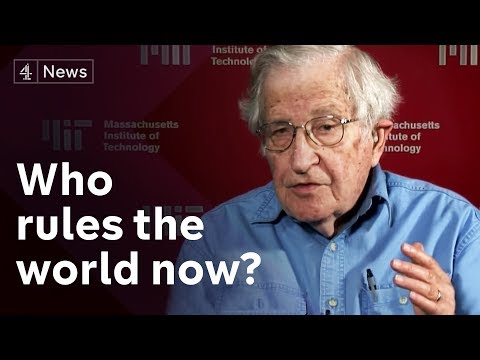
Noam Chomsky on Global Power: Who Rules the World Now?

What Chomsky talks about
Noam Chomsky gave this Channel 4 News interview in 2011 on global power, arguing that states, corporate wealth, and public pressure compete to shape world affairs.
Also known as: Noam Chomsky full length interview: Who rules the world now?; Who rules the world now? (Channel 4 News).
Chomsky argues that the world is shaped not by one simple ruler but by overlapping forms of power: states, corporate wealth, and public pressure. He says the United States remains the most powerful state, while internal power is increasingly concentrated in a narrow sector of corporate and private wealth.
He also connects global politics to concrete dangers: nuclear war, climate catastrophe, militarism, and secretive trade agreements like TTIP. Across the interview, he frames many official narratives as propaganda or misdirection that hides who benefits from policy.
The conversation ranges from Trump and Brexit to China, Russia, and the public’s capacity to resist. Chomsky’s central point is that power is real, but it is neither monolithic nor uncontested.
Chomsky is interviewed by a Channel 4 News host who asks the questions and follows up with audience submissions.
In his words
“There is no simple answer”
“The United States, despite its decline for many many years, is still overwhelmingly more powerful than any state or group of states”
“Power is overwhelmingly and increasingly, in recent years, in the hands of a very narrow sector of corporate wealth, private wealth and power”
“The greatest danger is – there are two huge dangers that the human species faces.”
“These are investor right agreements.”
Key points
- Trump’s support, he says, comes largely from white working-class people harmed by decades of stagnation and democratic decline.
- The biggest dangers facing humanity are nuclear war and environmental catastrophe.
- The United States remains the dominant state power, but domestic power is concentrated in corporate wealth.
- China is important economically, but Chomsky says it is far behind the U.S. in military power and faces major internal problems.
- Russia is authoritarian and harsh regionally, while the U.S. projects force worldwide.
- TTIP and similar agreements are, in his view, secretive investor-rights deals rather than genuine free trade.
- Public opinion and organized resistance can matter; the governed have force if they choose to exercise it.
Full transcript: Noam Chomsky, Channel 4 News interview: Who Rules the World Now? (2011)
Mr Chomsky that impotence of voters, that angry impotence as you talk about, presumably you’d say that is what is responsible for the rise of Donald Trump, is it? It’s pretty clear what is responsible for the rise of the support for Trump and there’s general agreement about it. If you take a simple look at economic statistics, the primary support for Trump is coming from mostly white working class poor people who’ve been cast by the wayside during the neo-liberal period. They’ve lived through a generation of stagnation or decline.
Real male wages are about what they were in the 1960s. There has also been a decline in functioning democracy, the overwhelming evidence reveals that even their own elected representatives barely reflect their interest and concerns. A contempt for institutions, especially congress has just increased, skyrocketed it’s down single digits often. These are people who, meanwhile there has of course been wealth created, it’s gone into very few hands, mostly into a fraction of the top 1%.
So there’s enormous opulence. Yes indeed and how dangerous do you think this all is in terms of Donald Trump for example. I mean he has been toning down some of his most extreme pronouncements recently. He may, if he ever got anywhere near power, he could be held in check by congressman. How dangerous do you think he is to America? Well the greatest danger that he and indeed every republican candidate poses is barely mentioned. It’s kind of reminiscent of Sherlock Holmes’ dog that did not bark. The greatest danger is – there are two huge dangers that the human species faces. We’re now in a situation where we have to decide whether the species survives in any decent form.
One is the rising danger of nuclear war, which is quite serious. The other is environmental catastrophe. Now on these issues Donald Trump and the other republican candidates are basically uniform. On the threat of nuclear war. And do you believe that Hilary Clinton, the democratic frontrunner, would champion those issues in a way that would satisfy you? Not in any way that would satisfy me, but at least she recognises that climate change is going on and that we have to do something about. Every single republican candidate denies that it’s happening, with the soul exception of Kasich who says sure it’s happening but we shouldn’t do anything about it and that’s having an impact.
The Paris negotiations last December were aiming at a treaty, they couldn’t reach it for a simple reason; the republican congress would not accept it. So it’s a voluntary agreement which means even the weak standards that we’re proposed will be barely, maybe it undermines the likelihood that even they will be met. Every Republican candidate, including Trump wants to eliminate the environmental protection agency, Richard Nixon’s legacy, to cut back regulation to restart the press of business quickly as possible. On militarism, every one of them wants to raise the huge military budget, already over half of discretionary spending leading right now.
It’s one factor leading to confrontations which could be extremely hazardous and this again is not being discussed. And briefly, I’d suggest one thing that you might agree with Donald Trump on would be about the EU. He talks about the UK may leave the EU, you’ve railed against European Union bureaucracy. Could you agree with him on that? No I don’t. In fact I actually have no real strong opinion on Brexit but my concern about it would be that it would weaken the European Union but it would also probably leave Britain even more, don’t want to use too strong a word, subordinate to US power than it is today.
Which I don’t think would be a good thing for the world or Britain. What in a nutshell is the answer to “Who rules the world now?” As I try to discuss in the book, there is no simple answer. We usually think of states when that question is raised and with regard to states there’s no doubt that the United States, despite its decline for many many years, is still overwhelmingly more powerful than any state or group of states. But that’s only one factor. States have internal structures. An internal distribution of power. In the United States power is overwhelmingly and increasingly, in recent years, in the hands of a very narrow sector of corporate wealth, private wealth and power.
And they have counterparts elsewhere who agree with them, who interact with them largely and that’s another dimension in who rules the world. And there’s also the public. The public can have, sometimes does have, enormous power. We can go back to David Hume, first major modern work on political philosophy. Foundations on the theory of government pointed out that force is on the side of the governed, those who are governed have the force if they are willing to and eager to and recognise the possibility to exercise it. Sometimes they do. That’s a major force in who rules the world. But when it comes to state power, you don’t buy the idea of China as the next superpower, the imminent superpower?
China? I mean China plays a very important role in the world undoubtedly. If you take a look at say per capita income, it’s far behind the United States and other developed states. It has enormous internal problems, demographic, ecological, resources and so on. It’s undoubtedly going to play an important, in military terms it’s not even a fraction of the United States and Western powers. So yes, economically it’s significant but bear in mind that a good deal of Chinese production is actually far unknown. Apple, world’s major corporation happens to produce in China, largely, but that’s US production which happens to use Chinese facilities, labour and other facilities.
So China is a growing, developing power, in some domains in fact it’s gone quite far even in the high technology industry. So for example in production of solar panels, China’s in the lead, not just in mass production but also in innovation and high tech development. All of this is significant but it is by no means of power on the scale of the United States. In fact take a look at the confrontations between China and the United States now. There are serious confrontations. Are they in the Caribbean? Are they off the coast if California? No, they’re in waters around China where China and others have territorial claims.
That’s symbolic reflection of the nature of state power. Well you describe, scathing about the United States, no one will be surprised to hear that. You described it as a leading terrorist state. I’m just interested how you’d describe Russia. How I describe Russia? Authoritarian, brutal, harsh. Carrying out ugly actions in its own region. The United States on the other hand carries out such actions all over the world. In fact again, look at the – there are serious confrontations between Russia and the United States and once again are they on the Mexican border?
The Canadian border? No, they’re on the Russian border. In fact right at the point of the traditional invasion route through which Russia has been virtually destroyed several times in the past century, also earlier history. Again, that’s no apologetics for what Putin may be doing but it should lead us to understand, have a rational perspective on the relationship between these forces in the world. As for the U.S. being the leading terrorist state I should say that’s hardly just my opinion. So for example I noted when I was introduced, the person who introduced me said that I regard the United States as the gravest threat to world peace.
That’s not exactly, it a little misrepresents the situation. There are international polls run by the leading U.S. polling agency, Gallop, its international affiliates Gallop/WIN and one of the questions they ask is “which country is the greatest threat to world peace?” and the United States is first by a huge margin. Far behind in second place is Pakistan, that’s undoubtedly inflated by the Indian vote and others have slight mention, so that’s global opinion. And I should mention that this was not even reported in the United States, happen to be reported by the BBC but wasn’t reported in the United States.
As for being a terrorist state, President Obama’s global assassination campaign, draw an assassination campaign, is extreme terrorist war. I mean if Iran, let’s say was carrying out a campaign to assassinate people around the world who would thought might be planning to harm Iran, we would regard it as terrorism. For example, if they were bombing the editorial offices of the New York Times and The Washington Post which publish [ ] by prominent figures saying that we should bomb Iran right now, not wait. So obviously they want to harm Iran.
Suppose Iran was assassinating them and anybody who happened to be standing around, all over would we regard that as terrorism? I think we would. Let me put a few questions to you from people online. People are sending in questions off our Facebook. First Gary says what are the dangers of T Tip? Putin? The dangers are- No, Sorry. What are the dangers or T TIP? The Transatlantic Trade Partnership? TTIP? Oh, TTIP? They’re pretty extreme. In fact Greenpeace, a couple of days ago, released 280 pages of internal documents on this so-called trade agreement and they spell out details of what all of us should know.
The so-called free trade agreements are not free trade agreements. In fact to a large extent they’re not even trade agreements. These are investor right agreements. There’s a reason why they’re kept secret from the public and as soon as you look them you see why. Notice I say secret from the public, not secret. They’re not kept secret, they’re not secret to the corporate lawyers and lobbyists who are writing the detailed regulations. Of course in the interests of their constituents, doesn’t happen to be the public of the world or their own countries. So these are highly protectionist for the benefit of private power, so-called intellectual property rights, effectively raise tariffs.
They’re called patents but which have an enormous impact on economies. Great, wonderful for pharmaceutical and media court conglomerates and others. Investors, corporations are given the right to sue governments, something you and I can’t do but a corporation can, to sue governments for harming their future, potentially future profits. You can figure out what that means and such cases already in the courts – they’re not in the courts they go to private trade adjudication groups made up largely of corporate representatives.
They’re already going on with NAFTA and we can expect more of them. There are provisions that undermine efforts at regulation including incidentally, regulation of environmental dangers and rather strikingly the phrase “Climate Change” does not appear in these 280 pages, which are illustrative of the whole structure. So they have almost no, I should say that these agreements, so-called Pacific and Atlantic have virtually no effect on tariffs. Tariffs are already quite low among the major trading partners.
When you read the propaganda about it, it says “oh yeah sure, Vietnam is going to have to lower its tariffs.” Yeah, almost no effect on trade. The major trading partners already have agreements that have reduced the terrorists very substantially. There are few exceptions, not many. So these are basically – we should disabuse our self of the illusion that these are free trade agreements, anything but. And to a large extent not even trade agreements. We have the experience of others like NAFTA, many years of experience. So take say NAFTA, it has all of the aspects that I just described but even more. Consider even what is called trade.
Interactions across the US-Mexico border, they’ve increased substantially since NAFTA. So economists will tell you trade is greatly increased but have a look at them. So for example, suppose that General Motors produces parts in Indiana, sends them to Mexico for assembly and sells the car in Los Angeles. That’s call trade in both directions, but it’s not. Its interactions internal to a command economy. It’s as if during the days of the Soviet Union, parts were made, say in Leningrad, sent to Warsaw for assembly and sold in Moscow.
We wouldn’t call that trade. That’s interactions internal to a command economy. Well Noam Chomsky, Thank you very much for being so generous with your time and for staying on to have that live online discussion. Thank you.
From the video's published captions. Timestamps link to the video above. Errors are possible.
Cite this recording
Noam Chomsky, “Channel 4 News interview: Who Rules the World Now? (2011)”, 2011. Transcript and video: Thinkers Archive, https://thinkersarchive.com/noam-chomsky/global-power-channel-4-news-2011/
Quoting a passage? Link to its exact moment: every timestamp above has its own anchor (for example https://thinkersarchive.com/noam-chomsky/global-power-channel-4-news-2011/#t-145).