Noam Chomsky on Inequality And Class
Chomsky sees inequality as a political project that concentrates wealth and class power, weakens labor and public institutions, and hollows out democracy.
- Inequality is not accidental; it reflects policies built to favor investors and concentrated wealth.
- Class power grows when unions, public institutions, and democratic participation are weakened.
- Stagnation and disillusionment help explain anger at establishment politics and the appeal of figures like Trump and Sanders.
- For Chomsky, economic inequality becomes democratic decay when money and private power dominate political life.
Inequality is a class project, not a natural outcome
Chomsky treats rising inequality as the result of deliberate institutional design. His basic claim is that power in the United States has become increasingly concentrated in a narrow sector of corporate and private wealth, and that this concentration shapes policy outcomes in its own interest1.
That is why he often describes major economic rules as serving investors first. When policies are made for those at the top, inequality is not a side effect of growth but a predictable expression of class power23.
Class power works by weakening labor and narrowing democracy
A central part of Chomsky’s account is the long weakening of organized labor. In his view, neoliberal policy shifted power toward business classes and away from workers, while union suppression helped accelerate inequality and reduce working-class power.
He connects this directly to democracy. In a capitalist democracy, he argues, formal political institutions operate within tight limits and are heavily biased by concentrations of private power, so attacks on labor are also attacks on mass democratic capacity.
Rising inequality turns into political anger and anti-establishment revolt
Chomsky reads recent political upheaval through this economic and class background. He links support for Trump to white working-class people who were harmed by stagnation and democratic decline, and he sees both Trump and Sanders as responses to a broad collapse of trust in establishment politics.
His point is not that these responses are the same, but that they arise from the same social wound: people feel robbed of influence, security, and a future. In that setting, anger can be directed toward democratic reform or toward demagoguery and scapegoating.
Institutions are reorganized around profit, not public need
Chomsky extends the class analysis beyond wages and elections. He argues that universities, hospitals, and public education have been pushed toward market models, managerial control, precarity, and narrow vocational priorities, all of which erode public purpose and democratic culture.
His criticism of health care fits the same pattern. A system built around insurance bureaucracy and profit serves private interests while imposing irrational burdens on ordinary people, which for him is another sign that class power shapes institutions from the top down.
The stakes are larger than economics because inequality weakens the capacity to face major threats
For Chomsky, inequality matters not only because it is unfair but because it degrades the public capacity needed to deal with existential dangers. When power is concentrated and public institutions are hollowed out, societies become less able to confront climate breakdown, nuclear danger, and other common problems.
That is why he treats inequality and class as part of a much bigger democratic crisis. A society organized around private wealth will struggle to act on behalf of the general population even when the risks are historic in scale.
Where to watch
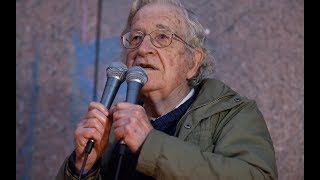 Noam Chomsky on Inequality and Democracy: Trump, Sanders, and Power2017 · 41 min · full transcriptBest overview of how Chomsky links inequality, elite power, political anger, and the 2016 election.
 Noam Chomsky on Neoliberalism and Democracy: Power, Reform, and Decline2021 · 65 min · full transcriptBest for his account of neoliberalism, union decline, and how class power reshaped public institutions.
 Noam Chomsky on War, Democracy, and Climate: Can We Choose?2020 · 110 min · full transcriptShows the long historical story: labor repression, democratic erosion, and wealth concentration.
 Noam Chomsky on Trump, Democracy, and Nuclear Risk2017 · 72 min · full transcriptUseful for seeing how inequality appears in policy areas like health care and in the Trump era’s class politics.
 Noam Chomsky on Global Power: Who Rules the World Now?2011 · 17 min · full transcriptConcise explanation of concentrated corporate power and the broader structure of rule.
Questions people ask
- What did Noam Chomsky say about TTIP and free trade agreements?
- What did Noam Chomsky say about capitalism and democracy?
- What did Noam Chomsky say about intellectual self-defense in education?
- What did Noam Chomsky say about the Trump administration and wealth in politics?
- What did Noam Chomsky say about the risk of fascism in the United States?
- What did Noam Chomsky say about unnecessary work and hospital bureaucracy?
Sources
Every quote above, word for word from the transcripts. Numbers match the text.
“…power is overwhelmingly and increasingly, in recent years, in the hands of a very narrow sector of corporate wealth, private wealth and power…”
“They’re designed for the benefit of investors.”
“The so-called free trade agreements are not free trade agreements. In fact to a large extent they’re not even trade agreements. These are investor right agreements. There’s a reason why they’re kept secret from the public and as soon as you look them you see why. Notice I say secret from the public, not secret. They’re not kept secret, they’re not secret to the corporate lawyers and lobbyists who are writing the detailed regulations. Of course in the interests of their constituents, doesn’t happen to be the public of the world or their own countries. So these are highly protectionist for the benefit of private power, so-called intellectual property rights, effectively raise tariffs.”
How this guide was made: drafted with AI from the full transcripts of the recordings cited, then checked: every quotation must match a transcript word for word and be the speaker's own words, and an independent review gates accuracy. Methodology and corrections.
