Noam Chomsky on NATO Expansion
Chomsky sees NATO expansion as a reckless U.S.-led strategy that predictably intensified Russian security fears, helped provoke the Ukraine crisis, and made diplomacy harder when it was most needed.
- He treats NATO expansion as a major provocation, not a justification for Russia’s invasion.
- He argues U.S. policy pushed Ukraine toward NATO and away from a negotiated settlement.
- He thinks the priority should be ending the war through diplomacy, not using Ukraine to weaken Russia.
- He warns that the real danger is escalation between nuclear powers.

Chomsky sees NATO expansion as a central cause of the crisis
Chomsky’s basic view is that the Ukraine war cannot be understood if NATO expansion is left out. He argues that the invasion was provoked by U.S. and NATO policy, especially the long drive to move the Western military alliance eastward toward Russia’s borders12.
For him, this is a structural argument, not a moral defense of Moscow. He says aggression remains aggression and that the invading power is responsible for the crime, but he also insists that serious analysis has to ask what policies helped bring about the confrontation34.
“…the invasion of Ukraine was demonstrably provoked…”Online interview, 2022 · full transcript →
He argues Washington kept closing off the path of neutrality and negotiation
Chomsky repeatedly argues that the most important question is not how to punish Russia but how to end the war. In his view, that required moving toward a negotiated settlement, yet U.S. policy instead signaled continued movement toward NATO integration for Ukraine and more military buildup567.
That matters because he thinks Ukrainian neutrality was the obvious basis for a settlement. His broader point is that if a great power treats a neighboring state’s military alignment as a red line, pushing directly through that red line is reckless statecraft even if the great power is acting criminally78.

“We can, however, look at the United States and we can see that our explicit policy — explicit — is rejection of any form of negotiations. The explicit policy goes way back, but it was given a definitive form in September 2021 in the September 1 joint policy statement that was then reiterated and expanded in the November 10 charter of agreement. And if you look at what it says, it basically says no negotiations. What it says is it calls for Ukraine to move towards what they called an enhanced program for entering NATO, which kills negotiations; — this is before the invasion notice — an increase in the dispatch of advanced weapons to Ukraine, more military training, the joint military exercises, weapons placed on the border.”The Intercept interview, 2022 · full transcript →
He separates explanation from justification
A constant feature of Chomsky’s view is the distinction between saying an act was provoked and saying it was right. He explicitly says the invasion was criminal aggression, while also saying it was demonstrably provoked, which is his way of insisting that causes and responsibilities are not the same thing134.
He also avoids speculation about Putin’s inner psychology. Instead, he says the right way to judge Russian policy is by observable actions and stated aims, including preventing Ukraine from entering NATO and restoring Russia’s power position9810.
He thinks NATO expansion became part of a wider strategy of weakening Russia
By 2022, Chomsky argues, NATO policy was no longer just about alliance enlargement but about sustaining a proxy war. He says much of the world sees the conflict as a U.S.-Russia proxy war fought over Ukrainian lives, and he criticizes the stated goal of continuing the war to weaken Russia1112.
That is why he uses harsh language about treating Ukraine instrumentally. His argument is that once weakening Russia becomes the priority, Ukrainian suffering becomes secondary and diplomacy gets pushed aside13.
Why he thinks this matters: NATO expansion raises the risk of nuclear war
For Chomsky, the biggest issue is not only justice for Ukraine but survival in a confrontation between nuclear powers. He warns that the war has to be approached with the growing threat of nuclear war in mind, which is why he opposes policies that intensify the conflict without a diplomatic exit1617.
He contrasts more militant U.S. rhetoric with efforts in Europe to move toward negotiations. His concern is that great-power rivalry can take on its own momentum, and once the goal shifts to defeating or destroying the enemy, the danger becomes much larger than Ukraine alone181920.
Chomsky on nato expansion, in his own words
“…the invasion of Ukraine was demonstrably provoked…”
“We can, however, look at the United States and we can see that our explicit policy — explicit — is rejection of any form of negotiations. The explicit policy goes way back, but it was given a definitive form in September 2021 in the September 1 joint policy statement that was then reiterated and expanded in the November 10 charter of agreement. And if you look at what it says, it basically says no negotiations. What it says is it calls for Ukraine to move towards what they called an enhanced program for entering NATO, which kills negotiations; — this is before the invasion notice — an increase in the dispatch of advanced weapons to Ukraine, more military training, the joint military exercises, weapons placed on the border.”
Where to watch
 Noam Chomsky on Russia and Ukraine: Power, NATO, and War2022 · 14 min · full transcriptBest short overview of how he links NATO expansion to the origins of the war and to Russia’s strategic aims.
 Noam Chomsky on the Ukraine War: Diplomacy or Escalation?2022 · 49 min · full transcriptBest single discussion of why he thinks diplomacy and neutrality were the practical alternative to escalation.
 Noam Chomsky on the Russia-Ukraine War: Propaganda and Escalation2022 · 57 min · full transcriptBest for his blunt claim that the invasion was provoked, alongside his criticism of war framing and escalation.
 Noam Chomsky on Russia-Ukraine Conflict: NATO, Escalation, and Europe2022 · 40 min · full transcriptBest for the broader European context: security fears, diplomacy, and the politics around escalation.
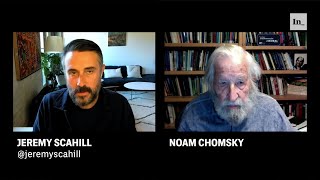 Noam Chomsky on the Russia-Ukraine War: Negotiation or Escalation2022 · 62 min · full transcriptBest for his argument that U.S. policy shut down negotiations and prioritized continued fighting.
 Noam Chomsky on Ukraine War Escalation: The Danger of Great-Power Conflict2022 · 18 min · full transcriptBest for his warning that the war became a proxy conflict aimed at weakening Russia at Ukraine’s expense.
Questions people ask
- What did Noam Chomsky say about the U.S. policy toward negotiations in Ukraine?
- What did Noam Chomsky say about who is to blame for the invasion of Ukraine?
- What did Noam Chomsky say is the most important question in the Ukraine war?
- What did Noam Chomsky say about being accused of moral equivalence or whataboutism?
- What did Noam Chomsky say about the Russia-Ukraine crisis and NATO expansion?
Sources
Every quote above, word for word from the transcripts. Numbers match the text.
“…the invasion of Ukraine was demonstrably provoked…”
“The United States had no interest in that.”
“Any power that commits aggression is to blame.”
“Well, who's to blame? Any power that commits aggression is to blame. So I continue to say, as I have been for many months, that the invasion, Putin's invasion of Ukraine, is on a par with such acts of aggression as the U.S. invasion of Iraq, the Stalin-Hitler invasion of Poland, other acts of supreme international crime under international law, aggression. Of course, he's to blame. You…”
“The most important question is how to end it.”
“The primary need to move towards a negotiated settlement…”
“We can, however, look at the United States and we can see that our explicit policy — explicit — is rejection of any form of negotiations. The explicit policy goes way back, but it was given a definitive form in September 2021 in the September 1 joint policy statement that was then reiterated and expanded in the November 10 charter of agreement. And if you look at what it says, it basically says no negotiations. What it says is it calls for Ukraine to move towards what they called an enhanced program for entering NATO, which kills negotiations; — this is before the invasion notice — an increase in the dispatch of advanced weapons to Ukraine, more military training, the joint military exercises, weapons placed on the border.”
“…what motivates him is what has been demonstrated in his actions…”
“I have no particular insight into Putin's mind.”
“I don't think anything's changed.”
“The world, most of the world sees this as a proxy war between Russia and the United States fought over Ukrainian bodies…”
“The war must continue in order to severely weaken Russia.”
“What happens to Ukrainians is incidental.”
“There are two huge problems: one is the growing threat of nuclear war…”
“The most important question is how to end it. It's a horrible criminal aggression, causing enormous atrocities, great dangers, and prospective dangers even up to nuclear war. So the main question is how to put it to an end. Well, there are two ways. One way is through a diplomatic settlement. If you don't want a diplomatic settlement, the second way is let them fight it out, and we'll see what happens. Horrible experiment. So if possible, we would like to pursue a diplomatic…”
“…the United States is full of militant talk…”
“Europe is trying to move towards some form of negotiations, diplomacy…”
“…the only thing in mind is to destroy the enemy…”
How this guide was made: drafted with AI from the full transcripts of the recordings cited, then checked: every quotation must match a transcript word for word and be the speaker's own words, and an independent review gates accuracy. Methodology and corrections.
