Noam Chomsky on Ethics & Integrity
Chomsky argues that intellectual responsibility begins with using privilege and access to expose lies, strip away moral cover for power, and help people act against destructive policies.
- Intellectuals have special duties because privilege creates responsibility
- Their job is to expose lies and clarify reality, not rationalize state power
- This matters most in war, where public apathy and propaganda let destruction continue
- Real criticism must question underlying power and consequences, not just tactics or image
- Responsibility should lead to action: inform the public, challenge illusions, and join popular struggles

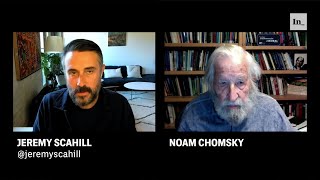
“You go to 1981: U.N. ambassador Jeane Kirkpatrick devises the notion of moral equivalence. She said: If you dare to criticize the United States, you’re guilty of moral equivalence. You’re saying we’re just like Stalin and Hitler. So you can’t talk about the United States. There’s another term that’s used now. It’s: whataboutism. If you talk about what the U.S. is doing right now, it’s whataboutism, you can’t do that. You’ve got to adhere firmly to the party line, strictly to the party line.”The Intercept interview, 2022 · 1:00:12
Intellectual responsibility starts from privilege
For Chomsky, intellectual responsibility is not mainly about prestige or academic status. It begins from a simple moral fact: some people have more education, more access to information, more freedom to speak, and more public standing than others. Because of that, they carry greater obligations, not fewer12.
He treats this as a practical duty, not a flattering identity. The point of being an intellectual is not to be admired as an expert, but to use opportunity to help others see what is being done in their name and with their consent13.
The core duty is to tell the truth and expose lies
Chomsky’s most direct formulation is that intellectuals should tell the truth and expose lies. He contrasts that task with a familiar failure: educated elites often provide noble language, technical jargon, and expert authority that make domination look reasonable or humane23.
That is why he is so hostile to the worship of expertise as such. Expertise deserves respect only when it is tied to evidence, honesty, and consequences. When experts mainly shield power from scrutiny, the authority they claim is fraudulent rather than enlightening3.
He also thinks reality is often less mysterious than elites suggest. The task is to cut through carefully constructed illusions, reveal the underlying facts, and make them understandable enough for ordinary people to act on them4.
War is where intellectual failure becomes most dangerous
Chomsky returns again and again to war because it shows what happens when intellectuals do not meet their responsibility. In Vietnam, he argues, the central issue was no longer an abstract debate among thinkers but a destructive policy that had to be stopped. Continued destruction depended in part on public apathy and acceptance, which made truthful explanation politically urgent567.
He insists that moral attention should stay fixed on human consequences. In Vietnam, that meant asking about the survival of Vietnam as a social and cultural entity, not treating the war as a strategic game or a test of national credibility8.
He applies the same standard to Ukraine. The first question, for him, is how to save Ukraine from further destruction, which is why he emphasizes movement toward a negotiated settlement and criticizes rhetoric that turns Ukrainians into expendable instruments in a larger power struggle91011.
Responsible thought means challenging your own side first
A defining feature of Chomsky’s view is that intellectual responsibility is directed most sharply at the crimes and deceptions of one’s own state and institutions. He argues that aggression is often hidden behind moral language, so criticism has to examine the gap between declared ideals and actual conduct1213.
He rejects the idea that bringing up your own government’s actions is disloyal or a distraction. He points to the policing of debate through labels that are meant to block scrutiny and force conformity, especially in times of war14.
This is why he repeatedly asks audiences to look at official policy, not just official rhetoric. On Ukraine, for example, he calls attention to policies that closed off negotiation while public discussion focused elsewhere, because intellectual responsibility requires following the real record of decisions and their likely effects1510.
“You go to 1981: U.N. ambassador Jeane Kirkpatrick devises the notion of moral equivalence. She said: If you dare to criticize the United States, you’re guilty of moral equivalence. You’re saying we’re just like Stalin and Hitler. So you can’t talk about the United States. There’s another term that’s used now. It’s: whataboutism. If you talk about what the U.S. is doing right now, it’s whataboutism, you can’t do that. You’ve got to adhere firmly to the party line, strictly to the party line.”The Intercept interview, 2022 · full transcript →
Guilt matters only if it leads to action
Chomsky does not think awareness alone is enough. Once people understand what is being done, the next question is whether they will act or retreat into private life. He frames this as a personal and political choice: either try to do something, or continue as if the surrounding destruction were someone else’s concern16.
He can speak in severe moral terms about complicity, even saying that decent and tolerant people may bear serious guilt when they allow atrocities to continue through passivity. But he also warns against letting guilt become paralyzing. The point is not confession for its own sake; it is effective action to stop harm1718.
That is why he ends not in despair but in obligation. There are always tasks for critical intellectuals: clear away illusion, inform the public, and join broader struggles for a better future19420.
Chomsky on ethics & integrity, in his own words
“…the cult of the experts is both self-serving for those who propound it and fraudulent…”
Where to watch
 Noam Chomsky on Responsibility of Intellectuals: Truth vs Power1988 · 64 min · full transcriptHis clearest statement of what intellectuals owe the public: truth-telling, exposing lies, and refusing to launder power.
 Noam Chomsky on Radical Intellectuals: Responsibility and Power2010 · 58 min · full transcriptShows how he connects privilege, political education, and the vocation of the critical intellectual.
 Noam Chomsky on Vietnam War: Morality, Terror, and Intervention1969 · 52 min · full transcriptA vivid example of intellectual responsibility applied to war, public apathy, and moral urgency.
 Noam Chomsky on the Russia-Ukraine War: Negotiation or Escalation2022 · 62 min · full transcriptDemonstrates how he applies the same standards to a current war: focus on lives, negotiation, and propaganda.
 Noam Chomsky on Global Risk and Power: War, Climate, and Empire2018 · 125 min · full transcriptBroadens the theme from war to long-term threats like climate and empire, asking what responsibility demands now.
Questions people ask
- What did Noam Chomsky say about Adam Smith and power?
- What did Noam Chomsky say about Julian Assange and journalism?
- What did Noam Chomsky say about the U.S. policy toward negotiations in Ukraine?
- What did Noam Chomsky say about the Vietnam War in 1969?
- What did Noam Chomsky say critical intellectuals should do in society?
- What did Noam Chomsky say about the job of critical intellectuals?
Sources
Every quote above, word for word from the transcripts. Numbers match the text.
“…privilege plainly confers opportunity and opportunity confers responsibility…”
“…the responsibility of intellectuals to speak the truth and to expose lies…”
“…the cult of the experts is both self-serving for those who propound it and fraudulent…”
“No, they can't sweep away—and try to sweep away—the mists of carefully contrived illusion and reveal the stark reality, which is often quite simple. When you clear away the mists, they can become engaged directly in popular struggles. They can help organize the countless Joe Stacks who are destroying themselves and maybe the world, and they could join them in leading the way to a better future. Thanks.”
“…there is no, fundamentally, there is no argument anymore on—on an intellectual level, in my opinion.”
“…the policy, the continuation of the policy, is, to some extent, based on the fact of public apathy or public acceptance.”
“Going on, and I think I feel the same way about Vietnam, and I really think that there is no, fundamentally, there is no argument anymore on—on an intellectual level, in my opinion. But I think it's very important to discuss it nevertheless. What level is there an argument? Well, there—the, uh, there is a policy which I think is a destructive and devastating policy; it's continuing. And the policy, the continuation of the policy, is, to some extent, based on the fact of public apathy or public acceptance. Hence, there still is the necessity to convince people that, uh, that they should act strongly to put an end to this policy at…”
“I think it's really an issue of the survival, of the existence of Vietnam as an entity, as a social and cultural entity.”
“What is the best thing to do to save Ukraine from a grim fate, from further destruction?”
“The primary need to move towards a negotiated settlement…”
“Let’s fight to the last Ukrainian.”
“American aggressiveness, however it may be masked in pious rhetoric, is a dominant force in world affairs…”
“We’re a rogue state, the leading rogue state by a huge dimension…”
“You go to 1981: U.N. ambassador Jeane Kirkpatrick devises the notion of moral equivalence. She said: If you dare to criticize the United States, you’re guilty of moral equivalence. You’re saying we’re just like Stalin and Hitler. So you can’t talk about the United States. There’s another term that’s used now. It’s: whataboutism. If you talk about what the U.S. is doing right now, it’s whataboutism, you can’t do that. You’ve got to adhere firmly to the party line, strictly to the party line.”
“We can, however, look at the United States and we can see that our explicit policy — explicit — is rejection of any form of negotiations. The explicit policy goes way back, but it was given a definitive form in September 2021 in the September 1 joint policy statement that was then reiterated and expanded in the November 10 charter of agreement. And if you look at what it says, it basically says no negotiations. What it says is it calls for Ukraine to move towards what they called an enhanced program for entering NATO, which kills negotiations; — this is before the invasion notice — an increase in the dispatch of advanced weapons to Ukraine, more military training, the joint military exercises, weapons placed on the border.”
“Nobody cares about this. Am I gonna start trying to do something about it, or can I keep to my work…”
“I think that it's in some sense the sane and reasonable and tolerant people who should share a very serious burden of guilt…”
“I think that the beginning of wisdom in this case is to recognize something about what we stand for in the world, what we're doing in the world. And I think when we do recognize that, we will feel an enormous sense of guilt. And I say somewhere in there that one should be very careful not to let confessions of guilt overcome the possibility of action. I said that conf…”
“…there's no shortage of tasks…”
“Well, the world's too complex for history to repeat, but there are some unpleasant memories reverberating, and there are lessons to keep in mind. We'll have to expand on them. There's for those who want to choose the vocation of critical intellectuals, there's no shortage of tasks. That's true whatever their station and life, whether they're called intellectuals or…”
How this guide was made: drafted with AI from the full transcripts of the recordings cited, then checked: every quotation must match a transcript word for word and be the speaker's own words, and an independent review gates accuracy. Methodology and corrections.

