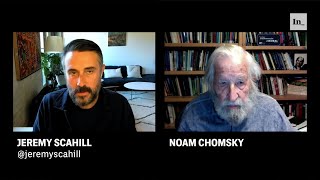
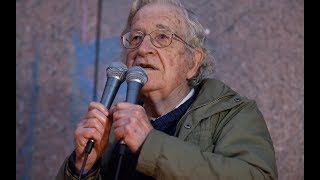
Noam Chomsky on Power
Chomsky sees global power as a shifting system in which the United States remains the strongest state, corporate wealth dominates policy, and humanity is pushed toward climate and nuclear catastrophe unless popular pressure forces diplomacy and democracy.
- The U.S. is still the most powerful state, even in relative decline.
- Real decision-making is increasingly concentrated in corporate and private wealth.
- Global power politics are most dangerous when they block diplomacy and normalize escalation.
- The biggest tests of power are nuclear war and environmental destruction, which outweigh ordinary political drama.
- Public action matters because elite institutions routinely serve concentrated interests unless they are pressured from below.
Global power is not one ruler but a hierarchy led by the United States
Chomsky does not treat world politics as if one actor controls everything. He presents global power as layered: states, military systems, corporate wealth, and popular forces all matter. Within that structure, he says the United States remains the leading state power even after a long relative decline.1
He draws a distinction between state dominance and overall human control over events. A country can remain militarily and geopolitically preponderant while still facing limits, rivals, and internal weaknesses. That is why he treats American power as still decisive, but not omnipotent or permanent.12
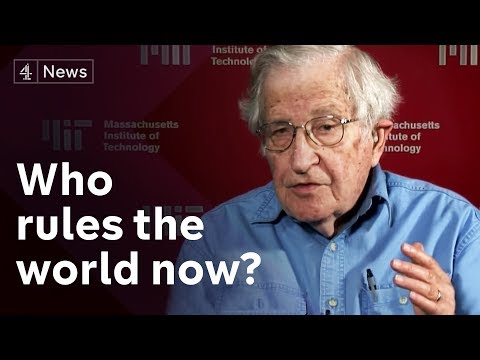
“…the United States, despite its decline for many many years, is still overwhelmingly more powerful than any state or group of states…”Channel 4 News interview, 2011 · full transcript →
Inside powerful states, corporate wealth shapes policy
For Chomsky, the key to global power is not just which flag is strongest but who governs inside the strongest states. He argues that power within the United States is increasingly concentrated in a narrow sector of corporate and private wealth, which helps explain why policy so often serves investors and elites over the broader public.3
He frames this as a long-standing pattern in capitalist democracies: the main architects of policy are owners and major economic actors, not ordinary citizens. On that view, multinational firms and financial institutions shape the rules, while the public is mostly excluded until it organizes enough pressure to change outcomes.
He applies this directly to contemporary politics, arguing that the Trump period displayed the underlying structure in unusually blunt form. Instead of hiding elite rule behind public language, it openly advertised a government run by billionaires and business power.
Militarism sustains dominance by pushing rivals and crises into confrontations
Chomsky argues that great powers often preserve influence by escalating threats, defining enemies, and sidelining negotiation. In his discussion of Ukraine, he warns that U.S. rhetoric has been heavily militant while parts of Europe have tried to move toward negotiation and diplomacy.67
He extends that argument by saying much of the world sees the Ukraine war not only as a local conflict but as a proxy war between Russia and the United States fought through Ukrainian suffering. In that framework, a strategy of continuing war to weaken a rival becomes a classic expression of global power politics.8910
The same logic appears in his warnings about relations among major powers more broadly. He treats direct war among nuclear states as irrational and potentially terminal, which is why diplomacy is not, for him, a soft alternative but a condition of survival.1112
The real measure of power is whether it drives humanity toward catastrophe
Chomsky repeatedly says the central issues in global politics are not the daily scandals that dominate headlines. The deepest question is whether the institutions that command power are increasing the two existential threats he emphasizes most: nuclear war and environmental destruction.14
He insists that these dangers outweigh almost every other political dispute. When governments intensify confrontation among nuclear powers or dismantle environmental protections, they are using power in ways that threaten the conditions for organized human life itself.151617
His strongest language is reserved for environmental breakdown. He describes the drive to destroy the environment as the worst danger because it overwhelms everything else, especially when backed by the most powerful states and their economic systems.181920
Trade, sanctions, and economic rules are also tools of empire
Chomsky treats global power as economic as well as military. He argues that so-called free trade agreements are often investor-rights systems written by corporate lawyers and lobbyists, designed to protect private power rather than democratic control or genuinely open exchange.21
This is part of his broader claim that humanitarian or neutral language often conceals coercive structures. Economic pressure, sanctions, and legal regimes can discipline weaker countries, block development, and shift decision-making away from publics and toward concentrated wealth.21
Seen this way, global power works through institutions that look technical or inevitable. Rules about investment, intellectual property, and market access are political instruments that help lock in hierarchy.21
Popular pressure is the only serious counterweight
Chomsky does not present concentrated power as all-powerful. His view assumes that elites will keep advancing their interests unless they are checked by organized publics, democratic participation, labor, and sustained activism.14
That is why he links analysis to responsibility. His recurring practical point is that people have to decide whether to ignore what is happening or act to change it, especially when the stakes are existential.22
Applied to global power, this means strengthening democratic institutions, resisting militarized solutions, and forcing policy toward negotiation and climate action. For Chomsky, ordinary politics matters only if it is redirected toward survival and public control.72217
Chomsky on power, in his own words
“…the United States, despite its decline for many many years, is still overwhelmingly more powerful than any state or group of states…”
Where to watch
 Noam Chomsky on Global Power: Who Rules the World Now?2011 · 17 min · full transcriptBest short overview of his core map of global power: U.S. dominance, corporate concentration, and existential danger.
 Noam Chomsky on War, Democracy, and Climate: Can We Choose?2020 · 110 min · full transcriptShows how he connects global power to nuclear risk, climate breakdown, democracy, and class power.
 Noam Chomsky on Global Risk and Power: War, Climate, and Empire2018 · 125 min · full transcriptBest for his broad theory that imperial rhetoric often masks coercion, sanctions, and environmental destruction.
 Noam Chomsky on Russia-Ukraine Conflict: NATO, Escalation, and Europe2022 · 40 min · full transcriptUseful for understanding how he reads NATO, Europe, diplomacy, and U.S. strategic aims in a live geopolitical crisis.
 Noam Chomsky on Ukraine War Escalation: The Danger of Great-Power Conflict2022 · 18 min · full transcriptSharpest statement of his warning that major-power rivalry in Ukraine became a dangerous proxy war.
 Noam Chomsky on Trump and U.S. Decline: Climate, Power, and Isolation2017 · 55 min · full transcriptGood for seeing how he ties U.S. decline and Trump-era politics to climate and nuclear threats.
Questions people ask
- What did Noam Chomsky say about Adam Smith and power?
- What did Noam Chomsky say about TTIP and free trade agreements?
- What did Noam Chomsky say about the Trump administration and wealth in politics?
- What did Noam Chomsky say the Cold War was for?
- What did Noam Chomsky say about U.S. officials inventing enemies?
- What did Noam Chomsky say about the Russia-Ukraine crisis and NATO expansion?
Sources
Every quote above, word for word from the transcripts. Numbers match the text.
“…the United States, despite its decline for many many years, is still overwhelmingly more powerful than any state or group of states…”
“…the leader of the free world, the richest and most powerful country in history…”
“…power is overwhelmingly and increasingly, in recent years, in the hands of a very narrow sector of corporate wealth, private wealth and power…”
“…the United States is full of militant talk…”
“Europe is trying to move towards some form of negotiations, diplomacy…”
“The world, most of the world sees this as a proxy war between Russia and the United States fought over Ukrainian bodies…”
“The war must continue in order to severely weaken Russia.”
“It's a bargain for the United States…”
“I mean, you cannot play that game in international affairs.”
“There can't be a U.S.-China war. Both countries get destroyed.”
“There are two huge problems: one is the growing threat of nuclear war…”
“Everything else fades into insignificance in comparison to them.”
“…the likely destruction of the possibility for organized human life…”
“…two major threats to survival begin to converge…”
“The worst one, which overwhelms everything else, is the dedication to destroy the environment.”
“…the most severe that have ever arisen in human history…”
“…we should never overlook the fact that the threats that we know we now face are the most severe…”
“The so-called free trade agreements are not free trade agreements. In fact to a large extent they’re not even trade agreements. These are investor right agreements. There’s a reason why they’re kept secret from the public and as soon as you look them you see why. Notice I say secret from the public, not secret. They’re not kept secret, they’re not secret to the corporate lawyers and lobbyists who are writing the detailed regulations. Of course in the interests of their constituents, doesn’t happen to be the public of the world or their own countries. So these are highly protectionist for the benefit of private power, so-called intellectual property rights, effectively raise tariffs.”
“Nobody cares about this. Am I gonna start trying to do something about it, or can I keep to my work…”
How this guide was made: drafted with AI from the full transcripts of the recordings cited, then checked: every quotation must match a transcript word for word and be the speaker's own words, and an independent review gates accuracy. Methodology and corrections.