Democracy vs Wealth
Why concentrated wealth becomes concentrated political power.
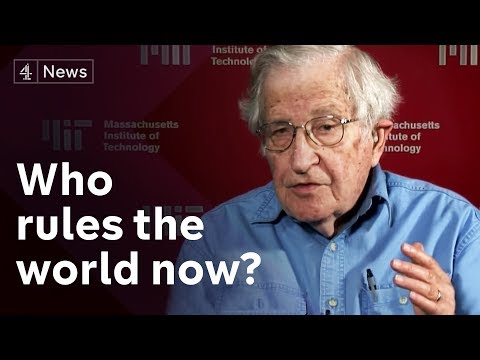
“…power is overwhelmingly and increasingly, in recent years, in the hands of a very narrow sector of corporate wealth, private wealth and power…”Channel 4 News interview, 2011 · 4:59
The lesson
Chomsky’s basic claim in this chapter is that inequality is not only about who has more money; it is about who gets to rule. Across these interviews, he argues that political systems are increasingly shaped by a narrow concentration of corporate and private wealth rather than by the broader public1. That means democratic decline is not a side effect of inequality but one of its main results.
He connects that concentration of power to neoliberalism. In his account, neoliberal policy was designed to shift power toward business classes and away from labor, public institutions, and the public at large. This shows up not only in tax and trade policy, but also in how institutions are reorganized around investors, management, and market discipline rather than public needs23.
A central mechanism in this story is the weakening of organized labor. Chomsky repeatedly links union suppression and the long assault on labor to rising inequality, stagnation, and reduced working-class power. When workers lose durable organizations, they lose one of the few counterweights to concentrated wealth, and frustration can then be redirected by demagogues instead of constructive mass politics4.
He also argues that formal democratic institutions can remain in place while real influence narrows. Policy may still be presented as neutral, technical, or inevitable, but in practice it often rewards wealth and expands systems of control unless people organize to push it in another direction56. This helps explain why public anger rises even when elections continue: many people sense that major decisions are being made elsewhere.
For Chomsky, the stakes are larger than ordinary partisan conflict. Concentrated wealth and weakened democracy make it harder to respond to the biggest dangers, especially nuclear war and environmental catastrophe, because urgent public problems are subordinated to private power and short-term gain789. Still, he insists that outcomes are not fixed: collective action, coalition-building, and democratic pressure can still alter the course.
4 principles from Noam Chomsky
Treat inequality as a problem of power
Do not stop at measuring gaps in income or wealth. Ask who gains the capacity to shape law, institutions, and public priorities when wealth becomes concentrated, because Chomsky’s point is that economic concentration turns into political concentration.
“…power is overwhelmingly and increasingly, in recent years, in the hands of a very narrow sector of corporate wealth, private wealth and power…”
Look behind market language to institutional design
Policies described as free, efficient, or technical may in practice be structured to protect investors and private power. To apply this idea, inspect who writes the rules, who benefits from them, and whether the public has meaningful access or oversight.
“They’re designed for the benefit of investors.”
Judge politics by policy effects, not spectacle
Headline drama can hide steady changes that transfer wealth and power upward or erode public protections. A better habit is to track what policies do to labor, education, health, climate, and democratic capacity.
“It's set now. The Trump Administration is kind of a caricature of this. It's, uh, it's always pretty much true, but here they’re—it’s as if they’re kind of purposely trying to flaunt the fact that this country is run by, uh, Goldman Sachs and billionaires and nobody else counts. W.R. Ross, Betsy DeVos, all of them. I mean, it’s, it’s almost like a shocking parody, as if they’re trying to show the what we all know is true is dramatically true, and we’re going to show it to you. Uh, the interesting—an interesting question, the one you raise, is how are they maintaining support among—…”
Use democratic action before concentrated power blocks urgent solutions
Chomsky ties democratic decline to failure on the most serious shared threats. If public institutions are too captured by wealth, societies become less able to act on climate and war risks, so organizing and coalition-building become practical necessities.
“There are two huge problems: one is the growing threat of nuclear war…”
In his own words
The quotes behind the lesson, word for word from the transcripts. Numbers match the lesson above.
“…power is overwhelmingly and increasingly, in recent years, in the hands of a very narrow sector of corporate wealth, private wealth and power…”
“They’re designed for the benefit of investors.”
“The so-called free trade agreements are not free trade agreements. In fact to a large extent they’re not even trade agreements. These are investor right agreements. There’s a reason why they’re kept secret from the public and as soon as you look them you see why. Notice I say secret from the public, not secret. They’re not kept secret, they’re not secret to the corporate lawyers and lobbyists who are writing the detailed regulations. Of course in the interests of their constituents, doesn’t happen to be the public of the world or their own countries. So these are highly protectionist for the benefit of private power, so-called intellectual property rights, effectively raise tariffs.”
“It takes a very cultivated demagogue to carry that off.”
“It can be used to increase the concentration of power, surveillance, domination, control, or it can be used to empower people.”
“Thing: in short, the democratic system at best functions within a very narrow range in a capitalist democracy, and even within this narrow range its functioning is enormously biased by the concentrations of private power and by the authoritarian and passive modes of thinking that are induced by autocratic institutions such as industries, for example. It's a truism, but one that must be constantly stressed that capitalism and democracy are ultimately quite incompatible, and a careful look at the matter, I think, merely strengthens this conclusion. There are perfectly obvious processes of centralization of control taking place in both the political and the industrial system.”
“The greatest danger is – there are two huge dangers that the human species faces.”
“There are two huge problems: one is the growing threat of nuclear war…”
“…two major threats to survival begin to converge…”
Reflect
- Think of one policy debate you follow closely. Who actually has organized influence over it: the public, firms, investors, unions, experts, or activists?
- Where in your workplace, school, or field do decisions get justified as efficient or inevitable? What would you ask to find out who really benefits?
- Have you seen anger at unfairness turned toward scapegoats rather than institutions? What kinds of organization might redirect that anger constructively?
Check your understanding
Go deeper
 Noam Chomsky on Neoliberalism and Democracy: Power, Reform, and Decline2021 · 65 min · full transcript
 Noam Chomsky on Inequality and Democracy: Trump, Sanders, and Power2017 · 41 min · full transcript
 Noam Chomsky on War, Democracy, and Climate: Can We Choose?2020 · 110 min · full transcript
 Noam Chomsky on Global Power: Who Rules the World Now?2011 · 17 min · full transcript
 Noam Chomsky on Trump, Democracy, and Nuclear Risk2017 · 72 min · full transcript
 Noam Chomsky on Trump and U.S. Decline: Climate, Power, and Isolation2017 · 55 min · full transcript
- What did Noam Chomsky say about capitalism and democracy?
- What did Noam Chomsky say about the Trump administration and wealth in politics?
- What did Noam Chomsky say about the risk of fascism in the United States?
- What did Noam Chomsky say about unnecessary work and hospital bureaucracy?
- What did Noam Chomsky say about TTIP and free trade agreements?