Propaganda in Freedom
How consent is manufactured without formal censorship.

“…they are simply major corporations, parts of even larger conglomerates.”TV interviews and public lectures, 1991 · 2:53
The lesson
Chomsky’s starting point is that propaganda in freer societies usually works without formal censorship. Media can look open and argumentative while still narrowing what counts as realistic, responsible, or even discussable. In his account, this happens through institutions: large corporate ownership, dependence on advertisers, regular reliance on official sources, and ideological pressures that reward some frames and marginalize others, so public debate is managed more by selection than by explicit bans1.
This means the key question is not whether journalists literally invent everything, but how reality is edited. Chomsky repeatedly points to cases where important options are pushed off the agenda, especially diplomatic ones. In both the Gulf War and the war in Ukraine, he argues that peaceful settlement was treated as secondary or invisible, which makes escalation seem natural and dissent seem naïve or disloyal345.
A major mechanism in this model is sourcing and editorial selection. Media organizations need a steady flow of credible-seeming material, so governments, militaries, and established experts become the default definers of events. The result is not total uniformity, but a structured field in which anti-war views are delegitimized, official assumptions dominate, and even serious reporting is filtered by what editors choose to foreground or omit678.
Chomsky also stresses ideology: public language can be shaped so that some comparisons or questions are treated as improper. He argues that criticism of U.S. policy is often dismissed with labels that discipline debate, while coverage highlights enemy crimes and downplays one’s own side. That pattern does not require a secret conspiracy; it follows from institutions and habits that align media performance with state and corporate power, especially in wartime or crisis910.
His practical conclusion is not to ignore mainstream media but to read them carefully and defensively. He says you begin with major media because they show both important facts and the boundaries of acceptable opinion, but you must ask what is missing, whose interests define relevance, and which options are being excluded. On that view, media literacy means reconstructing the choices behind the news, not just consuming the finished product76.
5 principles from Noam Chomsky
Look for selection, not just censorship
In Chomsky’s model, control often works by deciding what gets emphasized, normalized, or ignored rather than by openly banning speech. When you follow news, ask which facts are present but peripheral, and which possible interpretations never become serious options.
Follow the institutions behind the news
Ownership, advertisers, and elite alignment shape the environment in which journalism operates. To apply this, look at who owns the outlet, what audiences and sponsors it depends on, and how that might affect what seems publishable or respectable.
“…they are simply major corporations, parts of even larger conglomerates.”
Notice when diplomacy disappears
A strong sign of propaganda is when peaceful or negotiated alternatives are pushed outside legitimate discussion. If war is presented as the only serious path, ask whether settlement options have been omitted or trivialized.
“The possibility that there might be a political, peaceful political settlement was not even an option.”
Read major media defensively
Chomsky does not say to avoid mainstream outlets; he says to use them critically. Start with major reporting to learn the official picture, then test it by asking what assumptions, source biases, and absences structure that picture.
“You can, if you want to understand what's going on in the world, you have to start with the major media.”
Watch for ideological boundary-policing
Debate is often narrowed by labels that make some questions seem illegitimate before they are answered. When criticism is dismissed as disloyalty, equivalence, or some other taboo, treat that as evidence that the boundaries of discussion are being managed.
“You go to 1981: U.N. ambassador Jeane Kirkpatrick devises the notion of moral equivalence. She said: If you dare to criticize the United States, you’re guilty of moral equivalence. You’re saying we’re just like Stalin and Hitler. So you can’t talk about the United States. There’s another term that’s used now. It’s: whataboutism. If you talk about what the U.S. is doing right now, it’s whataboutism, you can’t do that. You’ve got to adhere firmly to the party line, strictly to the party line.”
In his own words
The quotes behind the lesson, word for word from the transcripts. Numbers match the lesson above.
“…they are simply major corporations, parts of even larger conglomerates.”
“The possibility that there might be a political, peaceful political settlement was not even an option.”
“The primary need to move towards a negotiated settlement…”
“That's the meaning of diplomacy.”
“You have to read it defensively.”
“You can, if you want to understand what's going on in the world, you have to start with the major media.”
“The first thing I do in the morning is read the national press.”
“You go to 1981: U.N. ambassador Jeane Kirkpatrick devises the notion of moral equivalence. She said: If you dare to criticize the United States, you’re guilty of moral equivalence. You’re saying we’re just like Stalin and Hitler. So you can’t talk about the United States. There’s another term that’s used now. It’s: whataboutism. If you talk about what the U.S. is doing right now, it’s whataboutism, you can’t do that. You’ve got to adhere firmly to the party line, strictly to the party line.”
“You go back to the 1940s and the early 1950s and the UN was everybody's darling. Tremendous coverage of the UN. It was marvelous. It was magnificent. Uh, and the reason was that, or let's say the correlation is, I assume the reason: that at that point the United States had an automatic majority in the UN. Anything the United States proposed the UN voted. That just had to do with the relations of power at the time.”
Reflect
- Pick one current conflict or political issue you follow. What options are presented as serious, and which options are absent or mocked?
- Choose a major news story from this week and list its main sources. How might those sources shape what counts as relevant fact or acceptable interpretation?
- Think of a time you accepted a media frame quickly. What questions could you ask now to read that kind of coverage more defensively?
Check your understanding
Go deeper
 Noam Chomsky on Media Propaganda: Manufacturing Consent and Power1989 · 154 min · full transcript
 Noam Chomsky on TV News and War: Gulf War Media Critique1991 · 29 min · full transcript
 Noam Chomsky on Russia-Ukraine War: Diplomacy or Disaster2022 · 163 min · full transcript
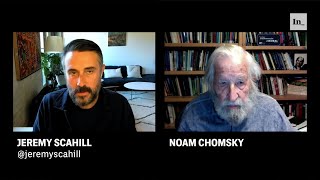 Noam Chomsky on the Russia-Ukraine War: Negotiation or Escalation2022 · 62 min · full transcript
 Noam Chomsky on the Russia-Ukraine War: Propaganda and Escalation2022 · 57 min · full transcript