Ukraine and Escalation
The urgent question in war: how to stop destruction rather than intensify it.

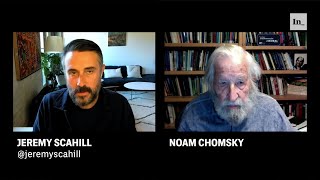
“We can, however, look at the United States and we can see that our explicit policy — explicit — is rejection of any form of negotiations. The explicit policy goes way back, but it was given a definitive form in September 2021 in the September 1 joint policy statement that was then reiterated and expanded in the November 10 charter of agreement. And if you look at what it says, it basically says no negotiations. What it says is it calls for Ukraine to move towards what they called an enhanced program for entering NATO, which kills negotiations; — this is before the invasion notice — an increase in the dispatch of advanced weapons to Ukraine, more military training, the joint military exercises, weapons placed on the border.”The Intercept interview, 2022 · 5:08
The lesson
Chomsky’s starting point is not who can score points, but how to stop Ukraine’s destruction. He treats the war first as a practical and moral question: what course is most likely to end the killing and reduce the risk of something even worse, including wider war. On that basis, he argues that the primary need is negotiation rather than an open-ended strategy of escalation and attrition123.
At the same time, he does not soften his judgment of the invasion itself. He says aggression is blameworthy wherever it comes from, and he places Russia’s invasion in that category without qualification45. But he also insists that explaining a war is not the same as excusing it: in his account, NATO expansion, U.S. policy, and the collapse of a more cooperative post-Cold War settlement helped create the conditions that led to this outcome67.
From there, Chomsky shifts attention to policy choices made before and during the war. He argues that U.S. policy had already moved against meaningful negotiation before the invasion by backing deeper military integration of Ukraine with NATO, more arms, and more joint military activity8. During the war, he says the dominant Western approach has treated weakening Russia as the main objective, with Ukrainian suffering becoming secondary, which is why he warns against a posture of fighting on regardless of the human cost91011.
He also argues that media framing narrows what the public is allowed to consider. In his view, wartime language and editorial selection can push people toward a mindset where defeating the enemy displaces discussion of settlement, compromise, and risk1213. Still, his position is not to ignore major media altogether; he says understanding the world requires starting there, then noticing what is emphasized, omitted, or ruled out1415.
Chomsky’s alternative is diplomacy grounded in unpleasant but necessary compromise. He points to negotiation not because it is ideal, but because that is what diplomacy means when the alternatives are prolonged destruction and possible great-power escalation163. He also warns that much of the world already sees the conflict as a proxy war fought over Ukrainian lives, which raises the stakes of choosing escalation over settlement17.
5 principles from Noam Chomsky
Start with how to end the war
Evaluate policies by whether they reduce destruction and open a path to settlement. If a proposal mainly promises more fighting, ask what concrete path it offers to ending the war rather than extending it.
“The most important question is how to end it.”
Explain causes without excusing aggression
You can condemn an invasion while still analyzing the policies and structures that helped provoke the conflict. This prevents moral clarity from turning into intellectual simplification.
“Well, who's to blame? Any power that commits aggression is to blame. So I continue to say, as I have been for many months, that the invasion, Putin's invasion of Ukraine, is on a par with such acts of aggression as the U.S. invasion of Iraq, the Stalin-Hitler invasion of Poland, other acts of supreme international crime under international law, aggression. Of course, he's to blame. You…”
Judge leaders by actions and policy, not mind-reading
Chomsky avoids speculation about private motives and instead looks at what states do, announce, and institutionalize. Apply this by focusing on observable decisions, military moves, treaties, and public doctrine.
“I have no particular insight into Putin's mind.”
Watch for escalation disguised as solidarity
Support for a victimized population can be used to justify policies whose real aim is to weaken a rival power. Ask whether the people said to be protected are actually being prioritized in the strategy.
“The war must continue in order to severely weaken Russia.”
Read mainstream coverage critically, not passively
Start with major media because they shape public understanding, then examine framing, omissions, and which options are treated as unthinkable. Critical reading means asking what kind of settlement talk is missing and why.
“…the only thing in mind is to destroy the enemy…”
Moments to watch
In his own words
The quotes behind the lesson, word for word from the transcripts. Numbers match the lesson above.
“What is the best thing to do to save Ukraine from a grim fate, from further destruction?”
“The primary need to move towards a negotiated settlement…”
“The most important question is how to end it. It's a horrible criminal aggression, causing enormous atrocities, great dangers, and prospective dangers even up to nuclear war. So the main question is how to put it to an end. Well, there are two ways. One way is through a diplomatic settlement. If you don't want a diplomatic settlement, the second way is let them fight it out, and we'll see what happens. Horrible experiment. So if possible, we would like to pursue a diplomatic…”
“Any power that commits aggression is to blame.”
“Well, who's to blame? Any power that commits aggression is to blame. So I continue to say, as I have been for many months, that the invasion, Putin's invasion of Ukraine, is on a par with such acts of aggression as the U.S. invasion of Iraq, the Stalin-Hitler invasion of Poland, other acts of supreme international crime under international law, aggression. Of course, he's to blame. You…”
“…the invasion of Ukraine was demonstrably provoked…”
“The United States had no interest in that.”
“We can, however, look at the United States and we can see that our explicit policy — explicit — is rejection of any form of negotiations. The explicit policy goes way back, but it was given a definitive form in September 2021 in the September 1 joint policy statement that was then reiterated and expanded in the November 10 charter of agreement. And if you look at what it says, it basically says no negotiations. What it says is it calls for Ukraine to move towards what they called an enhanced program for entering NATO, which kills negotiations; — this is before the invasion notice — an increase in the dispatch of advanced weapons to Ukraine, more military training, the joint military exercises, weapons placed on the border.”
“The war must continue in order to severely weaken Russia.”
“What happens to Ukrainians is incidental.”
“Let’s fight to the last Ukrainian.”
“…the only thing in mind is to destroy the enemy…”
“…language basically as a system of thought…”
“You can, if you want to understand what's going on in the world, you have to start with the major media.”
“The first thing I do in the morning is read the national press.”
“That's the meaning of diplomacy.”
“The world, most of the world sees this as a proxy war between Russia and the United States fought over Ukrainian bodies…”
Reflect
- When you read coverage of a war, do you first ask who is right, or what would most likely stop the destruction? How would your understanding change if you reversed that order?
- Think of a conflict in your own work or life. What would it mean to explain how it escalated without treating explanation as justification?
- Pick one major news source you follow. What options or assumptions does it make seem natural, and which ones does it make hard to think or say?
Check your understanding
Go deeper
 Noam Chomsky on the Russia-Ukraine War: Negotiation or Escalation2022 · 62 min · full transcript
 Noam Chomsky on the Ukraine War: Diplomacy or Escalation?2022 · 49 min · full transcript
 Noam Chomsky on Russia and Ukraine: Power, NATO, and War2022 · 14 min · full transcript
 Noam Chomsky on the Russia-Ukraine War: Propaganda and Escalation2022 · 57 min · full transcript
 Noam Chomsky on Russia-Ukraine Conflict: NATO, Escalation, and Europe2022 · 40 min · full transcript
 Noam Chomsky on Ukraine War Escalation: The Danger of Great-Power Conflict2022 · 18 min · full transcript
 Noam Chomsky on Russia-Ukraine War: Diplomacy or Disaster2022 · 163 min · full transcript
- What did Noam Chomsky say about the U.S. policy toward negotiations in Ukraine?
- What did Noam Chomsky say about who is to blame for the invasion of Ukraine?
- What did Noam Chomsky say is the most important question in the Ukraine war?
- What did Noam Chomsky say about the Russia-Ukraine crisis and NATO expansion?