Universal Grammar
Why limited experience can yield an infinite command of language.
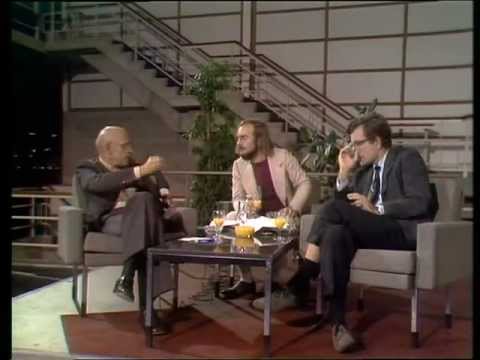
“…this instinctive knowledge, if you like, this schematism…”International Philosophers' Project debate, Eindhoven, 1971 · 8:18
The lesson
Chomsky’s central question is simple but deep: how do children reach a rich command of language when the experience available to them is limited? His answer is that language acquisition must rely on built-in structure, not just on what comes from the environment. He describes this as an innate organizing basis that makes learning possible rather than a blank mind waiting to be filled12.
This is why Universal Grammar matters. For Chomsky, the goal is not merely to list patterns in speech, but to explain how a speaker can develop an internal system that supports unlimited understanding and production from finite exposure. A theory of language counts only if it helps explain that internal capacity; otherwise it falls short of real explanation23.
He also connects this view to a broader picture of human nature. Language is one of the clearest cases showing that ordinary people are not passive recorders of data but active, creative knowers. The same underlying outlook appears in his claim that creativity is a basic human need and capacity, not a rare luxury45.
Chomsky therefore pushes linguistics toward simplicity and explanatory depth. If a theory permits countless impossible forms, it is too unconstrained to explain what humans actually know. A better theory narrows the possibilities, making it more plausible that children could arrive at a specific grammar from limited input and that science could explain this achievement with simple principles67.
4 principles from Noam Chomsky
Look for innate structure behind learning
When experience seems too limited to account for what is learned, ask what prior structure the learner must bring. Chomsky’s view is that language acquisition reveals built-in organization that guides development.
“…this instinctive knowledge, if you like, this schematism…”
Demand explanation, not just description
A useful theory should explain how a human being can actually acquire and use language, not merely sort or reproduce data. Chomsky treats explanatory adequacy as the real standard for progress in linguistics.
“…the holy grail was genuine explanations of fundamental properties of human language…”
Treat creativity as ordinary human capacity
Language matters because it shows everyday creativity: people produce and understand expressions they have never encountered before. Chomsky sees this as part of a broader human nature that seeks creative activity.
“…a fundamental element of human nature is the need for creative work…”
Prefer simpler, more constrained theories
If a theory allows too many impossible options, it explains little. Chomsky argues that simpler foundations increase explanatory power and better fit the problem of how language can be learned from limited evidence.
“That phrase structure grammar is completely unacceptable. They're way too complex. A phrase structure grammar, for one thing, allows totally impossible rules. So there's nothing in a phrase structure grammar that says you can't have a rule say, sentence becomes a preposition verb phrase or something or anything else you can imagine. So it just allows a huge number of rules that are completely impossible. So there's got to be something wrong with it. Also I think in retrospect we can now see that phrase structure grammar conflated three quite different notions.”
In his own words
The quotes behind the lesson, word for word from the transcripts. Numbers match the lesson above.
“…this instinctive knowledge, if you like, this schematism…”
“…the holy grail was genuine explanations of fundamental properties of human language…”
“Anything short of that is not a genuine explanation.”
“…a fundamental element of human nature is the need for creative work…”
“Now a federated, decentralized system of free associations, incorporating economic as well as social institutions, would be what I refer to as anarcho-syndicalism; and it seems to me that this is the appropriate form of social organization for an advanced technological society, in which human beings do not have to be forced into the position of tools, of cogs in the machine. In which the creative urge that I think is intrinsic to human nature, will in fact be able to realize itself in whatever way it will. I don't know all the ways in which it will.”
“That phrase structure grammar is completely unacceptable. They're way too complex. A phrase structure grammar, for one thing, allows totally impossible rules. So there's nothing in a phrase structure grammar that says you can't have a rule say, sentence becomes a preposition verb phrase or something or anything else you can imagine. So it just allows a huge number of rules that are completely impossible. So there's got to be something wrong with it. Also I think in retrospect we can now see that phrase structure grammar conflated three quite different notions.”
“Of course, always when you look in any field, you would be looking for the simplest theory that's simply a general fact about explanation. It's clear that as the foundations of a theory become simpler, its explanatory depth increases. So, if science is interested in explanation, not just simulation, it'll be, of course, looking for the simplest theory. There’s a second reason for looking for the simplest theory, which is a kind of a percept—it goes back to Galileo again, who simply urged that we accept the idea.”
Reflect
- Think of a skill you learned quickly as a child. What features of that learning seem hard to explain by raw exposure alone?
- When you evaluate a theory in your own field, do you mainly ask whether it fits the data or whether it explains how the ability is possible?
- Where in your work might a simpler, more constrained explanation be stronger than a more flexible but less informative one?

