Why did Noam Chomsky support anarcho-syndicalism?
Noam Chomsky said he favored a federated, decentralized system of free associations because he thought it best fit an advanced technological society. In his view, people should not be forced into the role of tools or cogs in a machine, and social institutions should let their creative urge realize itself.
“Now a federated, decentralized system of free associations, incorporating economic as well as social institutions, would be what I refer to as anarcho-syndicalism; and it seems to me that this is the appropriate form of social organization for an advanced technological society, in which human beings do not have to be forced into the position of tools, of cogs in the machine. In which the creative urge that I think is intrinsic to human nature, will in fact be able to realize itself in whatever way it will. I don't know all the ways in which it will.”
Key takeaways
- Prefer decentralized institutions over rigid hierarchy.
- Build systems where people are not reduced to cogs.
- Let creative human capacities shape social design.
Context
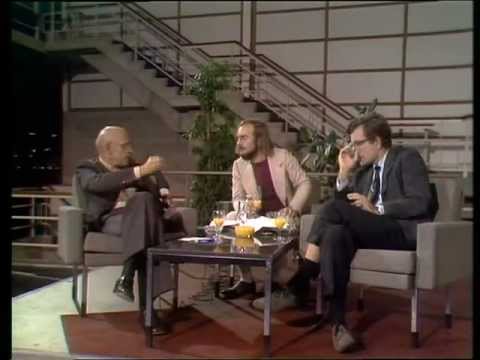
In the same 1971 debate, Chomsky explained how his political ideal followed from his view of human nature. The quote above is taken word for word from the recording's transcript.
In the transcript
…begin by referring to something that we have already discussed, that is, if it is correct, as I believe it is, that a fundamental element of human nature is the need for creative work, for creative inquiry, for free creation without the arbitrary limiting effect of coercive institutions, then, of course it will follow that a decent society should maximize the possibilities for this fundamental human characteristic to be realized.
Now a federated, decentralized system of free associations, incorporating economic as well as social institutions, would be what I refer to as anarcho-syndicalism; and it seems to me that this is the appropriate form of social organization for an advanced technological society, in which human beings do not have to be forced into the position of tools, of cogs in the machine. In which the creative urge that I think is intrinsic to human nature, will in fact be able to realize itself in whatever way it will. I don't know all the ways in which it will.
I would say that I am much less advanced than Mr. Chomsky in this respect. That is, I admit not being able to define, not even to propose, an ideal social model for the functioning of our scientific or technological society. On the other hand, one of the tasks that seems immediate and urgent to me, over and above anything else, is this: it is the custom, at least in…
Read the full transcript of International Philosophers' Project debate, Eindhoven, 1971
Topics
What others said about politics & government
- What did Ray Dalio say about populism and revolution?
- What did Mark Zuckerberg say about censorship during COVID and the pressure from government?
- What did Yuval Noah Harari say about why the war in Ukraine matters globally?
- What did Marc Andreessen say about political religions like communism and fascism?
More questions about Noam Chomsky
- What did Noam Chomsky say about the Trump administration and wealth in politics?
- What did Noam Chomsky say about the U.S. policy toward negotiations in Ukraine?
- What did Noam Chomsky say is the most important question in the Ukraine war?
- What did Noam Chomsky say about who is to blame for the invasion of Ukraine?
- What did Noam Chomsky say about the Vietnam War in 1969?
- What did Noam Chomsky say about libertarian socialism?
How this answer was made: the quote is checked word for word against the transcript of the recording and confirmed as the speaker's own words; the summary above it was drafted with AI from that transcript and quality-checked. Methodology and corrections.