Noam Chomsky on Trump And Fascism
Chomsky sees Trump less as a fully realized fascist than as a dangerous symptom of democratic decay: concentrated wealth, mass discontent, authoritarian politics, and reckless contempt for climate and nuclear survival.
- Trump is a product of long-term democratic erosion and concentrated corporate power.
- Chomsky treats Trump’s appeal as rooted in anger, loss, and disillusionment, which can be turned in authoritarian directions.
- He warns against obsessing over spectacle while deeper harms to health, the environment, and public welfare continue.
- For Chomsky, the gravest issue is that Trump intensifies the two biggest threats: nuclear war and environmental collapse.
- He does not dismiss fascist danger; he sees real risk when fear, racism, and social breakdown can be mobilized by power.

“Fascism, but it's not to be dismissed, and I think we can easily see how, if there had been a charismatic figure in the United States who could mobilize fears, anger, racism, a sense of loss of the future that belongs to us, this country could be in real danger. We're lucky that there never has been an honest charismatic figure. McCarthy was too much of a thug, you know; Nixon…”Democracy Now! interview, 2017 · 1:10:18
Trump is a symptom of a deeper crisis in democracy
Chomsky’s basic view is that Trump did not come out of nowhere. He places Trump inside a much longer process in which political and economic power moved upward, away from the public and toward wealthy elites and corporate interests. In that picture, Trump is not an exception to the system so much as an especially blunt display of how it works.1
That is why Chomsky connects Trump to democratic breakdown, not just to one personality. When wealth is heavily concentrated, public institutions weaken and large parts of the population feel abandoned. The result is anger without meaningful representation, which creates openings for harsher and more authoritarian politics.13
He also treats this as part of a broader structure of power in the United States, which remains extremely powerful as a state even while internal decision-making is increasingly dominated by narrow private interests. Trump matters, in this view, because he exposes that concentration rather than reversing it.41
Why Trump’s message could connect with mass anger
Chomsky links Trump’s support to real social injury. He points to people facing stagnation, loss of security, weakened unions, and a political system that no longer seems responsive. That discontent can move in very different directions, and Chomsky sees Trump and other anti-establishment figures as drawing from the same reservoir of frustration even when their politics diverge sharply.3
What makes this dangerous is that social pain does not automatically produce democratic renewal. It can also be channeled into fear, racism, resentment, and the search for a strongman. Chomsky explicitly warns that under those conditions a more capable authoritarian figure could place the country in real danger.5
So when people ask whether Chomsky thinks Trump is fascist, the most accurate answer is that he does not wave the label around casually, but he does insist that the danger is real and should not be minimized. His concern is less semantic than political: whether fear and loss are being organized into forms of domination.56
“Fascism, but it's not to be dismissed, and I think we can easily see how, if there had been a charismatic figure in the United States who could mobilize fears, anger, racism, a sense of loss of the future that belongs to us, this country could be in real danger. We're lucky that there never has been an honest charismatic figure. McCarthy was too much of a thug, you know; Nixon…”Democracy Now! interview, 2017 · full transcript →
The real danger is not the daily spectacle but the underlying program
Chomsky repeatedly argues that attention can be pulled toward the noisiest Trump scandals while more consequential policies proceed in the background. He is especially critical of the way opposition can become fixated on a single controversy while broader attacks on public welfare and democratic accountability receive less scrutiny.7
For him, this matters in concrete areas like health care and social provision. He describes the U.S. health care system in stark terms and sees attacks on already inadequate protections as part of a wider politics that harms ordinary people while serving concentrated wealth.8
This is one reason Chomsky treats Trump as more than a cultural phenomenon. The administration, in his account, dramatizes a governing model in which investor and billionaire priorities dominate, while the public is distracted by spectacle and conflict.9
“…the one issue that seems to, uh, inflame the Democratic opposition is the one thing that has some justification…”Democracy Now! interview, 2017 · full transcript →
Trump becomes most dangerous where authoritarianism meets existential risk
Chomsky’s strongest warnings about Trump are tied to climate and nuclear weapons. Across these interviews, he keeps returning to the claim that humanity faces two overriding dangers, and that everything else is secondary beside them.101112
He sees Trump as especially dangerous because the administration worsened both fronts at once. On climate, Chomsky argues that U.S. obstruction under Trump intensified the risk of environmental breakdown; on nuclear issues, he warns about reckless international conduct in a world where great-power confrontation can spiral.131415
This is where the question of fascism becomes practical rather than theoretical. An authoritarian politics is not only about internal repression or nationalist rhetoric; in Chomsky’s view, it is also about leadership that is willing to gamble with the conditions for organized human life. That is why he treats these threats as the essential measure of political judgment.141711
How Chomsky thinks people should understand and resist the danger
Chomsky’s answer is not fatalism. Since he sees Trump as rooted in concentrated power, democratic decline, and manipulated anger, resistance has to go deeper than outrage at one leader. It has to rebuild institutions through which ordinary people can exercise power rather than just react to it.16
That means keeping attention on class power, investor-driven policy, and the long attack on labor and social democracy. Chomsky’s point is that authoritarian tendencies grow when people are isolated, insecure, and convinced politics belongs to someone else. Reversing that requires organization and democratic empowerment, not just denunciation.69
So the lasting lesson of his view on Trump and fascism is that the danger is real, but it is also intelligible. If concentrated wealth keeps hollowing out democracy, if social suffering keeps being redirected into fear, and if existential threats are ignored, then more dangerous forms of authoritarian politics remain possible.5115
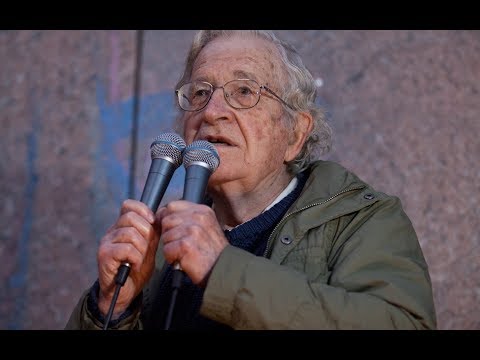
“It can be used to increase the concentration of power, surveillance, domination, control, or it can be used to empower people.”Interview on US elections and inequality, 2017 · full transcript →
Chomsky on trump and fascism, in his own words
“Fascism, but it's not to be dismissed, and I think we can easily see how, if there had been a charismatic figure in the United States who could mobilize fears, anger, racism, a sense of loss of the future that belongs to us, this country could be in real danger. We're lucky that there never has been an honest charismatic figure. McCarthy was too much of a thug, you know; Nixon…”
Where to watch
 Noam Chomsky on Trump, Democracy, and Nuclear Risk2017 · 72 min · full transcriptBest for Chomsky’s direct assessment of Trump’s presidency, elite power, distraction politics, and nuclear risk.
 Noam Chomsky on Inequality and Democracy: Trump, Sanders, and Power2017 · 41 min · full transcriptBest for understanding the inequality, disillusionment, and democratic decay that made Trump possible.
 Noam Chomsky on Trump and U.S. Decline: Climate, Power, and Isolation2017 · 55 min · full transcriptBest for Chomsky’s stark warning about Trump, climate breakdown, and the convergence of existential threats.
 Noam Chomsky on War, Democracy, and Climate: Can We Choose?2020 · 110 min · full transcriptBest for the wider framework linking authoritarian politics to neoliberalism, weakened democracy, and survival threats.
 Noam Chomsky on Global Power: Who Rules the World Now?2011 · 17 min · full transcriptBest for the big picture of concentrated corporate power and the larger structure behind Trump-era politics.
Questions people ask
Sources
Every quote above, word for word from the transcripts. Numbers match the text.
“…power is overwhelmingly and increasingly, in recent years, in the hands of a very narrow sector of corporate wealth, private wealth and power…”
“…the primary source of the so-called gridlock and dysfunction…”
“…the United States, despite its decline for many many years, is still overwhelmingly more powerful than any state or group of states…”
“Fascism, but it's not to be dismissed, and I think we can easily see how, if there had been a charismatic figure in the United States who could mobilize fears, anger, racism, a sense of loss of the future that belongs to us, this country could be in real danger. We're lucky that there never has been an honest charismatic figure. McCarthy was too much of a thug, you know; Nixon…”
“It can be used to increase the concentration of power, surveillance, domination, control, or it can be used to empower people.”
“…the one issue that seems to, uh, inflame the Democratic opposition is the one thing that has some justification…”
“The U.S. health care system is an international scandal.”
“They’re designed for the benefit of investors.”
“The greatest danger is – there are two huge dangers that the human species faces.”
“Everything else fades into insignificance in comparison to them.”
“There are two huge problems: one is the growing threat of nuclear war…”
“…the most severe that have ever arisen in human history…”
“…the likely destruction of the possibility for organized human life…”
“…two major threats to survival begin to converge…”
“…we should never overlook the fact that the threats that we know we now face are the most severe…”
How this guide was made: drafted with AI from the full transcripts of the recordings cited, then checked: every quotation must match a transcript word for word and be the speaker's own words, and an independent review gates accuracy. Methodology and corrections.