Jim Simons on Math and Philanthropy: A Short Story of My Life
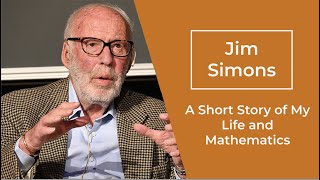

What Simons talks about
Jim Simons gives this short autobiographical talk for the Simons Foundation in 2022, tracing his path from mathematics and codebreaking to hedge fund success and philanthropy focused on science.
Also known as: Short Story of My Life and Mathematics; Simons Foundation short biography talk; Abel Prize short biography talk.
Jim Simons gives a brisk life story: he loved math early, studied at MIT and Berkeley, and became known for work in differential geometry and minimal surfaces. He also explains how mathematical ideas from his research later found major use in physics through Chern-Simons theory.
He then shifts to his career at the Institute for Defense Analyses, where he worked on codebreaking, before describing how he later founded a highly successful hedge fund. The talk ends with the way he and Marilyn Simons chose to give much of that wealth away through their foundation, with a strong emphasis on science funding.
Simons speaks throughout, ending with a brief audience Q&A.
In his words
“I did a lot of math, I made a lot of money, and I gave almost all of it away.”
“I really like that field”
“What we were supposed to do is, uh, break Russian codes.”
“You never know where something will go.”
“Ninety percent of it should be science”
Key points
- Simons says his life story is: math, money, and philanthropy.
- He describes an early fascination with doubling numbers and simple mathematical ideas.
- At MIT and Berkeley, he worked in differential geometry and minimal surfaces.
- He recounts solving an important open problem in higher-dimensional minimal surfaces.
- He explains how Chern-Simons theory later became central in physics.
- He worked at the Institute for Defense Analyses doing codebreaking work.
- He and Marilyn Simons put most of his wealth into a foundation focused mainly on science.
Full transcript: Jim Simons, A Short Story of My Life and Mathematics (2022)
Well, the short talk is this: I did a lot of math, I made a lot of money, and I gave almost all of it away. That's the story of my life. Now, it's a good story, but it's short. So, when I was a little boy, I, uh, I liked math in the sense that I liked to, when I was three or four or something like that, double the numbers to 4, 8, 16, 32, etc. I got up to a thousand and twenty-four.
And I said, enough of that. But, uh, I liked doubling numbers. And, uh, when I was a little boy also, I was in my father's—my father was driving me and he said he has to go to a gas station and get gasoline. I said, why do you need to get gasoline? He says, well, a car needs gasoline. I said, but you shouldn't need to have to get gasoline. You could just use half of what you now have, and then half of that, and half of that, and half of that, and you'll never run out of gas.
Without what's called Zeno's Paradox. But, uh, because it didn't occur to me that we wouldn't get very far either. But, uh, there, there it was. But I did always, always like math, and, uh, I went to MIT, and, uh, I took a graduate course right in my freshman year, which, uh, was puzzling to me. It was abstract algebra, but during this summer I figured it all out. I got a book; I figured it all out and then took a lot of math courses at MIT.
Um, and, uh, well, the field that I really liked was called differential geometry. How many of you have ever heard of differential geometry? Okay, the old folks know about differential geometry. Well, differential geometry is a study of curved spaces in many dimensions, typically with a metric on it so you can see how far apart any two points would be. And, uh, I really like that field, and, well, um...
I went to Berkeley. I forgot my—well, I—I graduated MIT in three years, so I stayed as a graduate student for a year, and then they told me you should go to Berkeley. And I said, why? Why should I go to Berkeley? They said, well, the great man in your field, differential geometry, a man named Chern, is just going to Berkeley, and you should work under Chern. So I said, okay. So I went out to Berkeley. Regrettably, uh, Chern was taking a sabbatical leave that year.
And so he wasn't there, so I worked with someone else, and that, that worked out fine. Uh, it was interesting, uh, working with this guy. I came up with a little theorem and I showed it to him, and he said, oh, that's a nice little theorem. It puts in mind an open question which I won't really describe to you, but, uh, but don't work on that question. I said, why? He said, because it's too tough. This one worked on it and tried, and that one worked on it and tried. Well, of course, that just sort of got me...
Going, and, uh, I said, okay, but I—I'm going to work on this problem. And, uh, well, uh, I did, and I solved the problem, and I was very pleased with myself, and, uh, went back to teach at MIT and Harvard. But for reasons which I won't go into, I, uh, I needed money, and I had borrowed money to invest in a company with some friends of mine, and I needed to pay it back. But there was a place in Princeton
called The Institute for Defense Analyses, which was a highly classified place under the aegis of the government, the Defense Department. And what we were supposed to do is, uh, break Russian codes. Well, that was an interesting challenge. Uh, I liked the work. They told us you could do your own mathematics up to half your time; the other half you had to do, you know, this code-cracking business.
And, well, uh, during that period I was very interested in an area of mathematics called minimal surfaces. Does any of you know what a minimal surface is? Well, someone must know what a minimal surface is. Okay, so a minimal surface is a surface of minimal area with respect to its boundary. So imagine taking a wire frame, just a closed frame, dipping it in, so in, in soap suds, and then take it out and there'll be a film
that is bounded by this thing, and that film, that soap film, has less an area than any other surface with that boundary. So that's a minimal, that's a minimal surface. And, uh, the first Fields Prize winner, uh, back in maybe 1905, had proved that any such boundary would have a minimal surface, just one, and it would be smooth. It wouldn't have any points or anything like that; it would just be a nice smooth surface.
And as I said, he won the Fields Medal for that. And, um, so I got interested in that area while I was there at, uh, at The Institute for Defense Analyses. So in my spare time, which was quite a lot, I worked on that problem because in higher dimensions it was an open—was an open problem. Someone had done it in one dimension higher, uh, so that would be, uh, a three-dimensional surface with a two-dimensional boundary in four-dimensional space.
And, uh, well, uh, but that's where it stopped. So I worked in that problem in higher dimensions and was, uh, lucky enough to solve the problem through ambient dimension seven. But in dimension eight, my proof didn't work, and, uh, and I constructed what I thought was a counterexample. A counterexample was something that, uh, you, you, you think you have a, you've proved the theorem, but someone comes along with an example that shows you didn't prove that theorem because...
This is a counterexample. So, uh, I found what I thought was a counterexample. I couldn't prove it, but a couple years and I—the paper got published. It was a pretty good paper, actually. And, um, but a few years later, a couple of mathematicians, one of whom was named Bombieri, and, uh, showed that my counterexample was really a counterexample. So that killed the problem altogether. Well, uh, at a certain point I came to Stony Brook University. I was 30 years
old to be the chair of their math department, which was not a very strong department, and I was pretty young to be the chairman, but I thought it would be fun. And I had a lot of money to work with because the governor at the time was a guy named Rockefeller. Now, I think everyone has probably heard of the name Rockefeller, but has anyone not heard of the name Rockefeller? Okay, most of you have heard of Rockefeller. Rockefeller loved the State University and was pouring money on it, so I had a lot of money to work with and, uh,
hired some terrific people. So I hired some terrific people. But at the same time in that timeframe, I started to get interested in another area of math, and, uh, I worked on that area and came up with something really quite beautiful: three dimensions. It was a function—I can't really describe it—but it lived in three-dimensional closed spaces, and I was quite pleased.
I showed it to Chern. I—I say I showed it—I—we—I sent it by mail, because those days there was no email. And Chern said, "Well, you've done this in three dimensions, but it should work in all dimensions." I was very dubious, but I said, "Okay, let's work together and see." And he was right. It would work in all dimensions, and I was very pleased. We published the paper, and about five years later a physicist named Witten saw this paper and thought—and he was
right—it could apply to physics. And then some other physicists saw how it could apply to physics. I didn't know any physics at all. Chern might have known something, but it never occurred to him that it would apply to physics, and remarkably so. You never know where something will go. You think you're doing math and you're actually doing physics, maybe, or whatever. So today that is called Chern-Simons Theory.
It's all over the place in physics. On average, every day four papers in physics reference this Chern-Simons Theory. So I can't take any credit for it at all, but there it was. And, of course, I'm quite pleased about it, but I can't say that, "Oh, I—I invented this for physics." Well, shortly after that, I started to get interested in the world of investments. I had come into a very small amount of money, but it was
enough to start investing, and one thing led to another—I started hiring people and we made what was called a hedge fund, and it was remarkably successful. It's still going. I'm not with it anymore, but I made a tremendous amount of money from this, from this hedge fund. Now, my lovely wife Marilyn said, "Let's give some of it away," so I said, "Okay, fine." So we gave some charity, and then she said, "Well, why don't we
start a foundation?" And, uh, okay, starting a foundation: she started a foundation, I put money into it. The good thing about putting money into a foundation is you can give the money away, you've got the tax advantage, but it doesn't have to be spent immediately, so you can put money into the foundation and say, "Well, we'll see what we want to do with it tomorrow or next year or whatever," but it grew and grew and grew. So, uh, it—today, oh, well, we decided to focus on science
with our, uh, foundation—focus on science. Uh, ninety percent of it should be science, 60 of that should be basic science, and 30 of that could be translational science, and 10 could be education and outreach and things like that. So today, uh, that foundation is extremely large, and, uh, so most of the money that I made was put into the foundation.
So I'm not so rich as I was before, but, uh, rich enough. And we had this wonderful foundation, and, uh, running it most of the time was my wonderful wife. Any questions? No questions? Yeah? Yuri is in the foundation. He just talked. Uh, that's a very good question. I could go into that, but it's a long story, so—I won't.
Any other questions? Okay, good luck to all of you. (applause)
From YouTube captions, lightly punctuated for readability. Timestamps link to the video above. Errors are possible.
Cite this recording
Jim Simons, “A Short Story of My Life and Mathematics (2022)”, Simons Foundation, 2022. Transcript and video: Thinkers Archive, https://thinkersarchive.com/jim-simons/math-and-philanthropy-short-story-2022/
Quoting a passage? Link to its exact moment: every timestamp above has its own anchor (for example https://thinkersarchive.com/jim-simons/math-and-philanthropy-short-story-2022/#t-131).