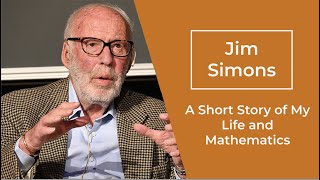
Jim Simons on Differential Geometry
Jim Simons saw differential geometry as a beautiful, structural way to understand manifolds, curvature, and invariants, with basic ideas that later turned out to matter far beyond pure math.
- He was drawn to differential geometry by the beauty of Stokes’ theorem and proof-based structure.
- He treated geometry as a source of deep invariants, moving from minimal varieties and holonomy to characteristic classes and Chern-Simons theory.
- He valued intrinsic, conceptual formulations, especially the line from Gauss-Bonnet to Chern-Weil and beyond.
- He believed basic mathematics often finds important uses later, especially in physics, even when that was not the original goal.

“…that opened the floodgates in a way of, uh, the theory of characteristic classes…”NAS Research Briefings lecture · 13:10
Differential geometry captured him because it was beautiful and exact
Simons’s attachment to differential geometry began with temperament as much as topic. He says mathematics felt natural to him from childhood, and he was especially drawn to the theorem-proof style of thinking rather than to status or competition123.
The decisive moment was Stokes’ theorem. He describes it as an epiphany that made him want to enter differential geometry, because it revealed a sweeping structure connecting calculus, dimension, and manifolds in one idea456.
That helps explain what differential geometry meant to him: not just studying curves and surfaces, but seeing a unified language for space, form, and proof. Its appeal was aesthetic and conceptual at once74.
He followed geometry from local calculations to global structure
Simons’s work in the field moved along a classic geometric path: from local differential data to global consequences. His interests included holonomy, minimal varieties, and the behavior of geometric objects in higher dimensions, all of which ask how local rules constrain overall form3.
That same pattern appears in his later focus on characteristic classes. He highlights the importance of the theory opened up by these ideas, showing his interest in invariants that convert geometric information into topological meaning910.
This is a central theme in how he thought about differential geometry: the field becomes powerful when curvature, connections, and transport stop being isolated computations and become a way to classify spaces and bundles10.
“…that opened the floodgates in a way of, uh, the theory of characteristic classes…”NAS Research Briefings lecture · full transcript →
He cared about intrinsic formulations, not just formulas
Simons repeatedly gravitates toward cleaner, more intrinsic ways of doing geometry. His discussion of Gauss-Bonnet and Chern’s intrinsic proof shows admiration for approaches that reveal the real geometric mechanism rather than relying on coordinates or ad hoc calculation10.
That preference also explains the progression from classical theorems to Chern-Weil theory and then to Chern-Simons forms. For him, differential geometry becomes richer when invariant polynomials, curvature, and bundles are organized into a conceptual framework1013.
Even failed attempts mattered if they exposed deeper structure. He recounts trying one route to a combinatorial formula and finding that it did not work, but the search led into a subject worth pursuing in its own right13.
His geometry led naturally to Chern-Simons and differential cohomology
One of Simons’s signature contributions came from extending geometric thinking about characteristic classes. He describes work that generalized these ideas into differential characters, showing his interest in refinements that keep both topological and geometric information in view10.
This line of thought produced Chern-Simons theory, which grows out of transgression ideas linking connections and curvature to secondary invariants. In Simons’s telling, this was not a side project but a natural continuation of core differential-geometric questions109.
He also makes clear that this work demanded persistence. He speaks about long stretches of effort, including periods where progress was hard and the right tools were not yet available, which underscores how seriously he took these geometric problems15.
He saw differential geometry as basic science that can travel far
Simons did not present differential geometry as useful because it had immediate applications. His view was almost the opposite: the best basic mathematics often goes somewhere surprising later, and you cannot predict that in advance1820.
His own career supplied the example. Ideas from his geometric work, especially Chern-Simons invariants, were later taken up by physicists and became important across several parts of modern physics18.
That is why differential geometry mattered so much to him. It was beautiful enough to pursue for its own sake, but also deep enough to reshape neighboring fields once the right connections appeared7.
Simons on differential geometry, in his own words
“It was just a beauty. It was just a beauty of it.”
“…that opened the floodgates in a way of, uh, the theory of characteristic classes…”
“…it ended up being something that seemed worthy of study on its own…”
Where to watch
 Jim Simons on Mathematics and Luck: A Life in Ideas81 min · full transcriptBest single overview of why Stokes’ theorem pulled him into differential geometry and how that led to later work.
 Jim Simons on Differential Cohomology: the mathematical roots2013 · 96 min · full transcriptBest for the mathematical arc from Gauss-Bonnet and characteristic classes to differential cohomology and differential characters.
 Jim Simons on Chern-Simons Forms: From Gauss-Bonnet to Physics68 min · full transcriptBest for understanding how Simons thought about Chern’s intrinsic proof, Chern-Weil theory, and the origin of Chern-Simons forms.
 Jim Simons on Mathematical Career: From Minimal Surfaces to Chern-Simons23 min · full transcriptBest short account of his path from minimal surfaces to characteristic classes and why basic math later mattered in physics.
 Jim Simons on Geometry and Physics: Math, Science, and Purpose60 min · full transcriptBest for his broad view that geometry and physics are deeply intertwined in modern science.
Questions people ask
- What did Jim Simons say about Stokes' theorem and why he chose mathematics?
- What did Jim Simons say about trying to compute the signature of a 4-manifold?
- What did Jim Simons say about how math leads to unexpected applications?
- What did Jim Simons say about taking on hard math problems?
- What did Jim Simons say about the later applications of Chern-Simons theory?
- What did Jim Simons say differential characters are?
Sources
Every quote above, word for word from the transcripts. Numbers match the text.
“It was very natural and I I always liked it.”
“As a child, I was always interested in mathematics…”
“The idea of theorems and proofs really appealed to me…”
“But I really had an epiphany when I learned Stokes' theorem. Now, I guess you're all mathematicians so you probably know Stokes' theorem. You integrate one thing over a boundary and you take its differential and you--that's the same as integrating that over the interior or something. And that, you know, is a great generalization of the fundamental theorem of calculus and it works at all dimensions. And I thought it was the most beautiful thing, that theorem. And it really made me appreciate mathematics, it made me want to become--go into this field of differential geometry which I had sort of gradually learned existed.”
“It was the most beautiful thing, that theorem.”
“And it made me appreciate the beauty of mathematics.”
“It was just a beauty. It was just a beauty of it.”
“…that opened the floodgates in a way of, uh, the theory of characteristic classes…”
“…the roots of the subject that's come to be known as differential cohomology…”
“…it ended up being something that seemed worthy of study on its own…”
“And I didn't publish anything during those five years, but it was worth it because I learned a lot about that stuff.”
“…you do something in basic mathematics or basic science, and you really don't know where it's going to go.”
“You never know where something will go.”
How this guide was made: drafted with AI from the full transcripts of the recordings cited, then checked: every quotation must match a transcript word for word and be the speaker's own words, and an independent review gates accuracy. Methodology and corrections.