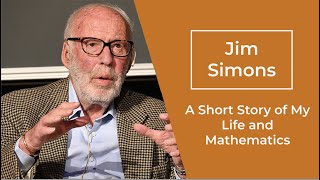
Jim Simons on Career Transitions
Jim Simons treated career transitions as moves toward problems he found more compelling, carrying over mathematical taste, algorithmic thinking, and a willingness to rebuild the work around data and great collaborators.
- He changed fields when a problem or way of working became more compelling than his current path.
- He carried skills across domains: math taste, algorithms, statistics, and model-building.
- His biggest investing transition was from intuition and fundamentals to fully systematic models.
- He saw great collaborators as the engine that makes a transition succeed.
- He thought luck matters, but so do distinctive methods and disciplined execution.

“I'm either going to write a thesis or trade soybeans because you couldn't possibly do both.”San Francisco State University lecture/conversation · 14:32
He moved when he could no longer do two things at once
Simons did not describe career change as a grand branding exercise. In his telling, transitions often came when he recognized that serious work requires commitment and that split attention has limits. His early flirtation with soybean trading clarified this fast: he concluded he had to choose between academic work and active trading rather than pretend he could excel at both.123
That point matters because it shows how practical his transitions were. He was willing to experiment, but once he saw that a new pursuit demanded real focus, he made a clean decision. For anyone considering a transition, his example suggests testing a field in reality, then committing only when the signal is strong enough to justify leaving the old lane.13
He did not abandon math; he exported its habits
Simons's moves across fields look less abrupt when you see what stayed constant. He was deeply attached to mathematics because of its clarity and beauty, and even after leaving full-time academic math he still felt more like a mathematician than a businessman. That suggests his real continuity was not industry but method: he kept carrying mathematical standards of rigor, structure, and abstraction into new settings.456
This is one of his most useful lessons on career transitions. A good transition is not starting from zero; it is finding a new arena where your old way of thinking becomes valuable. In his case, the taste formed in pure math later shaped how he approached market patterns, prediction, and system design.567
Codebreaking and computing became the bridge to finance
The middle step between academia and investing was crucial. At the Institute for Defense Analyses, Simons worked on breaking codes, and that experience taught him to design algorithms, look at data, and build models to interpret signals. He explicitly connected that work to what he later did in quantitative investing.89
That means his transition into finance was not a jump from pure thought into money-making. It was a progression from proof-oriented mathematics to applied pattern-finding under uncertainty. For people changing careers, this is a strong reminder to identify the bridge role that teaches transferable tools before making the largest leap.89
His decisive career pivot was from judgment to models
Even inside finance, Simons went through another major transition. He began with more discretionary and fundamental approaches, but came to believe markets contained patterns that could be studied mathematically and statistically. From there, the firm gradually built models that improved over time and eventually displaced the old approach.1011
He describes that shift as a turning point: once the operation became fully model-driven, it changed the nature of the business. By 1988, it was entirely models, and his rule was to follow those models consistently rather than override them with intuition. This was not just a technical upgrade; it was a philosophical commitment to disciplined execution.12131415
He believed transitions succeed through people, not solo genius
Simons repeatedly credits collaborators and hiring more than lone brilliance. He says the core advantage at Renaissance was starting with great scientists, and elsewhere he advises people to partner with the best people they can find because it amplifies what they can do. In practice, he built organizations by recruiting strong talent and getting smart people to work together.16171819
That is especially relevant for career transitions because entering a new field usually means your personal knowledge is incomplete. Simons's answer was not to wait until he knew everything. It was to assemble exceptional people, create an open research environment, and let many small improvements accumulate into an edge.201619
He paired bold moves with humility about luck
Simons did not tell his story as if every transition was the inevitable result of pure insight. He openly says luck played a major role in his success and gives concrete examples where timing mattered. At the same time, he also stresses doing something different from the pack and building a distinctive approach.21222324
That combination is important. His view is not that career transitions are random, nor that they are fully controllable. The practical takeaway is to choose an uncommon angle, work with rigor, follow the system you build, and still leave room for contingency because outcomes are never entirely yours to command.241321
Simons on career transitions, in his own words
“I'm either going to write a thesis or trade soybeans because you couldn't possibly do both.”
“…if you're going to trade using models, you just slavishly use the models…”
Where to watch
 Jim Simons on Quantitative Investing: From Math to Medallion2016 · 88 min · full transcriptBest overview of how he moved from early trading curiosity to a systematic, model-driven firm.
 Jim Simons on Mathematics and Luck: A Life in Ideas81 min · full transcriptBest for the personal turning points, especially the soybeans-or-thesis decision and his view of gradual progress through smart teams.
 Jim Simons on Mathematics and Investing: A Life Between Worlds7 min · full transcriptBest short summary of living between math and business and the shift to 100% models.
 Jim Simons on Mathematics to Quant Investing: From Geometry to Markets2007 · 61 min · full transcriptBest for seeing how his mathematical identity and later interest in prediction fit together.
 Jim Simons on Quantitative Investing: Common Sense and Good Luck2021 · 63 min · full transcriptBest for his mature view on discipline, hiring, and luck in quantitative investing.
Questions people ask
- How did Jim Simons go from intuition-based trading to quantitative investing?
- What did Jim Simons say about choosing partners and working with other people?
- What did Jim Simons say about how to succeed in mathematics and business?
- What did Jim Simons say about luck and success?
- What did Jim Simons say about the reality and permanence of mathematics?
- Why did Jim Simons think his IDA experience mattered for Renaissance Technologies?
Sources
Every quote above, word for word from the transcripts. Numbers match the text.
“I'm either going to write a thesis or trade soybeans because you couldn't possibly do both.”
“I realized I am either going to trade soybeans or write a thesis.”
“So I bought two contracts of soybeans and they did. They went up, I was making money, they went down, I was losing money. I sold them both, I got nervous then I bought one contract. Meanwhile, I was going back and forth from Berkeley into San Francisco early in the morning to watch the soybean market. And, you know, early was, you know, 8 o'clock in the morning already I was out, I mean, that was very early for a graduate student. And after a couple of weeks, I came to the most sensible conclusion of my life I think. I said, I'm either going to write a thesis or trade soybeans because you couldn't possibly do both. And I came to that realization at a good point. I had a very small profit.”
“It was just a beauty. It was just a beauty of it.”
“…deep down, I feel more like a mathematician than I do like a businessman…”
“Mathematics was my life, uh, for, uh, those years. Uh, it was, uh, so it seemed, you know, the most natural thing in the world to be always thinking about mathematics and, uh, so when I did leave the field after about 20 years in my late 30s and one of some business guy, I guess, and I went into business and business guy said to me, uh, well, how do you like the real world, you know, kind of joking around, and I said, well, you somehow it seems to me that, uh, something like the integers has a great deal more reality than some McDonald's stand or whatever, you know, that's here today and gone tomorrow and the integers are forever. So I think I implicitly, if not explicitly, I think like most mathematicians felt that these concepts were really, uh, h of an eternal nature. Uh, and so, uh, it was, that was my notion.”
“But mathematics is that way and basic science is that way. You do a piece of basic science, you know, and you don't know where it's going to go. But if it's pretty good science, it can lead to a surprising place. I mean when Maxwell developed the Maxwell equations, the television occurred to him as a consequence.”
“What we were supposed to do is, uh, break Russian codes.”
“But I really liked that whole process. I liked everything about it. I like designing an algorithm uh you know coming up with some attack, designing an efficient algorithm to uh to test it out and uh seeing how it came out. I mean you know it was uh like fishing or something. I don't know. I actually I don't like fishing because you never catch anything. But here I felt uh we might catch something every once in a while. And uh it was a lot of fun. I liked I I liked it all. And I'd never seen anything like that. So um yes, you're right. Later on that experience of making models, looking at data, making models to try to interpret the data uh was certainly learned there. Uh and I if I hadn't been there uh I think the the business that we built later would never have occurred.”
“And in looking at the patterns of prices, I could see that there was something we could study here, that there were maybe some ways to predict prices mathematically or statistically. And I started working on that and then brought in some other people and gradually we built models, and the models got better and better, and finally the models replaced the fundamental stuff. So it took a while. I would have thought with your background in mathematician this would have almost occurred to you immediately, like you would have straight away seen this. Well, what was the 2-year delay? >> Well, two things. I saw it pretty early but, and I brought in a guy who was a…”
“There should be a way to systematize it…”
“By 1988, it was 100% models.”
“…if you're going to trade using models, you just slavishly use the models…”
“Whatever the model says, they do.”
“From then on, we never looked back.”
“…the real secret sauce is that we start with great scientists…”
“Partner with the very best people you can find. And some people want to work alone their whole lives, but partnering is a great thing. And it amplifies what you can do. But you have to choose your partners carefully. I’ve been lucky enough to have wonderful partners, both in the financial business and in mathematics, and now in the foundation. So work with the best people you can find because that’s going to make your work better.”
“Well, I just thought it would be fun. Uh, the pay was pretty good, and, uh, the department was weakish, so I knew there could be improvement, and, uh, I just thought it would be fun. And it turned out I was a very good recruiter. I loved recruiting. Me too. You, you like it? Yeah, it’s really fun to find great people and lure them to your operation. So, um, so I did two things in those few years. Uh, I started what would become CH Simons, but, uh, I also, the first—…”
“Better personality for doing that. We underestimate, uh, the role of luck. It's typical that if someone fails at something, he'll say, "I had bad luck." And if he makes a success, he'll say, "I was a smart guy, and, uh, oh, I was just lucky." Uh, people don't usually say that, uh, when, when, uh, if they make a big success. And, of course, obviously not everyone can make a big success, but, uh, I think that luck played a role. I was in the right place at the right time. But I, I really, I think what I'm good at is getting good people to, uh, work together. So it was more, you would think it more…”
“…you have a lot of smart guys and they keep inching away and getting a new idea here and a new idea there…”
“The last word up there is luck. Luck. Good luck.”
“We were extremely successful. I think it was just plain good luck…”
“The good luck--if I hadn't called my stockbroker the day I did, Lenny would have held on to that gold.”
“And the first is just to do something that everybody else isn’t doing. If you run with the pack you’ll probably lose. You might win, but more likely you’ll lose. Try to come up with a different way of doing things or different set of problems to attack. And I think, anyway, that's what I did.”
How this guide was made: drafted with AI from the full transcripts of the recordings cited, then checked: every quotation must match a transcript word for word and be the speaker's own words, and an independent review gates accuracy. Methodology and corrections.