Jim Simons on Personal Story
Jim Simons tells his life as a chain of curious turns—math first, then codebreaking and models, then investing, then philanthropy—with beauty, luck, and strong collaborators shaping each step.
- His story starts with an early, almost instinctive love of mathematics.
- Beauty and proof—not status—pulled him into higher math, especially geometry and Stokes’ theorem.
- Key turning points came from trying different worlds: academia, codebreaking, trading, and eventually model-driven investing.
- He sees luck as real, but says his deeper strength was finding great people and getting them to work together.
- He sums up the arc simply: mathematics, wealth creation, and giving back through science-focused philanthropy.

“I liked counting. I liked doubling: 2, 4, 8, 16—all the way up to 128…”Origins Podcast interview, 2020s · 4:21
His life begins with liking math for its own sake
Simons describes his earliest motivation in very plain terms: math felt natural, enjoyable, and worth doing before it was a career plan. As a child he was drawn to counting, doubling, and the basic structure of numbers, and he presents that as the seed of everything that followed.1234
He also frames this early attraction as a love of thinking itself. That matters because his personal story is not mainly about ambition or external rewards; it starts from intellectual pleasure and a sense that mathematical ideas were unusually real and compelling.56
“I liked counting. I liked doubling: 2, 4, 8, 16—all the way up to 128…”Origins Podcast interview, 2020s · full transcript →
Beauty and proof gave his story its direction
When Simons explains why he became a mathematician, he keeps returning to beauty and clarity. He was especially moved by theorem-proof reasoning and by the elegance of geometry, which made mathematics feel more than useful—it felt profound.789
The strongest single episode in that story is his encounter with Stokes’ theorem. He treats it as an intellectual epiphany that clarified what kind of mathematician he wanted to become and pulled him toward differential geometry.1011

“It was the most beautiful thing, that theorem.”San Francisco State University lecture/conversation · full transcript →
His path was not linear: he chose between worlds
A big theme in Simons’s personal story is that major transitions came from decisive moments rather than a master plan. One of the clearest is the soybean episode, where he realized he could not seriously trade and seriously finish his thesis at the same time. That choice captures a pattern in his life: when two demanding paths conflicted, he eventually committed.121314
He also describes how work in codebreaking changed his toolkit. At the Institute for Defense Analyses, he was supposed to break Russian codes, but the deeper personal consequence was learning algorithms, data analysis, and model building—skills that later mattered in investing.1516
Later he moved from mathematics into business while still saying that, deep down, he felt more like a mathematician than a businessman, an identity tension that stayed with him for the rest of his career.1718
“I'm either going to write a thesis or trade soybeans because you couldn't possibly do both.”San Francisco State University lecture/conversation · full transcript →
He turned curiosity into a systematic investing career
Simons does not present his move into finance as a sudden conversion into a businessman. He says he had no real interest in business itself, though he was interested in money, and he gradually came to believe markets might be studied mathematically and statistically.2021
What changed everything was his conviction that trading could be systematized. From there, his story becomes one of replacing intuition and fundamental judgments with models, eventually reaching a fully model-driven approach.22232425
He also emphasizes that success did not come from one magic insight. It came from years of finding predictors, testing ideas, and improving the models bit by bit.2627

“There should be a way to systematize it…”MIT Sloan Fireside Chat, March 2016 · full transcript →
He sees luck as real, but collaboration as his edge
Simons resists heroic storytelling. He openly says luck played a role in his outcomes, both in investing success generally and in specific episodes where timing mattered. That makes his personal story less like a tale of total control and more like one of prepared opportunism.282930
At the same time, he does claim a repeatable strength: choosing excellent partners and building groups that work well together. He says partnering amplifies what a person can do, and he links that lesson across mathematics, finance, and philanthropy.3130
He also believes in going where others are not. In his telling, originality is practical: attack different problems, organize talent well, and let steady collective progress compound.3227

“Partner with the very best people you can find. And some people want to work alone their whole lives, but partnering is a great thing. And it amplifies what you can do. But you have to choose your partners carefully. I’ve been lucky enough to have wonderful partners, both in the financial business and in mathematics, and now in the foundation. So work with the best people you can find because that’s going to make your work better.”Public Lecture 1, University of Maryland, 2014 · full transcript →
He sums up his life as math, money, and giving back
In compact form, Simons describes the arc of his life as doing mathematics, making money, and giving most of it away. That summary is useful because it shows how he himself organizes the story: first discovery, then enterprise, then philanthropy.33
His philanthropy is not an afterthought in that arc. He speaks with special pride about scientific institutions he helped build and argues that most giving should go to science, reflecting his belief that basic research can lead to surprising and important outcomes.34353637
So the full personal story is not just child mathematician to investor. It is a continuous thread: fascination with abstract ideas, practical model-building, unusual success, and then a return to science by funding people and institutions that can extend the work beyond his own career.333437

“I did a lot of math, I made a lot of money, and I gave almost all of it away.”Simons Foundation short biography talk, 2022 · full transcript →
Simons on personal story, in his own words
“I did a lot of math, I made a lot of money, and I gave almost all of it away.”
“It was the most beautiful thing, that theorem.”
“I'm either going to write a thesis or trade soybeans because you couldn't possibly do both.”
“The businessmen looked at me like a mathematician, and the mathematicians looked at me like a businessman…”
“…deep down, I feel more like a mathematician than I do like a businessman…”
“I am as proud of the Flatiron Institute as I am for anything else I ever did.”
Where to watch
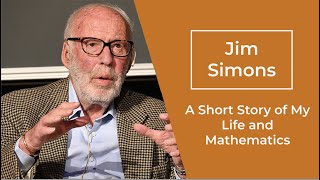 Jim Simons on Math and Philanthropy: A Short Story of My Life2022 · 16 min · full transcriptBest quick overview of how he frames his own life: math, wealth creation, and philanthropy.
 Jim Simons on Math, Codes, and Investing: A Life in Five Parts103 min · full transcriptBest for his childhood, family background, early mathematical instincts, and later pride in scientific philanthropy.
 Jim Simons on Mathematics and Luck: A Life in Ideas81 min · full transcriptBest long-form life narrative, including Stokes’ theorem, soybeans, luck, and collaboration.
 Jim Simons on Quantitative Investing: From Math to Medallion2016 · 88 min · full transcriptBest for the transition from pure math into trading and the move toward systematic investing.
 Jim Simons on Mathematics and Investing: A Life Between Worlds7 min · full transcriptBest short reflection on feeling split between mathematics and business, yet deeply a mathematician.
 Jim Simons on My Life in Mathematics: From Geometry to Quant Investing2014 · 52 min · full transcriptBest for hearing how beauty in mathematics and faith in models fit into one coherent life story.
Questions people ask
- How did Jim Simons go from intuition-based trading to quantitative investing?
- What did Jim Simons say about Stokes' theorem and why he chose mathematics?
- What did Jim Simons say about choosing partners and working with other people?
- What did Jim Simons say about how to succeed in mathematics and business?
- What did Jim Simons say about luck and success?
- Why did Jim Simons think his IDA experience mattered for Renaissance Technologies?
Sources
Every quote above, word for word from the transcripts. Numbers match the text.
“It was very natural and I I always liked it.”
“I liked counting. I liked doubling: 2, 4, 8, 16—all the way up to 128…”
“As a child, I was always interested in mathematics…”
“I just liked it, you know. I just liked it.”
“I was just a kid who just liked thinking.”
“Mathematics was my life, uh, for, uh, those years. Uh, it was, uh, so it seemed, you know, the most natural thing in the world to be always thinking about mathematics and, uh, so when I did leave the field after about 20 years in my late 30s and one of some business guy, I guess, and I went into business and business guy said to me, uh, well, how do you like the real world, you know, kind of joking around, and I said, well, you somehow it seems to me that, uh, something like the integers has a great deal more reality than some McDonald's stand or whatever, you know, that's here today and gone tomorrow and the integers are forever. So I think I implicitly, if not explicitly, I think like most mathematicians felt that these concepts were really, uh, h of an eternal nature. Uh, and so, uh, it was, that was my notion.”
“It was just a beauty. It was just a beauty of it.”
“And it made me appreciate the beauty of mathematics.”
“The idea of theorems and proofs really appealed to me…”
“It was the most beautiful thing, that theorem.”
“But I really had an epiphany when I learned Stokes' theorem. Now, I guess you're all mathematicians so you probably know Stokes' theorem. You integrate one thing over a boundary and you take its differential and you--that's the same as integrating that over the interior or something. And that, you know, is a great generalization of the fundamental theorem of calculus and it works at all dimensions. And I thought it was the most beautiful thing, that theorem. And it really made me appreciate mathematics, it made me want to become--go into this field of differential geometry which I had sort of gradually learned existed.”
“I'm either going to write a thesis or trade soybeans because you couldn't possibly do both.”
“I realized I am either going to trade soybeans or write a thesis.”
“So I bought two contracts of soybeans and they did. They went up, I was making money, they went down, I was losing money. I sold them both, I got nervous then I bought one contract. Meanwhile, I was going back and forth from Berkeley into San Francisco early in the morning to watch the soybean market. And, you know, early was, you know, 8 o'clock in the morning already I was out, I mean, that was very early for a graduate student. And after a couple of weeks, I came to the most sensible conclusion of my life I think. I said, I'm either going to write a thesis or trade soybeans because you couldn't possibly do both. And I came to that realization at a good point. I had a very small profit.”
“What we were supposed to do is, uh, break Russian codes.”
“But I really liked that whole process. I liked everything about it. I like designing an algorithm uh you know coming up with some attack, designing an efficient algorithm to uh to test it out and uh seeing how it came out. I mean you know it was uh like fishing or something. I don't know. I actually I don't like fishing because you never catch anything. But here I felt uh we might catch something every once in a while. And uh it was a lot of fun. I liked I I liked it all. And I'd never seen anything like that. So um yes, you're right. Later on that experience of making models, looking at data, making models to try to interpret the data uh was certainly learned there. Uh and I if I hadn't been there uh I think the the business that we built later would never have occurred.”
“The businessmen looked at me like a mathematician, and the mathematicians looked at me like a businessman…”
“…deep down, I feel more like a mathematician than I do like a businessman…”
“I thought I had no interest in business, which is not to say I had no interest in money…”
“And in looking at the patterns of prices, I could see that there was something we could study here, that there were maybe some ways to predict prices mathematically or statistically. And I started working on that and then brought in some other people and gradually we built models, and the models got better and better, and finally the models replaced the fundamental stuff. So it took a while. I would have thought with your background in mathematician this would have almost occurred to you immediately, like you would have straight away seen this. Well, what was the 2-year delay? >> Well, two things. I saw it pretty early but, and I brought in a guy who was a…”
“There should be a way to systematize it…”
“From then on, we never looked back.”
“By 1988, it was 100% models.”
“Whatever the model says, they do.”
“…we found lots of predictors over the years…”
“…you have a lot of smart guys and they keep inching away and getting a new idea here and a new idea there…”
“We were extremely successful. I think it was just plain good luck…”
“The good luck--if I hadn't called my stockbroker the day I did, Lenny would have held on to that gold.”
“Better personality for doing that. We underestimate, uh, the role of luck. It's typical that if someone fails at something, he'll say, "I had bad luck." And if he makes a success, he'll say, "I was a smart guy, and, uh, oh, I was just lucky." Uh, people don't usually say that, uh, when, when, uh, if they make a big success. And, of course, obviously not everyone can make a big success, but, uh, I think that luck played a role. I was in the right place at the right time. But I, I really, I think what I'm good at is getting good people to, uh, work together. So it was more, you would think it more…”
“Partner with the very best people you can find. And some people want to work alone their whole lives, but partnering is a great thing. And it amplifies what you can do. But you have to choose your partners carefully. I’ve been lucky enough to have wonderful partners, both in the financial business and in mathematics, and now in the foundation. So work with the best people you can find because that’s going to make your work better.”
“And the first is just to do something that everybody else isn’t doing. If you run with the pack you’ll probably lose. You might win, but more likely you’ll lose. Try to come up with a different way of doing things or different set of problems to attack. And I think, anyway, that's what I did.”
“I did a lot of math, I made a lot of money, and I gave almost all of it away.”
“I am as proud of the Flatiron Institute as I am for anything else I ever did.”
“You never know where something will go.”
“Ninety percent of it should be science…”
“But mathematics is that way and basic science is that way. You do a piece of basic science, you know, and you don't know where it's going to go. But if it's pretty good science, it can lead to a surprising place. I mean when Maxwell developed the Maxwell equations, the television occurred to him as a consequence.”
How this guide was made: drafted with AI from the full transcripts of the recordings cited, then checked: every quotation must match a transcript word for word and be the speaker's own words, and an independent review gates accuracy. Methodology and corrections.