Jim Simons on Chern-Simons Theory
Jim Simons saw Chern-Simons theory as a beautiful outgrowth of differential geometry that later became unexpectedly powerful across physics.
- Simons came to Chern-Simons theory through the beauty of differential geometry, especially Stokes’ theorem and characteristic classes.
- He treated it as basic mathematics first, not as a project aimed at applications.
- He viewed its later success in physics as a prime example of abstract math paying off in unexpected ways.
- He tied Chern-Simons ideas to a broader program that later grew into differential characters and differential cohomology.
- Collaboration was central: he repeatedly credits Chern, Cheeger, and other top collaborators in shaping the work.
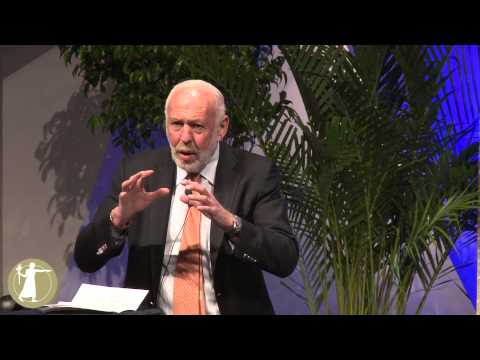
“I, I, I added this morning, in reflecting on what it is that I've accomplished, I've really always had outstanding collaborators. Really outstanding. In math, it was Churn, of course, uh, Chiger, uh, Sullivan—all members of the National Academy at one point or another. In business, it was Jim Ax and Henry Laufer and Peter Brown and Bob Mercer and that machine learning exercise. And in philanthropy and in life, of course, Maryland. So there it is, there's my talk, and…”NAS Research Briefings lecture · 22:03
Chern-Simons began for Simons as a problem of beauty, not utility
Simons’s route into Chern-Simons theory started with his attraction to mathematics as something natural and beautiful. He says mathematics felt natural to him from early on, and the decisive intellectual jolt was Stokes’ theorem, which he regarded as exceptionally beautiful and formative for his turn toward differential geometry.1234
That matters because Chern-Simons theory, in his telling, is not an isolated invention. It grows out of the same geometric world that first captivated him: manifolds, curvature, integration, and the theorem-proof structure of mathematics that he found deeply appealing.564
He understood Chern-Simons through characteristic classes and Gauss-Bonnet
Simons presents the theory as emerging from a classical chain of ideas: Euler characteristic, Gauss-Bonnet, Chern’s intrinsic proof, and then the theory of characteristic classes. He emphasizes Chern’s intrinsic proof of Gauss-Bonnet as a key conceptual opening, and says that development opened the floodgates for characteristic classes.8
From there, the central move is to connect topology with differential-geometric data such as connections and curvature. In his later talks, Simons frames Chern-Simons forms as part of the roots of differential cohomology, showing that he saw them not as a side result but as a structural bridge between forms, bundles, and topological invariants.910
For Simons, the theory was basic science whose destination no one could foresee
Simons repeatedly stresses that when you do basic mathematics, you do not know in advance where it will lead. He uses that point to explain how work like Chern-Simons could begin as pure geometry and later become important far outside its original setting.121314
This is one of his clearest beliefs about the subject: its later influence does not reduce its mathematical value, and its mathematical value did not depend on knowing the applications ahead of time. He treats that unpredictability as normal for serious science, not as an exception.1214
Its later role in physics confirmed his faith in pure mathematics
Simons points to the later uptake of Chern-Simons ideas by physicists as a striking vindication of pure mathematical work. He notes that physicists, including Ed Witten, found the theory useful and that it spread across quantum field theory, string theory, condensed matter, the quantum Hall effect, and even quantum computing.15
His tone on this point is part surprise, part satisfaction. The larger lesson he draws is that abstract mathematical structures can become ubiquitous in physics long after they are created, which is exactly why he believed foundational science deserves support.151614
He saw Chern-Simons as part of a larger geometric program
Simons did not treat Chern-Simons invariants as an endpoint. He describes how related work generalized into differential characters, and he places that in the roots of what became differential cohomology.179
That broader view shows what he thought the theory really contributed: not just an invariant, but a way of retaining geometric information alongside topological classes. Even his recollections of technical frustration around flat bundles and rationality questions underline how seriously he took these structures as mathematics worth pursuing in their own right.1019
Collaboration was essential to how he thought this work got done
Simons consistently presents major mathematical progress as collaborative. He advises people to work with the best partners they can find, and when reflecting on his own achievements he highlights outstanding collaborators in mathematics, especially Chern, Cheeger, and Sullivan.2021
That matters for understanding his view of Chern-Simons theory itself. He does not frame it as a lone-genius insight, but as part of a shared mathematical enterprise in which ideas are refined by strong collaborators over time.202223
“I, I, I added this morning, in reflecting on what it is that I've accomplished, I've really always had outstanding collaborators. Really outstanding. In math, it was Churn, of course, uh, Chiger, uh, Sullivan—all members of the National Academy at one point or another. In business, it was Jim Ax and Henry Laufer and Peter Brown and Bob Mercer and that machine learning exercise. And in philanthropy and in life, of course, Maryland. So there it is, there's my talk, and…”NAS Research Briefings lecture · full transcript →
Simons on chern-simons theory, in his own words
“…the roots of the subject that's come to be known as differential cohomology…”
“Some of this morphed into things called differential characters, which I did with... but I was always... I was here. And in fact, it's this work that led me. If you look at this for flat bundles, you've got some really interesting questions, and they have to do with whether certain numbers are rational or not. And I went two years without any appropriate technology—no, I think it would have mattered—trying to prove certain numbers were rational, and it drove me irrational, and I left and went into business and never—never turned back for quite a while. Any other questions? Anyway, I hope you're all having a good time at the conference, and…”
Where to watch
 Jim Simons on Chern-Simons Forms: From Gauss-Bonnet to Physics68 min · full transcriptBest single explanation of how Simons connects Gauss-Bonnet, characteristic classes, and the emergence of Chern-Simons forms.
 Jim Simons on Mathematical Career: From Minimal Surfaces to Chern-Simons23 min · full transcriptBest short overview of how his mathematical career led into Chern-Simons invariants and why he thought their later applications mattered.
 Jim Simons on Differential Cohomology: the mathematical roots2013 · 96 min · full transcriptBest for seeing how Simons places Chern-Simons inside the larger framework of differential cohomology.
 Jim Simons on Mathematics and Luck: A Life in Ideas81 min · full transcriptBest autobiographical account of why beauty in mathematics, especially Stokes’ theorem, drove him toward the geometry behind Chern-Simons.
 Jim Simons on My Life in Mathematics: From Geometry to Quant Investing2014 · 52 min · full transcriptGood concise public lecture linking his early love of geometry to later work including Chern-Simons invariants.
Questions people ask
- What did Jim Simons say about Stokes' theorem and why he chose mathematics?
- What did Jim Simons say about choosing partners and working with other people?
- What did Jim Simons say about how math leads to unexpected applications?
- What did Jim Simons say about the importance of collaborators?
- What did Jim Simons say about the later applications of Chern-Simons theory?
- Why did Jim Simons leave academia and go into business?
Sources
Every quote above, word for word from the transcripts. Numbers match the text.
“It was very natural and I I always liked it.”
“It was just a beauty. It was just a beauty of it.”
“It was the most beautiful thing, that theorem.”
“But I really had an epiphany when I learned Stokes' theorem. Now, I guess you're all mathematicians so you probably know Stokes' theorem. You integrate one thing over a boundary and you take its differential and you--that's the same as integrating that over the interior or something. And that, you know, is a great generalization of the fundamental theorem of calculus and it works at all dimensions. And I thought it was the most beautiful thing, that theorem. And it really made me appreciate mathematics, it made me want to become--go into this field of differential geometry which I had sort of gradually learned existed.”
“The idea of theorems and proofs really appealed to me…”
“And it made me appreciate the beauty of mathematics.”
“…that opened the floodgates in a way of, uh, the theory of characteristic classes…”
“…the roots of the subject that's come to be known as differential cohomology…”
“…it ended up being something that seemed worthy of study on its own…”
“…you do something in basic mathematics or basic science, and you really don't know where it's going to go.”
“You never know where something will go.”
“But mathematics is that way and basic science is that way. You do a piece of basic science, you know, and you don't know where it's going to go. But if it's pretty good science, it can lead to a surprising place. I mean when Maxwell developed the Maxwell equations, the television occurred to him as a consequence.”
“What was interesting—or what else was interesting—ten years later or so, Ed Witten and some other physicists found that this stuff was useful in physics, not only in string theory and quantum field theory. Other people applied it to condensed matter physics, and now these Chern-Simons invariants are really kind of ubiquitous in many aspects of physics: the quantum Hall effect, whatever that is, even—I think—you have to get something cold, but I'm not sure. And even in quantum computing. I was just out in the steps with someone who…”
“Ninety percent of it should be science…”
“In generalizing this stuff in '73 with Chigi, we define something called differential characters, and this is where I was going to stop in this— what, how much time? This is a good time to stop; it's a logical stop. I'm going to stop. Yeah, 15-minute break. It does anyone have a question? All right, go ahead. You know, what is a— what P P P spin? Yes.”
“Some of this morphed into things called differential characters, which I did with... but I was always... I was here. And in fact, it's this work that led me. If you look at this for flat bundles, you've got some really interesting questions, and they have to do with whether certain numbers are rational or not. And I went two years without any appropriate technology—no, I think it would have mattered—trying to prove certain numbers were rational, and it drove me irrational, and I left and went into business and never—never turned back for quite a while. Any other questions? Anyway, I hope you're all having a good time at the conference, and…”
“Partner with the very best people you can find. And some people want to work alone their whole lives, but partnering is a great thing. And it amplifies what you can do. But you have to choose your partners carefully. I’ve been lucky enough to have wonderful partners, both in the financial business and in mathematics, and now in the foundation. So work with the best people you can find because that’s going to make your work better.”
“I, I, I added this morning, in reflecting on what it is that I've accomplished, I've really always had outstanding collaborators. Really outstanding. In math, it was Churn, of course, uh, Chiger, uh, Sullivan—all members of the National Academy at one point or another. In business, it was Jim Ax and Henry Laufer and Peter Brown and Bob Mercer and that machine learning exercise. And in philanthropy and in life, of course, Maryland. So there it is, there's my talk, and…”
“…you have a lot of smart guys and they keep inching away and getting a new idea here and a new idea there…”
“So now, roughly at the same time that Cheeger and I were doing the stuff I just showed…”
How this guide was made: drafted with AI from the full transcripts of the recordings cited, then checked: every quotation must match a transcript word for word and be the speaker's own words, and an independent review gates accuracy. Methodology and corrections.