Yuval Noah Harari on Nationalism
Harari sees nationalism as a powerful way to build solidarity among strangers, but he argues it becomes dangerous when it turns exclusive and it cannot handle borderless problems on its own.
- Nationalism can be healthy when it means caring for strangers who share a nation.
- Fascism is different: it demands exclusive loyalty to the nation and elevates it above everything else.
- Today’s main political divide is often national versus global cooperation, because climate, AI, pandemics, and the economy cross borders.
- Harari argues you can be loyal to a nation and also loyal to humankind.
- The war in Ukraine shows why denying another people’s nationhood is both morally dangerous and politically self-defeating.

“Nationalism at its core is about loving and caring about a a a large number of strangers that you do not know personally…”The Ezra Klein Show interview, 2025 · 5:06
Nationalism starts with solidarity, not hatred
Harari does not treat nationalism as inherently evil. At its core, he presents it as a way of extending care beyond family and close acquaintances so that millions of strangers can feel mutual obligation and build a functioning society together.12
That is why nationalism has real emotional and political power. It helps create trust at large scale, and Harari sees large-scale cooperation as one of the basic engines of human history.1
“Nationalism at its core is about loving and caring about a a a large number of strangers that you do not know personally…”The Ezra Klein Show interview, 2025 · full transcript →
For Harari, fascism is nationalism made exclusive
Harari draws a sharp line between nationalism and fascism. Nationalism can coexist with other loyalties and identities, but fascism turns the nation into the supreme object of loyalty and makes that exclusivity the point.3
He also thinks fascism is tempting because it flatters people. It gives them a grand image of themselves through the nation, which makes it emotionally seductive even when it is politically destructive.34
In modern conditions, this danger grows because digital systems can manipulate fear, hate, and vanity at scale. Harari warns that these emotional triggers can be used to polarize societies and undermine democracy from within.56

“Fascism makes people see themselves as belonging to the most beautiful and most important thing in the world -- the nation.”TED talk, 2018 · full transcript →
National politics cannot solve borderless problems by itself
Harari argues that the key political divide today is no longer mainly left versus right, but national versus global. His reason is simple: humanity now lives inside systems that are already global, while politics remains trapped inside nation-states.78
He applies this especially to climate change, the global economy, AI, and bioengineering. These forces do not stop at borders, so purely national solutions are too weak or too narrow to govern them effectively.8910
The same point appears in his discussion of pandemics. COVID exposed how weak international coordination is, and he argues the deeper crisis was political because there was no shared plan strong enough to match a global threat.1112
He argues for dual loyalty: nation and humanity
Harari rejects the idea that caring about your nation means you cannot also care about humanity as a whole. He explicitly asks why loyalty to country must exclude loyalty to humankind, which captures his broader view that identities can be layered rather than mutually exclusive.14
That is also why he insists that stronger global governance should not abolish local or national identities. In his view, cooperation at the human level has to be built as an added layer, not as a replacement for people’s existing communities.
So his position is not anti-national. It is that nationalism works best when it helps people cooperate locally, while broader institutions handle the problems no nation can solve alone.18
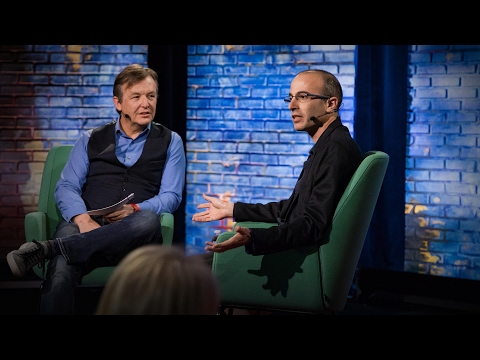
“…why can't you also be loyal to humankind as a whole?”TED Dialogues in New York, 2016 · full transcript →
Ukraine shows what happens when nationalism becomes imperial denial
Harari treats the war in Ukraine as a vivid case of nationalist danger in its imperial form. He argues that the conflict is fundamentally about denying the reality of another people’s nationhood and trying to erase it by force.16
He emphasizes that conquest is not the same as durable political control. Even if an army can invade, it cannot simply absorb a population that rejects domination, and attempts to do so only deepen hatred across generations.1819
He also links this to a broader rule of international order: borders matter because if states invade neighbors on the claim that another people really belongs to them, the logic spreads endlessly. That is why this kind of nationalism threatens not just one country but the stability of the wider world.20

“The borders are sacred because if we start invading neighboring countries because, "Hey, this is part of our countries, these people are part of our nation," there will not be an end to it. And if this now happens in Ukraine, it will be a blueprint for copycats all over the world. The other thing which is different is that we are talking about superpowers. This is not a war between Israel and Hezbollah.”TED conversation, 2022 · full transcript →
Harari on nationalism, in his own words
“Nationalism at its core is about loving and caring about a a a large number of strangers that you do not know personally…”
“…why can't you also be loyal to humankind as a whole?”
“Fascism makes people see themselves as belonging to the most beautiful and most important thing in the world -- the nation.”
“The borders are sacred because if we start invading neighboring countries because, "Hey, this is part of our countries, these people are part of our nation," there will not be an end to it. And if this now happens in Ukraine, it will be a blueprint for copycats all over the world. The other thing which is different is that we are talking about superpowers. This is not a war between Israel and Hezbollah.”
Where to watch
 Yuval Noah Harari on Nationalism and Global Governance: The New Divide2016 · 60 min · full transcriptBest single overview of why Harari thinks nationalism is politically powerful but inadequate for governing global problems.
 Yuval Noah Harari on Fascism and Data: Why It’s So Tempting2018 · 18 min · full transcriptBest for understanding his distinction between ordinary nationalism and fascism, and why exclusive nationalism is so seductive.
 Yuval Noah Harari on Liberalism and Cooperation: Stories, Truth, and AI2025 · 116 min · full transcriptBest for his positive account of nationalism as care for strangers and his larger view that cooperation drives history.
 Yuval Noah Harari on Pandemic, Politics & Society: Making Sense of Crisis2020 · 71 min · full transcriptShows how Harari applies his critique of nationalism to pandemics, trust, and failures of international coordination.
 Yuval Noah Harari on Ukraine and Geopolitics: Why This War Matters2022 · 50 min · full transcriptApplies his ideas to Ukraine, especially the danger of denying another nation’s existence and the limits of conquest.
Questions people ask
- What did Yuval Noah Harari say about strong leaders and war?
- What did Yuval Noah Harari say about the Ukraine war and climate action?
- What did Yuval Noah Harari say about why the war in Ukraine matters globally?
- What did Yuval Noah Harari say about global governance and catastrophe?
- What did Yuval Noah Harari say could happen if Russia keeps attacking Ukraine?
Sources
Every quote above, word for word from the transcripts. Numbers match the text.
“…the whole of human history is about how do you get more people to cooperate and to trust each other…”
“Nationalism at its core is about loving and caring about a a a large number of strangers that you do not know personally…”
“Fascism makes people see themselves as belonging to the most beautiful and most important thing in the world -- the nation.”
“…if somebody puts a mirror in front of your eyes that hides all your ugly bits and makes you see yourself as far more beautiful and far more important than you really are, just break that mirror.”
“They hack our feelings of fear and hate and vanity, and then use these feelings to polarize and destroy democracy from within.”
“…the easiest way to make people engaged is to press the hate button or the greed button or the fear button in their mind…”
“…the real divide today is between global and national…”
“…we now have global ecology, we have a global economy but we have national politics…”
“…it’s not the Mexicans or Chinese who will take the jobs from the people in Pennsylvania, it’s the robots and algorithms…”
“What we see now in the world is authority shifting away from humans to algorithms.”
“There is no global plan of action…”
“COVID-nineteen crisis, it's not a health crisis, It's above all a political crisis.”
“…why can't you also be loyal to humankind as a whole?”
“…this is really what is at stake in this war…”
“You can conquer a country, But as the Russians learned in Afghanistan, as the Americans learned also in Afghanistan, also in Iraq, it's much harder to hold a country.”
“You will not be able to absorb Ukraine into Russia. They don't want it, they don't want you. If you continue, the only thing you will achieve is to create terrible hatred between Ukrainians and Russians for generations. It doesn't have to be like that.”
“The borders are sacred because if we start invading neighboring countries because, "Hey, this is part of our countries, these people are part of our nation," there will not be an end to it. And if this now happens in Ukraine, it will be a blueprint for copycats all over the world. The other thing which is different is that we are talking about superpowers. This is not a war between Israel and Hezbollah.”
How this guide was made: drafted with AI from the full transcripts of the recordings cited, then checked: every quotation must match a transcript word for word and be the speaker's own words, and an independent review gates accuracy. Methodology and corrections.