Yuval Noah Harari on Education
Harari thinks education must prepare people for a volatile age of AI and biotech by teaching self-knowledge, emotional balance, and the capacity to reinvent themselves again and again.
- Education should train people to reinvent themselves repeatedly, not prepare for one fixed career.
- The central skills are emotional intelligence, mental balance, and self-knowledge.
- This matters because AI and algorithms may know, predict, and influence people better than they know themselves.
- Schools should help humans stay sovereign over technology rather than adapt themselves to serve it.
- The real goal is protecting people in disruption, not merely preserving existing jobs.

“…the ability to reinvent themselves repeatedly throughout their lives…”Talks at Google, 2018 · 2:34
Education is changing because the world is no longer stable
Harari’s starting point is that education built for a predictable world is no longer enough. He expects rapid change from AI and biotech, and he repeatedly stresses that what matters is preparing people for deep uncertainty rather than for a single lifelong role.12
That is why he says learners need the ability to reinvent themselves repeatedly throughout life. In his view, the future is not mainly about one round of training followed by decades of stability, but about repeated adaptation as technology reshapes work, institutions, and daily life.3
“…the ability to reinvent themselves repeatedly throughout their lives…”Talks at Google, 2018 · full transcript →
The core subjects should be emotional intelligence, mental balance, and self-knowledge
Harari is unusually direct about what education should prioritize. He says the most important goals of education in the 21st century are probably to develop emotional intelligence and mental balance, which marks a shift away from rote learning as the center of schooling.4
He also treats self-knowledge as a practical survival skill. Knowing yourself is not just a philosophical ideal in his account; it is a defense against a world in which outside systems become increasingly good at reading and steering human behavior. He adds that self-understanding is not the same as high IQ, and that very intelligent people can still be dangerously unaware of themselves.5
Reflection and attention matter here too. Harari explicitly advises people to consume less information and spend more time reflecting, suggesting that education should cultivate depth of awareness, not just faster intake of content.67
Why self-knowledge matters more when algorithms know you well
Harari’s argument about education is inseparable from his broader view of technology. He warns that humans will soon be hackable animals and says authority is beginning to shift from humans to algorithms, especially as systems gather enough data to predict preferences and choices.89
This creates a new educational challenge: not simply how to use tools, but how to avoid being passively managed by them. Harari imagines systems that know a person so well they can even anticipate resistance to their own advice, which means education must strengthen inner awareness and judgment before external systems become the default authority.1011
In older humanist culture, people were told to follow their heart. Harari thinks that advice becomes unstable when technology can manipulate or outcompete the signals people trust inside themselves. Education, then, must help people examine their own minds rather than outsource decisions too easily.1213
Memorizing information matters less than learning how to adapt
Harari’s practical conclusion is that schools should put less emphasis on stuffing students with information and more emphasis on capacities that stay useful when knowledge, tools, and job descriptions keep changing. Reinvention is central because what people learn today may become obsolete faster than in earlier generations.34
This does not mean technology is the enemy or that education should reject it. Harari says technology can protect and help people, but the crucial principle is that humans created these systems to serve human beings, not the other way around. Education should therefore train people to use powerful tools without surrendering agency to them.141516
He also leaves room for uncertainty. Even while warning about algorithmic power, he notes that humans are still far from fully understanding the brain and mind, so education should combine technological literacy with intellectual humility.17
The goal is to protect humans, not just jobs
Harari thinks the social danger ahead is bigger than ordinary automation anxiety. He warns that AI and big data could create large-scale human irrelevance, including what he once called a useless class, so education cannot be limited to making workers marginally more employable in the old sense.18
That is why he says what needs protection is not the jobs, but the humans. Education should help people preserve dignity, adaptability, and psychological stability even when labor markets are transformed in ways no curriculum can fully predict.19
This also changes how responsibility is understood. No institution can walk the whole path for a person; at some point, each individual has to do the inner work directly. Harari’s educational vision therefore combines social preparation with personal effort.20
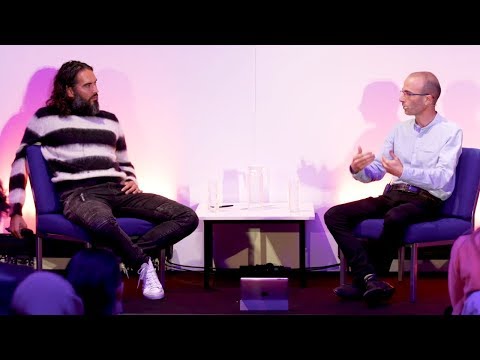
“What we need to protect is not the jobs, it's the humans…”Penguin Talks with Russell Brand, 2018 · full transcript →
Harari on education, in his own words
“…the ability to reinvent themselves repeatedly throughout their lives…”
“What we need to protect is not the jobs, it's the humans…”
Where to watch
 Yuval Noah Harari on Future of Education: Learning to Reinvent Yourself2018 · 60 min · full transcriptHis clearest, most direct statement of what 21st-century education should teach: emotional intelligence, mental balance, self-knowledge, and reinvention.
 Yuval Noah Harari on AI, Biotech, and Meaning: Google Talk2018 · 59 min · full transcriptShows how his education ideas fit into a larger argument about AI, biotech, agency, and the need to keep technology serving humans.
 Yuval Noah Harari on Dataism and Algorithms: Who Will Rule Next2017 · 58 min · full transcriptExplains why education becomes a struggle over authority when algorithms may understand people better than people understand themselves.
 Yuval Noah Harari on AI and Human Futures: Homo Deus Debated2015 · 91 min · full transcriptAdds the economic and political stakes by connecting education to automation, irrelevance, and the danger of a useless class.
 Yuval Noah Harari on AI and Human Futures: Urgent Warnings2024 · 106 min · full transcriptUseful for understanding his newer emphasis on reflection, manipulation, and AI as a decision-making technology unlike earlier tools.
Questions people ask
- What did Yuval Noah Harari say about asking Google or Amazon what to do with your life?
- What did Yuval Noah Harari say about how to know yourself better?
- What did Yuval Noah Harari say about whether we can trust our inner voice in the age of algorithms?
- What did Yuval Noah Harari say about why AI is different from previous technologies?
- What did Yuval Noah Harari say are the limits of hacking the human mind?
- What did Yuval Noah Harari say meditation does for focus and clarity?
Sources
Every quote above, word for word from the transcripts. Numbers match the text.
“We haven't seen nothing yet.”
“It's the first technology in history that can make decisions by itself…”
“…the ability to reinvent themselves repeatedly throughout their lives…”
“…the most important goals of education in the 21st century are probably to develop your emotional intelligence and your mental balance…”
“No, I don't think that knowing yourself is necessarily all about intelligence. Certainly not in the narrow sense of intelligence. If you include emotional intelligence and so forth, then yes. But in the more narrow sense of IQ, I think this is not-- there are many very intelligent people in the world who don't know themselves at all, which is an extremely dangerous combination. Now some people explore themselves through therapy. Some use meditation. Some use art. Some use poems.”
“I would say that people should consume less information and spend more time reflecting…”
“And maybe the two most important influences is that first it enabled me to have more clarity and more focus. And certainly when you write about such big subjects like trying to summarize the whole of history in 400 pages. So having a very, very focused mind is very important, because the great difficulty is that everything kind of distracts you. You start writing about the Roman Empire and you say, well, I have to explain this and this and this and this, and you end up with 4,000 pages. So we have to be very-- what is really important, and what can be left outside? And the other thing is that at least the meditation that I practice, which is with passive meditation, it's all about really knowing the difference between the fictions and stories generated by our mind and the reality.”
“…humans will soon be hackable animals…”
“…authority is beginning to slip away, to shift from us to other entities, and in particular, to shift from us to algorithms.”
“I know you so well, that I even know you don't like the advice I now gave you.”
“And it won't happen overnight, like in some immediate revolution, it's a process. We'll ask Google or Amazon or Facebook or whatever, for their advice on more and more decisions, and if we see that indeed we get good recommendations better than the decisions we ourselves usually take, then we trust them more and more, trust them more with our data, and also trust them more with authority to make decisions for us.”
“In the humanist age, in the 19th and 20th century, they will tell you just follow your heart. Just try to connect to your authentic self and just follow your heart. In the 21st century, the advice will be "Oh, listen to Amazon, "ask Google what to do". And I would come to Google or Amazon, and I would say, "Google, I have this dilemma. "What do you recommend that I do? "What is the best course of action for me?".”
“I agree that more people have more voice than ever before, both in the US and globally. I think you're absolutely right. My concern is, to what extent we can trust the voice of people... To what extent I can trust my voice? Like, I'm... We have this picture of the world that I have this voice inside me, which tells me what is right and what is wrong. And the more I'm able to express this voice in the outside world and influence what's happening, the more people can express their voices, it's better, it's more democratic. But what happens if at the same time that more people can express their voices, it's also easier to manipulate your inner voice? To what extent you can really trust that the thought that just popped up in your mind is the result of some free will, and not the result of an extremely powerful algorithm that understands what's happening inside you and knows how to push the buttons and press the levers, and is serving some external entity and it has planted this thought or this desire that you now express?”
“The key is to remember that we created them to serve us, and not that we are here in order to serve them.”
“An AI system that gets to know me in order to protect me…”
“No, I don't think that technology is inherently undermining compassion. It can go both ways. Certainly, communication technology can make you aware of the plight of people on the other side of the world. And without that, you may be extremely compassionate about your immediate, like, family members and neighbors, and won't care at all about people on the other side of the world. So I don't think there is an inherent contradiction or collision between technology and compassion. But it is true that the way we design technology can make us less compassionate, and even the way that we design ourselves.”
“First of all very important to emphasize that all this depends on the idea that we are in the process of hacking the human being, and in particular, of hacking the human mind and the human brain. But we are still very, very far from understanding the brain and even further from understanding the mind. And there is a chance that in the end, it will turn out that organisms aren't algorithms after all. There are some very deep things we still don't understand about the brain and the mind, and all this dream will turn out to be a fantasy.”
“…a new massive class of useless people: the useless class…”
“What we need to protect is not the jobs, it's the humans…”
“…you need to walk the last mile yourself…”
How this guide was made: drafted with AI from the full transcripts of the recordings cited, then checked: every quotation must match a transcript word for word and be the speaker's own words, and an independent review gates accuracy. Methodology and corrections.