Richard Branson on Adventure
Richard Branson sees adventure as a way to make life richer, test yourself, and create openings, but only if you accept fear, act decisively, and manage the downside.
- Adventure starts with saying yes to the right challenge.
- He treats adventure as a calculated risk, not reckless thrill-seeking.
- Fear of failure blocks action; learning comes from trying.
- Adventure and business share the same mindset: spot opportunity and move.
- Luck matters, because the line between success and disaster is thin.
Adventure begins with saying yes
For Branson, adventure is not mainly about extreme stunts. It begins with a habit of saying yes to experience, challenge, and uncertainty instead of shrinking back from them. He presents that choice as one of the main reasons life becomes more vivid and rewarding.12
That does not mean every impulse should be followed blindly. His point is that too many people freeze, overthink, or default to no, while a fuller life comes from making the call and giving things a go. He ties that outlook to regret as much as to ambition: he would rather jump in than watch someone else do the thing he turned down.34
He links adventure with courage, foolishness, and calculated risk
Branson does not romanticize adventure as pure heroism. He says taking big leaps requires being willing to look brave, stupid, and foolish at the same time, which is a useful correction to polished stories of success. In his view, adventure often starts where dignity and certainty end.53
At the same time, he consistently frames risk as something to calculate, not just celebrate. The point is not to avoid danger completely, but to avoid becoming passive through caution. His version of adventure asks for movement with judgment: take the shot, but understand that action without any thought can push you to the wrong side of a very narrow margin.67
Adventure is a learning process, not a one-off thrill
Branson treats adventure as part of a broader philosophy of growth. He describes life as a long learning process, which means challenge is valuable not only for the adrenaline but for what it teaches about judgment, resilience, and self-knowledge.89
That helps explain why adventure and entrepreneurship sound so similar when he talks about them. Both involve entering situations without guarantees, relying on curiosity, and accepting that failure is always nearby. If you are too afraid of failure, you stop learning before you begin.107
The same mindset drives his business moves
Branson does not separate adventure from business very much. He approaches both by looking for opportunity, moving when he sees an opening, and trying to create something better rather than copying what already exists.1112
That is clear in the way he talks about launching Virgin Atlantic. Buying a single secondhand 747 was both a business decision and an adventurous wager on doing something bigger than his company had any obvious right to attempt. He was willing to make a bold move because he believed a better experience could beat tired incumbents.13
Adventure demands humility about luck and survival
One of the most important parts of Branson's view is that adventure is never fully under your control. He openly credits luck for surviving dangerous situations, which keeps his attitude from sounding like mastery theater. Adventure may reward boldness, but it also exposes how thin the line is between a great story and catastrophe.7
That humility matters because it keeps adventure tied to responsibility. He repeatedly emphasizes reputation and the consequences of decisions, suggesting that daring should never become carelessness toward other people or toward what you have built. The challenge is to stay bold without becoming reckless.
Branson on adventure, in his own words
“I think if the, if the right challenge comes up, I will, I will still jump in and say yes.”
Where to watch
 Richard Branson on Adventure and Resilience: Balloons, Airlines, Space2025 · 74 min · full transcriptBest for seeing how Branson connects life-or-death adventure, instinct, luck, and later business decisions.
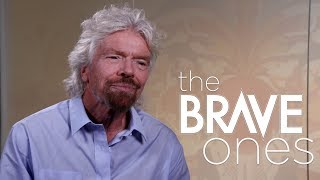 Richard Branson on Calculated Risk Taking: Say Yes and Go for It2016 · 26 min · full transcriptBest concise statement of his say-yes philosophy and his view of calculated risk.
 Richard Branson on Virgin Brand Strategy: Fun, Differentiation, and Bold Bets1998 · 11 min · full transcriptBest for how he ties ballooning, novelty, and doing what others have not done to the Virgin identity.
 Richard Branson on Entrepreneurship: Building, Risk, and Purpose26 min · full transcriptBest for understanding adventure as part of a lifelong learning process and a broader entrepreneurial mindset.
 Richard Branson on Business, Innovation and Giving Back: TED Talk2004 · 30 min · full transcriptBest for his emphasis on the thin line between success and failure when taking bold risks.
Questions people ask
- What did Richard Branson say about saying yes and taking risks?
- Why did Richard Branson keep taking on big challenges?
- Why did Richard Branson sell Virgin Records to support Virgin Atlantic?
- What did Richard Branson say about taking risks in life?
- What did Richard Branson say made Virgin Atlantic different from other airlines?
Sources
Every quote above, word for word from the transcripts. Numbers match the text.
“…life’s a lot more fun when you say yes, not when you say no…”
“I think if the, if the right challenge comes up, I will, I will still jump in and say yes.”
“Well, I suppose I've stuck my neck out a lot of times. I've learned that life’s a lot more fun when you say yes, not when you say no. Sometimes you thought that and your face won’t do it that way. Look, sometimes you've got to make a decision, get on and give it a go. You have to be a little bit brave and stupid and foolish to do that, and fortunately we've got away with it more often.”
“I can't resist saying yes. Uh, if there's a, you know, if there's a challenge, uh, that, um, that I'm going to regret sitting and watching somebody else doing on television and having said no myself. So, you know, I think if the, if the right challenge comes up, I will, I will still jump in and say yes. Um, you know, the, the, the challenge that we are concentrating on right now, uh, is one that, uh, you know, has been perhaps the biggest challenge of my, uh, my life, and that, and that is, um, building a space line, and, um, it's taken 10 years to get to you, to get to where we are today.”
“…you have to be a little bit brave and stupid and foolish to do that…”
“In the end, you've got to, I think, take calculated risks in life; otherwise, you're going to, you know, sit it off mothballs or all they do and do nothing. And life is a hell of a lot more fun if you say yes rather than say no.”
“There's a very thin dividing line between success and failure…”
“I’ve seen life as one long, one long learning process…”
“I mean, I think I learned early on that if you can, uh, if you can run one company, um, you can really run any company. I mean, company's all about finding the right people and inspiring those people, um, uh, you know, drawing out the best in people and, um, and I'm, uh, I just love learning and I'm incredibly inquisitive, and, um, I love taking on the, you know, the status quo and trying to turn it upside down. So, um, so I've seen life as one long, one long learning process, and if I see, you know, if I fly on somebody else's airline and find the experience is not a pleasant one.”
“…not having a fear of failure is at the heart of entrepreneurialism…”
“I look at everything as an opportunity.”
“…my whole attitude to life is, you know, if you create a new business that's the best in its field, it's likely to survive.”
“I think the thing that put Virgin on the map was when we bought one secondhand 747…”
How this guide was made: drafted with AI from the full transcripts of the recordings cited, then checked: every quotation must match a transcript word for word and be the speaker's own words, and an independent review gates accuracy. Methodology and corrections.
