Noam Chomsky on Libertarian Socialism
Chomsky treats libertarian socialism as a society of free, democratic associations that protects human creativity by opposing both state domination and concentrated private power.
- He sees libertarian socialism as the natural extension of classical liberal ideals into modern industrial society.
- Its goal is a decentralized order of free associations with democratic control over social and economic life.
- He grounds it in a view of human beings as creative and self-developing, not fit to be ruled or reduced to tools.
- He rejects both state socialism and capitalism because each concentrates power and blocks real democracy.
- He connects the ideal to practical struggle: clear away propaganda, join popular movements, and build institutions that expand freedom.
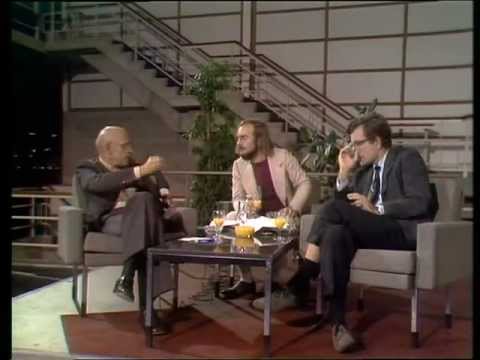
“…a fundamental element of human nature is the need for creative work…”International Philosophers' Project debate, Eindhoven, 1971 · 36:01
Libertarian socialism is Chomsky’s positive political ideal
Chomsky presents libertarian socialism not as a vague mood but as a definite political tradition. He places it on a spectrum running from left-wing Marxism through anarchism, and says it carries forward the best part of classical liberalism under modern industrial conditions1.
That matters because he does not think freedom is secured merely by limiting the state while leaving private concentrations of power untouched. His target is domination itself, whether it comes from government bureaucracies or from economic hierarchies that control work, policy, and social life1.
Its moral basis is human creativity and self-development
Chomsky ties politics to a view of human nature. He argues that people are not passive material to be managed, but beings with a built-in drive toward inquiry, creation, and growth4.
From that starting point, a good society is one that leaves room for creative work, participation, and self-direction. If a fundamental part of being human is the need for creative work, then social institutions should be judged by whether they enlarge or suppress that capacity56.
This is why libertarian socialism is, for him, more than a complaint about injustice. It is a constructive answer to the question of what kind of order fits human beings: one aimed at freedom, participation, and the full development of their powers64.
“…a fundamental element of human nature is the need for creative work…”International Philosophers' Project debate, Eindhoven, 1971 · full transcript →
He imagines a decentralized society of free associations
When Chomsky describes the institutional form of libertarian socialism, he points to a federated, decentralized system of free associations. Those associations are not only cultural or civic; they include economic life too, so workplaces and production are part of democratic self-government rather than zones of private rule78.
He treats this as especially appropriate for advanced industrial society. Modern technology, in his view, should make it less necessary to force human beings into narrow, mechanical roles, and more possible to organize production around human needs and creativity8.
This is also why he often links libertarian socialism with anarcho-syndicalism. The point is not disorder, but coordinated freedom: institutions that are organized and connected, yet controlled from below rather than by unaccountable elites78.
“Now a federated, decentralized system of free associations, incorporating economic as well as social institutions, would be what I refer to as anarcho-syndicalism; and it seems to me that this is the appropriate form of social organization for an advanced technological society, in which human beings do not have to be forced into the position of tools, of cogs in the machine. In which the creative urge that I think is intrinsic to human nature, will in fact be able to realize itself in whatever way it will. I don't know all the ways in which it will.”International Philosophers' Project debate, Eindhoven, 1971 · full transcript →
Capitalism and state socialism fail for the same basic reason
Chomsky criticizes capitalism because it narrows democracy and concentrates power in private hands. In capitalist democracy, he argues, formal political choice operates inside a narrow range and is heavily distorted by concentrations of private power and by habits of passivity shaped inside authoritarian institutions like the workplace.
He also thinks industrial capitalism deforms human work itself. When labor is fragmented and subordinated, the worker is reduced rather than developed, which directly collides with his view that people need creative, self-directed activity95.
But he does not treat state socialism as the cure. He argues that Bolshevik-style state socialism and modern state capitalism are both regressive because both leave control in the hands of elites rather than the public, and both preserve structures of command over ordinary people110.
The ideal applies to education, work, and political action now
Chomsky’s view is not that libertarian socialism must wait for a total transformation before it matters. He applies the same principles right now: education should teach people how to think for themselves, not train obedience; work should be organized to serve human needs rather than managerial control; and intellectual life should expose illusion and help people act together1113.
That practical side also explains his emphasis on responsibility. Those with knowledge or privilege should help clarify how power works and join popular struggles instead of serving established authority14.
He sees no shortage of urgent tasks, from resisting propaganda and concentrated power to building democratic movements and institutions. The point of libertarian socialism is not only to criticize domination, but to widen the spaces where people can govern their own lives together15.
Chomsky on libertarian socialism, in his own words
“…a federated, decentralized system of free associations…”
“Now a federated, decentralized system of free associations, incorporating economic as well as social institutions, would be what I refer to as anarcho-syndicalism; and it seems to me that this is the appropriate form of social organization for an advanced technological society, in which human beings do not have to be forced into the position of tools, of cogs in the machine. In which the creative urge that I think is intrinsic to human nature, will in fact be able to realize itself in whatever way it will. I don't know all the ways in which it will.”
“…a fundamental element of human nature is the need for creative work…”
“…man is in his essence a free, searching, self-perfecting being…”
Where to watch
 Noam Chomsky on Libertarian Socialism: The State and Freedom1970 · 57 min · full transcriptHis clearest direct statement of what libertarian socialism is, why he favors it, and why he opposes both state socialism and state capitalism.
 Noam Chomsky on Human Nature: Creativity, Justice, and Power1971 · 70 min · full transcriptShows how his politics grows out of his view that human beings are naturally creative and need free, meaningful activity.
 Noam Chomsky on Radical Intellectuals: Responsibility and Power2010 · 58 min · full transcriptConnects the ideal to political responsibility, the anarchist tradition, and the role of intellectuals in democratic struggle.
 Noam Chomsky on Neoliberalism and Democracy: Power, Reform, and Decline2021 · 65 min · full transcriptApplies the critique of concentrated private power to neoliberal institutions, education, labor, and everyday bureaucracy.
 Noam Chomsky on War, Democracy, and Climate: Can We Choose?2020 · 110 min · full transcriptPlaces the same themes inside current crises like war, climate, weakened unions, and democratic decline.
Questions people ask
- What did Noam Chomsky say about Adam Smith and power?
- What did Noam Chomsky say about capitalism and democracy?
- What did Noam Chomsky say about intellectual self-defense in education?
- What did Noam Chomsky say critical intellectuals should do in society?
- What did Noam Chomsky say the Cold War was for?
- What did Noam Chomsky say about unnecessary work and hospital bureaucracy?
Sources
Every quote above, word for word from the transcripts. Numbers match the text.
“I'd like to make clear my own point of view in advance so you can evaluate and judge what I'm saying. I think that the libertarian socialist concepts, and by that I mean a range of thinking that extends from left-wing Marxism through anarchism, I think that these are fundamentally correct and that they are the proper and natural extension of classical liberalism into the era of advanced industrial society. In contrast, it seems to me that the ideology of state socialism—that is what has become of Bolshevism—and of state capitalism, the modern welfare state, these of course are dominant in the industrial countries and the industrial societies, but I believe that they are regressive and highly inadequate social.”
“…man is born to inquire and create…”
“…a fundamental element of human nature is the need for creative work…”
“…man is in his essence a free, searching, self-perfecting being…”
“…a federated, decentralized system of free associations…”
“Now a federated, decentralized system of free associations, incorporating economic as well as social institutions, would be what I refer to as anarcho-syndicalism; and it seems to me that this is the appropriate form of social organization for an advanced technological society, in which human beings do not have to be forced into the position of tools, of cogs in the machine. In which the creative urge that I think is intrinsic to human nature, will in fact be able to realize itself in whatever way it will. I don't know all the ways in which it will.”
“The worker will remain a fragment of a human being…”
“…the state is a profoundly anti-human institution…”
“If you want intellectual self-defense, that means teaching people how to think, how to think for themselves, not pass a test. I don't care if you pass a test or not. I mean, in a serious scientific university like MIT, nobody cares about test scores.”
“I mean, there's an awful lot of work that's done just in managing systems that isn't really necessary at all. I mean, you can see it in the United States. One place where you see it dramatically is if you go into a hospital. Before you can—you know, you go into the emergency room, you've had to do a number of times—and before you can even be looked at, you have to fill a lot of paperwork out. You know, is the insurance company going to pay for it? Is there a small something in the small print you didn't notice? So you have to show you can pay for it myself, and on and on.”
“…privilege plainly confers opportunity and opportunity confers responsibility…”
“…there's no shortage of tasks…”
How this guide was made: drafted with AI from the full transcripts of the recordings cited, then checked: every quotation must match a transcript word for word and be the speaker's own words, and an independent review gates accuracy. Methodology and corrections.