Jeff Bezos on Saving Earth
Jeff Bezos argues that humanity must preserve Earth as home by using long-term invention to move heavy industry and infrastructure into space.
- Earth is not replaceable; he sees saving it as non-negotiable.
- His main solution is to keep Earth residential and move polluting heavy industry into space over time.
- He thinks long-term thinking makes seemingly impossible problems solvable.
- Lowering the cost of space through reusability and industrial scale is essential to that vision.
- He treats this as an invention and entrepreneurship challenge, not a reason to shrink ambition.

“First, Mars and everywhere else too. And we'll build large O'Neill, Jerry O'Neil style colonies in space as well. Yeah. And and we'll build big, you know, we'll use asteroids and near earth objects and the moon and so on to build compute in space and solar cells in space and so on. And a lot of our compute will be done in space. It will make more sense. And ultimately, we even manufacture the chips that the compute runs on. And then the answers can just be beamed back to us here. And this planet, Dave said it before, but our long term vision, our dream is that all the polluting industry can be done off Earth. If space travel gets reliable enough and inexpensive enough and we can get materials from asteroids and near Earth objects and the moon, then this garden planet can be returned to its pre industrial revolution state.”VivaTech conference talk, Paris, 2026 · 12:26
Earth is the place to protect, not abandon
Bezos’s starting point is simple: Earth is the best place humans have, and it must be preserved. He rejects the idea that another planet is a backup for the damage done here, and he treats protecting Earth as a basic requirement rather than an optional aspiration.12
That leads to a very specific moral frame. In his view, space is not an excuse to give up on Earth; it is part of the strategy for keeping Earth livable and beautiful for future generations.123
His core solution is to move heavy industry off Earth
Bezos’s signature idea is that Earth should remain where people live, while much of the heavy, polluting industrial base gradually shifts into space. He imagines using the Moon, asteroids, and near-Earth resources to build manufacturing, compute, solar infrastructure, and other industrial systems away from the planet’s surface.45
This is why his space vision is tightly connected to saving Earth. The point is not space for its own sake, but to reduce the environmental burden on the planet by relocating large-scale industry outward once transportation and infrastructure become reliable and affordable enough.42
“First, Mars and everywhere else too. And we'll build large O'Neill, Jerry O'Neil style colonies in space as well. Yeah. And and we'll build big, you know, we'll use asteroids and near earth objects and the moon and so on to build compute in space and solar cells in space and so on. And a lot of our compute will be done in space. It will make more sense. And ultimately, we even manufacture the chips that the compute runs on. And then the answers can just be beamed back to us here. And this planet, Dave said it before, but our long term vision, our dream is that all the polluting industry can be done off Earth. If space travel gets reliable enough and inexpensive enough and we can get materials from asteroids and near Earth objects and the moon, then this garden planet can be returned to its pre industrial revolution state.”VivaTech conference talk, Paris, 2026 · full transcript →
Saving Earth requires long-term thinking about solvable problems
Bezos repeatedly argues that many hard problems look impossible only when people think too short term. His view is that longer time horizons unlock solutions that institutions miss when they focus on the next few years instead of the next few decades.3
That helps explain his optimism about environmental and civilizational challenges. He is cautious about declaring things impossible, and he links progress to the willingness to take on ambitious problems with patience, invention, and persistence.7
The bottleneck is not dreaming big but building affordable space infrastructure
For Bezos, saving Earth through space development depends on making space access cheap, routine, and operationally reliable. Reusability matters because a true space economy cannot exist if every launch throws away the hardware or requires heroic refurbishment.
He also stresses that spaceflight itself is not the unsolved mystery. The real challenge is building the industrial capability, manufacturing systems, and repeatable operations that can support large-scale activity beyond Earth.
This is why he favors steady execution over flashy timelines. Complex systems that will eventually carry people and support industry need to be built carefully, with repeated learning and operational discipline.
He sees growth, invention, and entrepreneurship as part of the answer
Bezos does not frame saving Earth as a reason to retreat from growth or ambition. He argues instead for expanding capability: more invention, stronger entrepreneurship, and the confidence to build new industries that can solve big constraints.
That stance fits his self-conception as an inventor. He tends to approach large problems by searching for unconventional solutions, expecting many ideas to fail and a few to open new paths forward.1415
In practice, that means leaning toward the future instead of away from it. He sees technological progress, startups, and bold builders as central to creating the tools that can preserve Earth while supporting human flourishing.161718
Bezos on saving earth, in his own words
“No. We have to save... So so first of all, there is no plan b. We have to save Earth. So we've sent robotic probes to all of the planets in this solar system. This is the good one. And and we must save it. We cannot... Look. We can live. We can choose how we want to live. We could... It is not impossible. If you think about climate change and so on, some of the issues that we face here because of the way way we're doing things currently, you could imagine a world with enough technological sophistication where we can turn Earth into sort of a giant spaceship, you know, like air conditioned…”
“First, Mars and everywhere else too. And we'll build large O'Neill, Jerry O'Neil style colonies in space as well. Yeah. And and we'll build big, you know, we'll use asteroids and near earth objects and the moon and so on to build compute in space and solar cells in space and so on. And a lot of our compute will be done in space. It will make more sense. And ultimately, we even manufacture the chips that the compute runs on. And then the answers can just be beamed back to us here. And this planet, Dave said it before, but our long term vision, our dream is that all the polluting industry can be done off Earth. If space travel gets reliable enough and inexpensive enough and we can get materials from asteroids and near Earth objects and the moon, then this garden planet can be returned to its pre industrial revolution state.”
Where to watch
 Jeff Bezos on Growth and Space: Save Earth, Build Upward2026 · 66 min · full transcriptBest single overview of his claim that Earth must be saved and that growth and space development belong together.
 Jeff Bezos on Space Economy: Moon First, Build in Space2026 · 171 min · full transcriptBest for understanding how a space economy could shift industry off Earth using the Moon and in-space infrastructure.
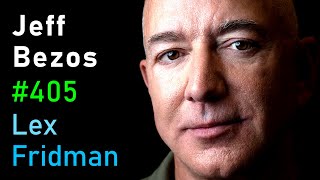 Jeff Bezos on Long-Term Thinking: Space, Decisions, and Mortality2023 · 132 min · full transcriptBest for the philosophical foundation: long-term thinking, caution about calling things impossible, and civilizational scale.
 Jeff Bezos on Reusable Spaceflight: New Shepard and New Glenn2017 · 27 min · full transcriptBest for the practical side of the vision: reusability, operational reliability, and lowering the cost of access to space.
 Jeff Bezos on AI and Space Futures: Optimistic, Long-Term, Bold2025 · 64 min · full transcriptBest for his optimism about entrepreneurs and why rapid technological change can help solve large future problems.
Questions people ask
- What did Jeff Bezos say about building compute and industry in space?
- What did Jeff Bezos say about long-term thinking?
- What did Jeff Bezos say about whether there is a plan B for Earth?
- What did Jeff Bezos say about why this is a great time to start a company?
- What is Jeff Bezos's vision for humanity in space?
- What does Jeff Bezos think about the future of humanity?
Sources
Every quote above, word for word from the transcripts. Numbers match the text.
“There is no plan b. We have to save Earth.”
“No. We have to save... So so first of all, there is no plan b. We have to save Earth. So we've sent robotic probes to all of the planets in this solar system. This is the good one. And and we must save it. We cannot... Look. We can live. We can choose how we want to live. We could... It is not impossible. If you think about climate change and so on, some of the issues that we face here because of the way way we're doing things currently, you could imagine a world with enough technological sophistication where we can turn Earth into sort of a giant spaceship, you know, like air conditioned…”
“Long term thinking is a giant lever. You can literally solve problems if you think long term that are impossible to solve if you think short term. And we aren't really good at thinking long term. As... You know, it's not really... You were kind of... You know, five years is a tough time frame for most institutions to think past. And we probably need to stretch that to ten years, and fifteen years, and twenty years, and twenty five years. And we'd do a better job for our children or our grandchildren if we could stretch those thinking horizons.”
“First, Mars and everywhere else too. And we'll build large O'Neill, Jerry O'Neil style colonies in space as well. Yeah. And and we'll build big, you know, we'll use asteroids and near earth objects and the moon and so on to build compute in space and solar cells in space and so on. And a lot of our compute will be done in space. It will make more sense. And ultimately, we even manufacture the chips that the compute runs on. And then the answers can just be beamed back to us here. And this planet, Dave said it before, but our long term vision, our dream is that all the polluting industry can be done off Earth. If space travel gets reliable enough and inexpensive enough and we can get materials from asteroids and near Earth objects and the moon, then this garden planet can be returned to its pre industrial revolution state.”
“Yeah. The only way to get to that vision is with giant space stations. You know, the planetary surfaces are just way too small. So you can... I mean, unless you turn them into giant space stations or something. But but, yeah, we will take materials from the moon and from near earth objects and from the asteroid belt and so on, and we'll build giant O'Neill style colonies, and people will live in those. And they have a lot of advantages over planetary surfaces. You can spin them to get normal earth gravity. You can put them where you want them. I think most people are gonna wanna live near Earth, not necessarily in Earth orbit, but in, you know, Earth... But near Earth vicinity orbits. And so they can move, you know, relatively quickly back and forth between their station and Earth.”
“I have come to use the word impossible with great caution.”
“I think of myself as an inventor.”
“That's very kind. I have... I'm an inventor. If you if you wanna boil down what I am, I'm really an inventor. And I look at things and I can come up with atypical solutions and, you know, and then I can create a 100 such atypical solutions for something. 99 of them may not survive, you know, scrutiny. But one of those 100 is like, maybe there is... Maybe that might work, and then you can keep going from there. So that kind of lateral thinking, that kind of inventiveness... In a high dimensionality space where the search space is very large, that's where my inventive skills come. That's the thing I'm... If if I I self identify as an inventor more than anything else.”
“You have to always be leaning into the future.”
“Never, ever, ever lean away from the future.”
“And of course, startup companies, small companies thrive in moments of great and rapid change. Stability favors incumbents and rapid change favors small, dynamic, nimble startup companies. And so the world is so rapidly changing right now. There's never been a better moment to be an entrepreneur. There has never been a better moment to be a startup company.”
How this guide was made: drafted with AI from the full transcripts of the recordings cited, then checked: every quotation must match a transcript word for word and be the speaker's own words, and an independent review gates accuracy. Methodology and corrections.
