Jeff Bezos on Regret Minimization
Bezos’s regret minimization idea is to make big choices by looking back from old age and choosing the path you would be least likely to regret not taking.
- Project yourself forward and choose the path that leaves fewer regrets later in life.
- Bezos thinks people usually regret not acting more than trying and failing.
- For him, regret minimization justified leaving Wall Street to pursue the internet opportunity.
- The framework is long-term, not impulsive; it favors enduring meaning over short-term safety.
- Once you choose, stay focused on customers and accept being misunderstood when doing something new.

“I don't go in for carpe diem. I go in for regret minimization framework, absolutely.”60 Minutes profile, 1997 · 4:22
Regret minimization means deciding from the vantage point of your future self
Bezos’s central move is simple: imagine yourself at age 80, looking back on your life, and ask which choice would leave you with fewer regrets. He presents this as a deliberate decision framework, not a slogan about living recklessly in the moment.123
That future-looking perspective changes what matters. Short-term comfort, prestige, or security can look smaller when compared with the chance to participate in something you believe matters deeply.34
He used it to leave Wall Street and start Amazon
Bezos made his best-known use of the framework when deciding whether to leave a secure Wall Street job to start an internet company. He concluded that trying and failing would be easier to live with than never trying at all.563
What pulled him was not adventure for its own sake. He saw the internet as a major emerging force and wanted to participate in it, so the real risk in his mind was missing the opportunity and being haunted by that omission later.31
The regret he fears most is omission, not failure
A key part of Bezos’s view is that many of life’s biggest regrets come from what you do not do. That shifts the emotional balance of hard choices: failure may sting, but inaction can linger for decades.75
This is why the framework does not promise safety. It helps you identify which pain is more acceptable: the temporary pain of a failed attempt, or the lasting pain of wondering what would have happened if you had tried. Bezos says he did not expect to regret trying, but did expect to regret failing to act.56
It is a long-term framework, not a license for impulsive risk
Bezos contrasts regret minimization with a seize-the-day mentality. His version is reflective and long-range: step outside the noise of the present and judge choices by their long-run weight.248
That same long-term mindset shows up elsewhere in how he thinks. He prefers building things that compound over time, starting small, and making important decisions with analysis plus intuition, heart, and instinct. Regret minimization fits that pattern because the biggest choices cannot be settled by spreadsheets alone.9
“I don't go in for carpe diem. I go in for regret minimization framework, absolutely.”60 Minutes profile, 1997 · full transcript →
After the leap, the work is customer focus and courage
For Bezos, deciding to take a leap is only the beginning. Once committed, the right response is not to obsess over rivals or outside drama but to direct energy toward customers and what they need.111213
That matters because original decisions often look strange at first. Bezos warns that anyone doing something genuinely new must be able to tolerate misunderstanding, which is one reason regret minimization is useful: it gives you an internal standard stronger than public approval.1415
His broader moral frame also matters here. Choices define a life, and he repeatedly connects meaningful choices with character, especially courage and kindness rather than mere cleverness.161718
Bezos on regret minimization, in his own words
“I didn't think I'd regret trying and failing, and I suspected I would always be haunted by a decision to not try at all.”
“I don't go in for carpe diem. I go in for regret minimization framework, absolutely.”
Where to watch
 Jeff Bezos on Regret Minimization: Why He Left Wall Street2001 · 48 min · full transcriptBest full explanation of the age-80 framework and why Bezos thinks omissions create the deepest regrets.
 Jeff Bezos on Regret Minimization: Why He Chose Books1997 · 14 min · full transcriptThe clearest early statement of the regret minimization framework and how it led him to start Amazon.
 Jeff Bezos on Gifts and Choices: Build Yourself a Great Story2010 · 17 min · full transcriptShows how regret minimization fits his larger view that choices, not gifts, define a life.
 Jeff Bezos on Leadership and Long-Term Thinking2018 · 71 min · full transcriptConnects regret minimization to long-term thinking, starting small, and making big decisions with intuition plus analysis.
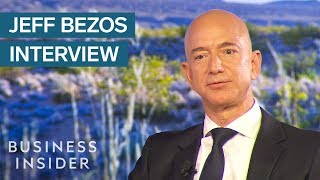 Jeff Bezos on Customer Obsession: Why Amazon, Not Competitors, Wins2018 · 49 min · full transcriptShows what comes after the decision: focus on customers, ignore competitor obsession, and accept misunderstanding.
Questions people ask
- What did Jeff Bezos say about regret minimization when he left Wall Street?
- Why did Jeff Bezos decide to leave a safe job and start Amazon?
- What did Jeff Bezos say about instinct in important decisions?
- Why does Jeff Bezos say focus on the customer instead of competitors?
- What did Jeff Bezos say about dealing with competitors and criticism?
- What advice did Jeff Bezos give college graduates about choosing a career?
Sources
Every quote above, word for word from the transcripts. Numbers match the text.
“It was a regret minimization framework.”
“I don't go in for carpe diem. I go in for regret minimization framework, absolutely.”
“Was what I called—which only a nerd would call—a regret minimization framework. So I wanted to project myself forward to age 80 and say, okay, now I'm looking back on my life. I want to have minimized the number of regrets I have. And, you know, I knew that when I was 80 I was not going to regret having tried this. I was not going to regret having wanted, you know, trying to participate in this thing called the Internet, that I thought was going to be a really big deal. I knew that if I failed, I wouldn't.”
“In the short run, the stock market is a voting machine. In the long run, it's a weighing machine.”
“I didn't think I'd regret trying and failing, and I suspected I would always be haunted by a decision to not try at all.”
“Seen in that light, it really was a difficult choice. But ultimately, I decided I had to give it a shot. I didn't think I'd regret trying and failing, and I suspected I would always be haunted by a decision to not try at all. After much consideration, I took the less safe path to follow my passion. And I'm proud of that choice.”
“Most regrets, by the way, are acts of omission and not commission.”
“Never spend any time thinking about the daily stock price. I don't.”
“Day one. Everything I've ever done has started small.”
“…you need to harness that energy primarily on your customers instead of on your competitors…”
“I said, "Look, it's okay to be afraid "but don't be afraid of our competitors "because they're never gonna send us any money, "be afraid of our customers. "And if we just stay focused on them "instead of obsessing over this big competitor "that we just got, we'll be fine." And I really do believe that. I think that if you stay focused and the more drama there is and everything else, no matter what the drama is, whatever the external distraction is, your response to it should be to double down on the customer, satisfying them, not just satisfying them, delighting them.”
“The number one thing that has made us successful by far is obsessive compulsive focus on the customer as opposed to obsession over the competitor. And I talk so often to other CEOs and some other CEOs and also founders and entrepreneurs. And I can tell that even though they're talking about customers, they're really focusing on competitors. And it is a huge advantage to any company if you can stay focused on your customer instead of your competitors. So then you have to identify who is your customer.”
“If you can't afford to be misunderstood, then for goodness sake, don't do anything new or innovative.”
“Look, it's okay to be afraid but don't be afraid of our competitors…”
“In the end, we are our choices.”
“Cleverness is a gift. Kindness is a choice.”
“It's harder to be kind than clever.”
How this guide was made: drafted with AI from the full transcripts of the recordings cited, then checked: every quotation must match a transcript word for word and be the speaker's own words, and an independent review gates accuracy. Methodology and corrections.
