Jeff Bezos on Blue Origin
Bezos sees Blue Origin as long-term infrastructure work to move heavy industry off Earth, lower the cost of space through real reusability, and build outward starting with the Moon.
- Blue Origin is about protecting Earth by building industry and infrastructure in space
- Its core technical path is true reusability plus high-rate manufacturing, not one-off rockets
- Bezos argues for a Moon-first strategy because it is a practical stepping stone to a larger space economy
- He treats Blue Origin as his most important very-long-term work and frames it in decades, not news cycles
- The operating style is experimentation, careful human-flight readiness, and many attempts to find what works

“But long term, the thing, if you take a really long run view, many decades, maybe even a couple of hundred years, I think the most important work that I'm doing, and I get increasing conviction on this with every passing year, is the work I'm doing at Blue Origin on space travel.”Forum on Leadership, Dallas, 2018 · 32:55
Blue Origin’s purpose is to preserve Earth by moving out into space
Bezos does not frame Blue Origin mainly as a prestige rocket company or a race to plant flags. He frames it as a civilizational project: Earth must be protected, and the way to keep growth and energy use going over the very long term is to build industrial capability off-planet rather than forcing all expansion onto one world1.
That is why his view of space is bigger than transportation. He talks about using space resources, building large habitats, and eventually relocating heavy or polluting industry away from Earth, while people continue to live near Earth in a much larger economic sphere.
His optimism here is not casual. He repeatedly treats seemingly impossible goals as problems that become solvable when people extend their time horizon and stop assuming current constraints are permanent567.
He thinks the real breakthrough is cheap, operationally reusable access to space
For Bezos, the key to Blue Origin is not just building a rocket that can technically fly twice. The point is operational reusability: fly, land, refurbish minimally, and fly again in a way that starts to resemble routine transport rather than bespoke aerospace craftsmanship89.
That is why New Shepard matters in his framework even though Blue Origin’s ambitions are much larger. Repeated suborbital flights create engineering and operational lessons that can carry into larger systems, including orbital launch, and they force the company to learn what repeatable reuse really demands89.
He also argues that space travel itself is not the unsolved mystery. The deeper challenge is making access frequent and affordable enough to support a true economy in space, which requires systems, operations, and production capacity, not heroic one-off missions109.
Blue Origin is building infrastructure, not chasing one dramatic mission
Bezos consistently describes Blue Origin as infrastructure work. In his telling, the company’s job is to help create the foundational layers a space economy needs: reusable launch, landers, manufacturing capability, and eventually the ability to use off-Earth materials and energy at scale5.
This explains why he emphasizes manufacturing so much. Building one impressive vehicle is not enough; the hard part is creating the organizational and industrial system that can build many vehicles reliably and repeatedly over time1011.
That long-term lens also explains his confidence that this is among the most important things he can work on. He explicitly ranks Blue Origin as his most important work over many decades because it is aimed at enabling a much larger future, not just producing a single product127.
“But long term, the thing, if you take a really long run view, many decades, maybe even a couple of hundred years, I think the most important work that I'm doing, and I get increasing conviction on this with every passing year, is the work I'm doing at Blue Origin on space travel.”Forum on Leadership, Dallas, 2018 · full transcript →
His strategy is Moon first because it is useful, reachable, and builds capabilities
Bezos argues against skipping directly to more distant goals when a nearer stepping stone can teach the right lessons and support future operations. His case for the Moon is practical: it is closer, easier to reach, and useful as a place to develop logistics, infrastructure, and resource use that can later support Mars and beyond13.
In his broader vision, the Moon is not just a symbolic destination. It can become part of a supply chain for a larger space economy, alongside asteroids and near-Earth objects, helping humanity build habitats, energy systems, computing, and industrial capacity off Earth.
So his Moon-first view is really a capabilities-first view. He prefers the path that compounds know-how, lowers costs, and creates reusable infrastructure over a path optimized mainly for spectacle67.
He runs Blue Origin with patience, experimentation, and long-term conviction
Bezos’s operating philosophy around Blue Origin combines urgency of vision with patience in execution. He favors lots of experimentation, accepts that many tries will fail, and believes the few successes can pay for the many misses as long as the organization keeps learning141516.
At the same time, he is especially cautious where human flight is involved. Readiness matters more than schedule promises, which is why he stresses launching when systems are ready and using a disciplined pace that reduces errors rather than performing speed for its own sake178.
Underneath that is a style of decision-making built for hard technical work: move quickly on reversible choices, think more carefully on irreversible ones, and keep long time horizons so that very ambitious goals become tractable instead of absurd18197.

“The short answer to the question is when it's ready.”Space Symposium talk, 2017 · full transcript →
Bezos on blue origin, in his own words
“But long term, the thing, if you take a really long run view, many decades, maybe even a couple of hundred years, I think the most important work that I'm doing, and I get increasing conviction on this with every passing year, is the work I'm doing at Blue Origin on space travel.”
Where to watch
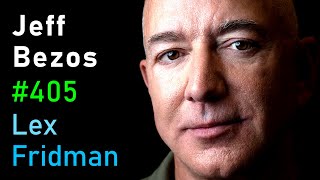 Jeff Bezos on Long-Term Thinking: Space, Decisions, and Mortality2023 · 132 min · full transcriptBest single overview of why Blue Origin matters to Bezos and how it fits his deepest long-term thinking.
 Jeff Bezos on Space Economy: Moon First, Build in Space2026 · 171 min · full transcriptBest explanation of the Moon-first strategy, space economy, and why manufacturing scale matters.
 Jeff Bezos on Reusable Spaceflight: New Shepard and New Glenn2017 · 27 min · full transcriptBest for understanding Bezos’s view of real reusability, operational discipline, and how New Shepard feeds bigger systems.
 Jeff Bezos on Growth and Space: Save Earth, Build Upward2026 · 66 min · full transcriptBest short statement of the Earth-first rationale: Blue Origin is about growth in space so Earth can be preserved.
 Jeff Bezos on Innovation and Leadership: Experiment, Decide Fast2018 · 50 min · full transcriptBest for the management philosophy behind Blue Origin: experimentation, decision speed, and multiple paths to yes.
Questions people ask
- What did Jeff Bezos say about building compute and industry in space?
- What did Jeff Bezos say about long-term thinking?
- What did Jeff Bezos say about whether there is a plan B for Earth?
- What is Jeff Bezos's vision for humanity in space?
- Why does Jeff Bezos say large companies make decisions slowly?
- What did Jeff Bezos say about his most important long-term work?
Sources
Every quote above, word for word from the transcripts. Numbers match the text.
“There is no plan b. We have to save Earth.”
“I have come to use the word impossible with great caution.”
“This attitude, this approach to life that any problem is solvable.”
“Long term thinking is a giant lever. You can literally solve problems if you think long term that are impossible to solve if you think short term. And we aren't really good at thinking long term. As... You know, it's not really... You were kind of... You know, five years is a tough time frame for most institutions to think past. And we probably need to stretch that to ten years, and fifteen years, and twenty years, and twenty five years. And we'd do a better job for our children or our grandchildren if we could stretch those thinking horizons.”
“…slow is smooth, and smooth is fast…”
“…only thing that's disruptive is customer adoption…”
“Space travel is a solved problem for six decades.”
“The professional pride part is so important, because 90% of what all of you do, nobody ever sees. It's something it's inside the work. People see something finished, but they don't see what's inside it. Only you see that while you're doing the work. And that so you have and those things can't be great since nobody's seen them. Nobody's inspecting it. You're not going to get any credit for it. The only thing that's going to make you have high standards on that piece of the work that nobody is ever going to see is your own professional pride in operational excellence.”
“But long term, the thing, if you take a really long run view, many decades, maybe even a couple of hundred years, I think the most important work that I'm doing, and I get increasing conviction on this with every passing year, is the work I'm doing at Blue Origin on space travel.”
“I totally disagree with this point of view.”
“If you want to have more invention, you need to do more experiments per week, per month, per year, per decade.”
“The winners, when you're doing these experiments, winners pay for thousands of losers.”
“That's very kind. I have... I'm an inventor. If you if you wanna boil down what I am, I'm really an inventor. And I look at things and I can come up with atypical solutions and, you know, and then I can create a 100 such atypical solutions for something. 99 of them may not survive, you know, scrutiny. But one of those 100 is like, maybe there is... Maybe that might work, and then you can keep going from there. So that kind of lateral thinking, that kind of inventiveness... In a high dimensionality space where the search space is very large, that's where my inventive skills come. That's the thing I'm... If if I I self identify as an inventor more than anything else.”
“The short answer to the question is when it's ready.”
“Most decisions are two way doors.”
“And the reason is you start making all decisions as if they're all the same size. It's like one size fits all thinking. And you know if you have a one size fits all robe, it never fits. And so there are different decisions that should be made in different ways. There are giant decisions which are consequential and irreversible or almost irreversible. Super hard to reverse.”
How this guide was made: drafted with AI from the full transcripts of the recordings cited, then checked: every quotation must match a transcript word for word and be the speaker's own words, and an independent review gates accuracy. Methodology and corrections.

