Competing in Software
How Gates explains Microsoft’s rise through timing, platform economics, rivals, and Internet-era adaptation.
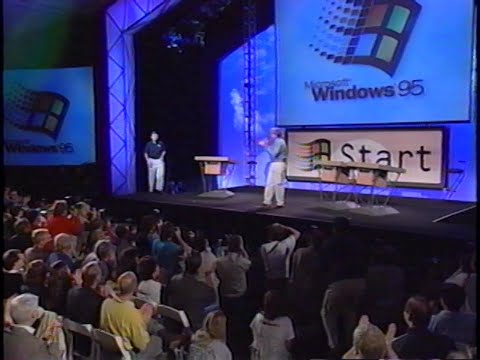
“…the original vision of "a computer on every desk and in every home" is slowly but surely coming true…”Microsoft Windows 95 launch event, Redmond, 1995 · 24:16
The lesson
Gates explains Microsoft’s rise as an early conviction about a coming shift: computing would move from scarce, expensive machines toward personal computers used widely by ordinary people. He and Paul Allen focused on software before most of the industry treated software as the main source of value, which let them aim at the layer that could spread across many machines and many customers12. His point is not just that they were smart, but that they were pointed at the right transition at the right time, in a period when software companies were still unusual34.
That strategy worked because software has unusual economics. Gates emphasizes that software can scale without the heavy capital needs of many other industries, but he also shows that this does not remove operational discipline: even in growth, he wanted enough cash to keep paying people, and major releases had to meet a high quality bar before shipping567. Microsoft’s advantage, in his account, came from pairing a big platform opportunity with rigorous execution.
He also describes platform power as something many incumbents misunderstood. In Gates’s telling, IBM helped create Microsoft’s opening because it underestimated where the long-term value would sit; it did not fully appreciate that control over software could matter more than control over hardware8. That helps explain why compatibility, installed base, and broad device support mattered so much to Microsoft’s approach: once software becomes the common layer across many machines, the platform owner can compound its position9.
On Apple, Gates presents competition and partnership as intertwined rather than purely hostile. Microsoft’s work on Mac software and his later reflections on Apple suggest that durable industry impact can come from recognizing another company’s strengths instead of treating the relationship as zero-sum10. In the same spirit, his view of the Internet era was adaptive rather than defensive: the Internet was a major new medium, but he did not think the future belonged to the browser alone; he argued that the winning model would combine connected services with powerful local software11121314.
Finally, Gates frames his own role change as part of competing at scale. Early on, he was intensely absorbed in software itself, but as Microsoft expanded, the job had to shift from direct coding toward broader strategy, product judgment, and organizational leadership158. The lesson is that a founder’s edge must evolve with the company: seeing the technical opportunity gets you started, but sustaining advantage requires managing platforms, partnerships, product quality, and the next transition.
5 principles from Bill Gates
Bet early on a real platform shift
Look for moments when a technology moves from specialist use to broad use. Gates’s edge came from recognizing that personal computing would become widespread and that software would be central to that change, before that view was common.
“…the original vision of "a computer on every desk and in every home" is slowly but surely coming true…”
Capture value at the software layer
When hardware commoditizes, the common software layer can become more strategic than the machines themselves. Gates’s account of IBM shows why understanding where value is migrating matters more than following industry habits.
“The idea of software companies wasn't around all that much.”
Scale with discipline, not just ambition
Software can grow fast, but fast growth still needs cash management and quality control. Gates ties Microsoft’s expansion to careful financial thinking and a willingness to delay launch in order to protect reliability.
“I always wanted to have enough cash to pay everybody for a year.”
Compete without assuming every rivalry is zero-sum
A rival can also expand the market, strengthen standards, or complement your strengths. Gates’s view of Apple shows that strategic competition can coexist with respect, partnership, and mutual benefit.
“Steve gave a speech once, which is one of my favorites, where he talked about, in a certain sense, we build the products that we want to use ourselves. And so he's really pursued that with incredible taste and elegance that has had a huge impact on the industry. And his ability to always come around and figure out where that next bet should be, has been phenomenal. Apple literally was failing when Steve went back and reinfused the innovation and risk taking that have, been phenomenal. So the industry has benefited immensely, from his work. We've both been lucky to be part of it, but, I'd say he's contributed as much as anyone.”
Adapt the platform to each new wave
Do not treat a new medium as either irrelevant or all-powerful. Gates’s Internet-era view was to absorb the shift by connecting services to strong local software, rather than abandoning the advantages of the client platform.
“Sure. What, what the hell is that exactly? Well, it's become a place where people are publishing information, so everybody can have their own homepage. Companies are there with the latest information. It's wild what's going on. You can send electronic mail to people. Uh, it is the big new thing. Yeah. But you know, uh, it's easy to criticize something you don't fully understand, which is my position here. Go ahead. But I, I can remember a couple of months ago there was like a big breakthrough announcement.”
In his own words
The quotes behind the lesson, word for word from the transcripts. Numbers match the lesson above.
“…the original vision of "a computer on every desk and in every home" is slowly but surely coming true…”
“No. It turns out that the urgency we felt that if we hadn't started in 1979, if we'd waited and started in 1980 or even 1981 because of the way we thought about the problem, because we, you know, we're so software oriented and thought... And and most companies weren't focused on software. People did software sort of a a side deal because they had to, but the hardware was what you paid all the money for. The software just came free. So the idea of software companies wasn't around all that much. So we, in fact, although we felt like we had to do it that day, an extra year would have would have been okay. Yeah. It wouldn't have changed the the course of history to to hang out another year.”
“The idea of software companies wasn't around all that much.”
“So software... Either software research or even having a modest software company, I think that that there are eras where certain kinds of endeavors are having more impact. You know, it's not like I think, oh, I wish I'd been doing auto engineering in the nineteen eighties. I'm not trying to denigrate the people who are doing auto engineering, but it wasn't in a an exponential change the world type mode. You know, today, are certain things in biology, hopefully in energy, still in the software IT space. So there's more domains now that are changing the world. So, you know, young people have more choices where they could they could, and I'm not saying economics, just in in terms of their IQ having huge impact, there's more choices today than than when I was young.”
“I always wanted to have enough cash to pay everybody for a year.”
“…we decided to take the extra nine months in order to test Windows 95 thoroughly…”
“…make sure it met the highest quality standards…”
“They didn't see the value being in the software.”
“We've got over a million and a half devices that are compatible…”
“Steve gave a speech once, which is one of my favorites, where he talked about, in a certain sense, we build the products that we want to use ourselves. And so he's really pursued that with incredible taste and elegance that has had a huge impact on the industry. And his ability to always come around and figure out where that next bet should be, has been phenomenal. Apple literally was failing when Steve went back and reinfused the innovation and risk taking that have, been phenomenal. So the industry has benefited immensely, from his work. We've both been lucky to be part of it, but, I'd say he's contributed as much as anyone.”
“Sure. What, what the hell is that exactly? Well, it's become a place where people are publishing information, so everybody can have their own homepage. Companies are there with the latest information. It's wild what's going on. You can send electronic mail to people. Uh, it is the big new thing. Yeah. But you know, uh, it's easy to criticize something you don't fully understand, which is my position here. Go ahead. But I, I can remember a couple of months ago there was like a big breakthrough announcement.”
“Architecturally, the question is, do you run just in the cloud and all you have down locally is the browser? And that is the same question for the phone as it is for the full screen device. There'll always be different screen sizes because these are the eight the five inches screen does not really compete with the 20 inches screen does not compete with the big living room screen. Those are, things that there'll be some type of computing behind all of those things, all connected to the Internet. But the idea that locally, you have the responsiveness of immediate interaction without the latency or bandwidth limitations that you get if you try and do it all behind, That's what leads to the right balance.”
“But that alone is not enough.”
“The key thing missing is the connections.”
“The most important work I got a chance to be involved in, no matter what I do, is the personal computer. That's what I grew up in my teens, my 20s, my 30s. I even knew not to get married because I was so, until later, because I was so obsessed with it. That's my life's work. And I, it's lucky for me that some of the skills and resources, but I put skills first, that I was able to develop through those experiences can be applied to the benefit of the people who haven't had technology, including, medicine, working for them. So it's an incredible blessing to have two things like that. But the thing that I'll, my, if you look inside my brain, it's filled with software and the magic of software and a bleep in software, and that's not going to…”
Reflect
- What technology shift in your field is currently treated as secondary, the way software once was, and what would it mean to build around that layer early?
- Where in your work are you relying on momentum or hype when you should instead raise the quality bar or improve compatibility?
- Which competitor in your space might actually become more useful to you if you stopped viewing the relationship as purely zero-sum?
Check your understanding
Go deeper
 Bill Gates on Microsoft and Philanthropy: Building, Learning, Giving2016 · 25 min · full transcript
 Bill Gates on Philanthropy and Global Health: Harvard Q&A2007 · 55 min · full transcript
 Bill Gates on Apple and Microsoft: Rivalry, Partnership, and the Future2007 · 90 min · full transcript
 Bill Gates on the Internet and the Future: Letterman interview1995 · 20 min · full transcript
 Bill Gates on Success and Parenting: Lessons from His Parents2025 · 81 min · full transcript
 Bill Gates on Windows 95 Launch: Faster, Easier, More Fun1995 · 92 min · full transcript
 Bill Gates on Connected Experiences: Windows Vista, Media, and Devices2007 · 76 min · full transcript
- What did Bill Gates say about Steve Jobs and Apple’s innovation?
- What did Bill Gates say about the future of cloud computing and local software?
- What did Bill Gates say about why he left Harvard to start Microsoft?
- What did Bill Gates say the Internet was for?
- Why did Bill Gates say he would not have left software to become a lawyer or mathematician?