Platforms and Products
Build for usability, compatibility, ecosystems, and non-zero-sum competition.
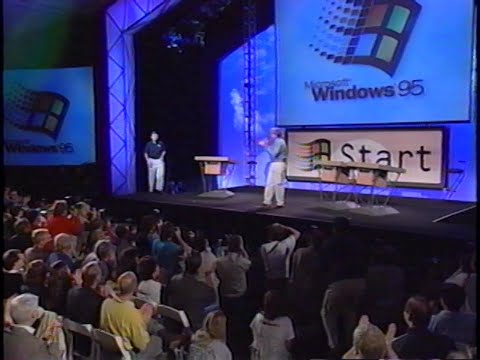
“…we decided to take the extra nine months in order to test Windows 95 thoroughly…”Microsoft Windows 95 launch event, Redmond, 1995 · 11:24
The lesson
Gates’s product thinking starts with a simple test: does the software make computing easier for normal people to use? In the Windows 95 launch, he frames the goal as making computing faster, easier, and more fun, and he points to interface changes like integrated systems and simpler commands as the kind of improvements that matter in practice. He also treats usability as part of a broader platform shift, where better product design helps more people take advantage of what computing can do1.
That usability standard does not mean rushing releases. Gates says Windows 95 took extra time so it could be tested thoroughly and meet high quality standards, which shows a willingness to trade speed for reliability when the product is foundational23. In his view, platform products earn trust when they work across the hardware and software people already depend on, not when they force unnecessary breakage; that is why compatibility is emphasized alongside integration in the Windows 95 launch and later in his discussion of broad device support4.
As computing matures, Gates argues that hardware progress by itself is no longer enough. The bigger opportunity is to connect devices, content, and services so people can move across work, home, and mobile settings without starting over each time6. That leads to a cloud-plus-client view: the internet is a powerful publishing and communication medium, but rich local software still matters because it gives immediate responsiveness and avoids the limits of latency and bandwidth7.
This also shapes how he thinks about devices. Gates does not expect one machine to do everything; he expects multiple form factors, each tuned to a context, from pocket devices to larger reading and work screens, with software tying them together87. In that world, the role of software expands beyond apps on a PC to include speech, vision, robotics, meetings, and services embedded across environments, which is why he keeps returning to software as the central layer of value creation91011.
Finally, Gates treats competition as something that can create value rather than destroy it. In the Apple discussion, he argues that both Apple and Microsoft benefited when rivalry stopped being zero-sum and each company focused on its strengths, including Apple’s ability to build products with taste and clear software direction12. The practical lesson is that platform strategy is not only about winning head-to-head; it is also about growing the whole ecosystem through compatibility, complementary products, and a clear sense of what you uniquely do well.
5 principles from Bill Gates
Design for ease of use, not just technical power
A strong product helps people do more with less friction. When evaluating a feature or redesign, ask whether it actually makes common tasks faster, easier, or more intuitive for the user.
Delay when necessary to reach quality
For foundational products, trust is hard to recover once lost. If testing shows the experience is not ready, taking more time can be the better strategic choice than shipping on schedule.
“…we decided to take the extra nine months in order to test Windows 95 thoroughly…”
Build connected experiences across devices and services
Users experience your offering as a whole, not as isolated products. Design the handoff between devices, content, and online services so work can continue smoothly from one context to another.
“The key thing missing is the connections.”
Use cloud and client together
Web services are powerful for sharing, updating, and access, but local software still matters for speed and responsiveness. Choose the split deliberately: what must feel immediate should not depend entirely on the network.
“Architecturally, the question is, do you run just in the cloud and all you have down locally is the browser? And that is the same question for the phone as it is for the full screen device. There'll always be different screen sizes because these are the eight the five inches screen does not really compete with the 20 inches screen does not compete with the big living room screen. Those are, things that there'll be some type of computing behind all of those things, all connected to the Internet. But the idea that locally, you have the responsiveness of immediate interaction without the latency or bandwidth limitations that you get if you try and do it all behind, That's what leads to the right balance.”
Treat rivalry as a way to grow the market
Competition does not have to be zero-sum if each company sharpens its strengths and the overall ecosystem becomes more valuable. Look for places where compatibility, partnerships, or complementary products can expand the pie.
“Steve gave a speech once, which is one of my favorites, where he talked about, in a certain sense, we build the products that we want to use ourselves. And so he's really pursued that with incredible taste and elegance that has had a huge impact on the industry. And his ability to always come around and figure out where that next bet should be, has been phenomenal. Apple literally was failing when Steve went back and reinfused the innovation and risk taking that have, been phenomenal. So the industry has benefited immensely, from his work. We've both been lucky to be part of it, but, I'd say he's contributed as much as anyone.”
In his own words
The quotes behind the lesson, word for word from the transcripts. Numbers match the lesson above.
“…the original vision of "a computer on every desk and in every home" is slowly but surely coming true…”
“…we decided to take the extra nine months in order to test Windows 95 thoroughly…”
“…make sure it met the highest quality standards…”
“We've got over a million and a half devices that are compatible…”
“The key thing missing is the connections.”
“Architecturally, the question is, do you run just in the cloud and all you have down locally is the browser? And that is the same question for the phone as it is for the full screen device. There'll always be different screen sizes because these are the eight the five inches screen does not really compete with the 20 inches screen does not compete with the big living room screen. Those are, things that there'll be some type of computing behind all of those things, all connected to the Internet. But the idea that locally, you have the responsiveness of immediate interaction without the latency or bandwidth limitations that you get if you try and do it all behind, That's what leads to the right balance.”
“I don't think you'll have one device. I think you'll have a full screen device that you can carry around, and you'll do dramatically more reading off of yes. I mean I believe in the tablet form factor. I think you'll have voice. I think you'll have ink. You'll have some way of having a hardware keyboard and some settings for that. And then you'll have the device that fits in your pocket, which the whole notion of how much function should you combine in there. There's navigation computers. There's media. There's phone. Technology is letting us put more things in there. But then again, you really want to tune it so people know what they expect. So there's quite a bit of experimentation in that pocket sized device. But I think those are natural form factors, and that we'll have the evolution of the portable machine and the evolution of the phone will both be extremely high volume complementary.”
“…the role of robots in helping to deal with those problems…”
“…the central role of software is providing something that's important.”
“This is video recognition. This is a camera seeing what's going on. And in a meeting, like you're on a video conference, you don't know who's speaking, when they're audio only, things like that. The camera will be ubiquitous. Now of course, we have to design the way that people's expectations about privacy are handled appropriately. But software can do vision, and it can do it very, very inexpensively. And that means this stuff becomes pervasive. You don't just talk about it being in a laptop device. You talk about it being part of the meeting room or the living room…”
“Steve gave a speech once, which is one of my favorites, where he talked about, in a certain sense, we build the products that we want to use ourselves. And so he's really pursued that with incredible taste and elegance that has had a huge impact on the industry. And his ability to always come around and figure out where that next bet should be, has been phenomenal. Apple literally was failing when Steve went back and reinfused the innovation and risk taking that have, been phenomenal. So the industry has benefited immensely, from his work. We've both been lucky to be part of it, but, I'd say he's contributed as much as anyone.”
Reflect
- Where in your work are you optimizing for feature count when the bigger gain would come from making the experience simpler and more reliable?
- What parts of your product should work locally for speed and responsiveness, and what parts are better delivered as connected services?
- Who do you treat as a rival that might also help grow the overall ecosystem if you focused on complementary strengths?
Check your understanding
Go deeper
 Bill Gates on Apple and Microsoft: Rivalry, Partnership, and the Future2007 · 90 min · full transcript
 Bill Gates on Windows 95 Launch: Faster, Easier, More Fun1995 · 92 min · full transcript
 Bill Gates on Connected Experiences: Windows Vista, Media, and Devices2007 · 76 min · full transcript
 Bill Gates on the Internet and the Future: Letterman interview1995 · 20 min · full transcript
 Bill Gates on Education and Health: Technology Can Lift Lives2007 · 33 min · full transcript