Inequity as Compass
The moral turn: don't let complexity become an excuse.
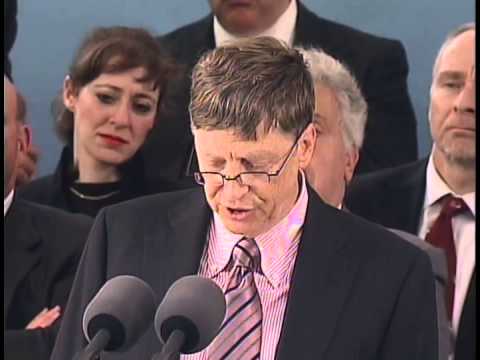
“In line with the promise of this age, I wanna exhort each of the graduates here to take on an issue, a complex problem, a deep inequity, and become a specialist on it. If you make it the focus of your career, that would be phenomenal. But you don't have to do that to make an impact. For a few hours every week, you can use the growing power of the Internet to get informed, find others with the same interests, see the barriers, and find ways to cut through them. Don't let complexity stop you. Be active... Activists. Take on big inequities. I feel sure it will be one of the great experiences of your lives. You graduates are coming of age in an amazing time.”Harvard Commencement, 2007 · 26:16
The lesson
Gates frames inequity not as a side issue but as a central measure of human progress. He says his own perspective changed because he realized he had left Harvard without understanding the scale of global unfairness in health, wealth, and opportunity, and he later came to see reducing that unfairness as one of humanity’s highest achievements123. In this chapter, inequity functions like a compass: it points attention toward the people who are most left behind and toward problems that matter most.
A key part of his argument is that the world’s worst inequities often persist not because nobody cares, but because the problems are hard to see, hard to solve, and hard to track. Gates argues that people often fail to act because complexity blocks the path from emotion to effective action, so the task is to make problems visible, identify workable interventions, and measure whether they are working456. That is why he urges people not to treat complexity as an excuse for paralysis7.
This logic explains why Gates and Melinda Gates focused on global health. They saw child mortality as an extreme form of inequity, especially because poor children face vastly higher risks of dying young, often from preventable causes89. They were also struck by the fact that low-cost lifesaving interventions existed but were not reaching children, largely because market incentives and government attention did not serve families with little economic or political power10.
Gates extends that point into a broader critique of where talent and funding go. Some urgent problems do not get solved naturally by the market, so progress requires deliberately attracting scientists, communicators, governments, and other capable people to work on them1112. His optimism comes from the belief that new tools such as biotechnology, computing, and the Internet can help people cut through complexity and direct caring toward real results13.
The practical takeaway is not that everyone must build a career in philanthropy, but that everyone can pick a serious inequity and move from awareness to action. Gates recommends becoming informed, finding others who care, looking for barriers, and then measuring impact so that success and failure both teach something1415. In his view, moral seriousness means refusing both indifference and helplessness: choose a problem, learn it deeply, and keep working even when the system is complicated.
4 principles from Bill Gates
Use inequity to choose where to focus
Look first at where suffering, risk, or opportunity gaps are most extreme. Gates’s point is that the biggest moral opportunities are often found where entire groups are being systematically left behind, especially in health and basic life chances.
“Reducing inequity is the highest human achievement.”
Treat complexity as a design problem, not an excuse
When action stalls, ask what is making the problem hard to see, solve, or evaluate. Break the challenge into clearer steps: make the need visible, find an intervention, and create a way to track whether it works.
“The barrier to change is not too little caring. It is too much complexity.”
Notice where the market will not naturally help
Some of the most important problems are neglected precisely because the people affected have little money or political voice. In those cases, you should not wait for ordinary incentives to fix things; you need intentional effort, funding, and advocacy.
“For under a dollar, there were interventions that could save lives that just weren't being delivered. If you believe that every life has equal value, it's revolting to learn that some lives are seen as worth saving and others are not. We said to ourselves, this can't be true, but if it is true, it deserves to be the priority of our giving. So we began began our work in the same way anyone here would begin it. We asked how could the world let these children die? The answer is simple and harsh. The market did not reward saving the lives of these children, and governments did not subsidize it. So the children died because their mothers and fathers had no power in the market and no voice in the system.”
Pair caring with measurement
Good intentions are not enough if you cannot tell whether lives are improving. Gates argues for measuring outcomes and sharing results so that work can improve and others can build on what actually works.
“The crucial thing is to never stop thinking and working and never do what we did with malaria and tuberculosis in the twentieth century, which is to surrender to complexity and quit. The final step after seeing the problem and finding an approach is to measure the impact of the work and to share that success or failure so that others can learn from the efforts. You have to have the statistics, of course. You have to be able to show, for example, that a program is vaccinating million more... Millions more children. You have to be able to show, for example, a decline in the number of children dying from the diseases.”
Moments to watch
In his own words
The quotes behind the lesson, word for word from the transcripts. Numbers match the lesson above.
“I left Harvard with no real awareness of the awful inequities in the world…”
“Reducing inequity is the highest human achievement.”
“What I remember above all about Harvard was being in the midst of so much energy and intelligence. It could be exhilarating, intimidating, sometimes even discouraging, but always challenging. It was an amazing privilege. And though I left early, I was transformed by my years at Harvard, the friendships I made, and the ideas I worked on. But taking a serious look back, I do have one big regret. I left Harvard with no real awareness of the awful inequities in the world, the appalling disparities of health and wealth, and opportunity that condemn millions of people to lives of despair. I learned a lot here at Harvard about new ideas in economics and politics.”
“The barrier to change is not too little caring. It is too much complexity.”
“If we had known how to help, we would have acted. The barrier to change is not too little caring. It is too much complexity. To turn caring into action, we need to see a problem, see a solution, and see the impact. But complexity blocks all three steps. Even with the advent of the Internet and twenty four hour news, it is still a complex enterprise to get people to truly see the problems. When an airplane crashes, officials immediately call a press conference. They promise to investigate, determine the cause, and prevent similar crashes in the future. But if the officials were brutally honest, they would say, of all the people in the world who die today from preventable causes, one half of one percent were on this plane.”
“Now this task is open ended. It can never be finished. But a conscious effort to answer this challenge can change the world. I'm optimistic that we can do this. But I talked to skeptics who claim there is no hope. They say, inequity has been with us since the beginning and will be with us until the end because people just don't care. I completely disagree. I believe we have more caring than we know what to do with. All of us here in this yard, at one time or another, have seen human tragedies that broke our heart. And yet we did nothing, not because we didn't care, but because we didn't know what to do.”
“Don't let complexity stop you.”
“If you're a poor child, you have fifty times more chance of dying before the age of five than a person in the rich world.”
“Yeah. The global health thing was pretty straightforward. It's easy not to be aware of the the number of children who die in the ill health. You know, if you're a poor child, you have fifty times more chance of dying before the age of five than a person in the rich world. And that's partly because you're not getting the right medicines, partly because if you live in Equatorial areas, things like malaria are threatening you and not threatening the the rich countries. So the idea that that's the greatest inequity in the world, you know, jumped out at us both from a visiting Africa and parts of Asia and a numeric point of view. You know, many people think that, okay, Syria is terrible. Yes. It's incredibly terrible. But a few hundred thousand over several years is less than six million per year.”
“For under a dollar, there were interventions that could save lives that just weren't being delivered. If you believe that every life has equal value, it's revolting to learn that some lives are seen as worth saving and others are not. We said to ourselves, this can't be true, but if it is true, it deserves to be the priority of our giving. So we began began our work in the same way anyone here would begin it. We asked how could the world let these children die? The answer is simple and harsh. The market did not reward saving the lives of these children, and governments did not subsidize it. So the children died because their mothers and fathers had no power in the market and no voice in the system.”
“There's more money put into baldness drugs than are put into malaria.”
“A goal I had there was to draw more people in to work on those problems because I think there are some very important problems that don't get worked on naturally. That is the market does not drive the scientists, the communicators, the thinkers, the governments to do the right things. And only by paying attention to these things and having brilliant people who care and draw other people in can we make as much progress as we need to.”
“Still, I'm optimistic. Yes, inequity has been with us forever. But the new tools we have to cut through complexity have not been with us forever. They are new. They can help us make the most of our caring, and that's why the future can be different from the past. The defining and ongoing innovations of this age, biotechnology, the personal computer, and the Internet give us a chance we've never had before to end extreme poverty and end death from preventable disease.”
“In line with the promise of this age, I wanna exhort each of the graduates here to take on an issue, a complex problem, a deep inequity, and become a specialist on it. If you make it the focus of your career, that would be phenomenal. But you don't have to do that to make an impact. For a few hours every week, you can use the growing power of the Internet to get informed, find others with the same interests, see the barriers, and find ways to cut through them. Don't let complexity stop you. Be active... Activists. Take on big inequities. I feel sure it will be one of the great experiences of your lives. You graduates are coming of age in an amazing time.”
“The crucial thing is to never stop thinking and working and never do what we did with malaria and tuberculosis in the twentieth century, which is to surrender to complexity and quit. The final step after seeing the problem and finding an approach is to measure the impact of the work and to share that success or failure so that others can learn from the efforts. You have to have the statistics, of course. You have to be able to show, for example, that a program is vaccinating million more... Millions more children. You have to be able to show, for example, a decline in the number of children dying from the diseases.”
Reflect
- What inequity in your field or community is widely acknowledged but still poorly addressed because it feels too complex?
- Where are you relying on general concern or good intentions when what is really needed is a clearer intervention and better measurement?
- Which important problem around you is unlikely to be solved by market incentives alone, and what kind of organized effort would it require?
Check your understanding
Go deeper
 Bill Gates on Global Inequity: Don’t Let Complexity Stop You2007 · 36 min · full transcript
 Bill Gates on Optimism and Empathy: Change the World2014 · 25 min · full transcript
 Bill Gates on Malaria and Education: Two Solvable Problems2009 · 20 min · full transcript
 Bill Gates on Philanthropy: Giving Away Wealth and Changing Systems2013 · 25 min · full transcript
 Bill Gates on Philanthropy and Global Health: Harvard Q&A2007 · 55 min · full transcript
- What advice did Bill Gates give Harvard graduates about making a difference?
- What was Bill Gates's biggest regret about leaving Harvard?
- What did Bill Gates say is the main barrier to change?
- Why does Bill Gates say people fail to act on inequity?
- Why did Bill Gates say some important problems get ignored?
- Why did Bill Gates think poor children were dying needlessly?