Why did Bill Gates choose global health for his philanthropy?
Bill Gates said global health was the clearest and most obvious place to focus because child mortality was the greatest inequity in the world. He pointed to the huge gap between rich and poor countries and said the foundation could help drive deaths of children under five dramatically lower. For him, the scale of the problem and the chance to make measurable progress made the choice straightforward.
“Yeah. The global health thing was pretty straightforward. It's easy not to be aware of the the number of children who die in the ill health. You know, if you're a poor child, you have fifty times more chance of dying before the age of five than a person in the rich world. And that's partly because you're not getting the right medicines, partly because if you live in Equatorial areas, things like malaria are threatening you and not threatening the the rich countries. So the idea that that's the greatest inequity in the world, you know, jumped out at us both from a visiting Africa and parts of Asia and a numeric point of view. You know, many people think that, okay, Syria is terrible. Yes. It's incredibly terrible. But a few hundred thousand over several years is less than six million per year.”
Key takeaways
- Choose problems where the injustice is obvious and the need is enormous.
- Look for places where science and delivery can save lives at scale.
- Use measurable outcomes when the goal is concrete and urgent.
Context
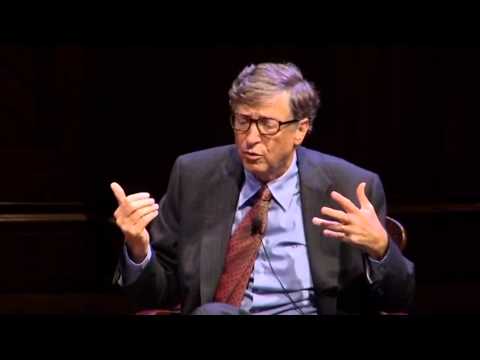
In the Harvard Campaign Launch Q&A, Gates was explaining the foundation's focus areas and why he and Melinda picked them. The quote above is taken word for word from the recording's transcript.
In the transcript
Yeah. The global health thing was pretty straightforward. It's easy not to be aware of the the number of children who die in the ill health. You know, if you're a poor child, you have fifty times more chance of dying before the age of five than a person in the rich world. And that's partly because you're not getting the right medicines, partly because if you live in Equatorial areas, things like malaria are threatening you and not threatening the the rich countries. So the idea that that's the greatest inequity in the world, you know, jumped out at us both from a visiting Africa and parts of Asia and a numeric point of view. You know, many people think that, okay, Syria is terrible. Yes. It's incredibly terrible. But a few hundred thousand over several years is less than six million per year.
Now that's the number of, children under five who died. When the foundation got started, it was twelve million and, you know, so over period of about a decade, it's gone from 12,000,000 a year to about 6... A little more than 6,000,000 a year. And we'll get it down in our lifetime to under 1,000,000 a year. So the equity between the poor and the rich will largely be…
Read the full transcript of Harvard Campaign Launch Q&A, 2007
Topics
More questions about Bill Gates
- What did Bill Gates say about measuring better teaching?
- What did Bill Gates say about why he left Harvard to start Microsoft?
- What did Bill Gates say about polio eradication and vaccines?
- Why did Bill Gates say the Gates Foundation should spend down instead of lasting forever?
- Why did Bill Gates say he would not have left software to become a lawyer or mathematician?
- What did Bill Gates say about choosing a career with the biggest impact?
How this answer was made: the quote is checked word for word against the transcript of the recording and confirmed as the speaker's own words; the summary above it was drafted with AI from that transcript and quality-checked. Methodology and corrections.