Bill Gates on Philanthropy and Global Health: Harvard Q&A

What Gates talks about
Bill Gates took part in this Q&A at Harvard University on June 7, 2007, reflecting on Harvard, Microsoft, and his philanthropic focus on global health, education, and reducing child mortality.
Also known as: William H. Gates III COL '77, LLD '07 Q&A; Harvard Q&A on philanthropy and global health.
In this Harvard Q&A, Gates looks back on his years at Harvard, the early days of Microsoft, and the logic behind leaving school to start a software company. He argues that the software opportunity was so urgent that a delay would not have changed history much, but timing still mattered a great deal.
The deeper focus of the conversation is his turn toward philanthropy: why he and Melinda chose global health and K-12 education, how they measure impact, and why the foundation is designed to spend down rather than exist forever. Gates frames global child mortality as the most glaring inequity in the world.
He also talks about Warren Buffett, the origins of the Giving Pledge, and how good questions, long-term thinking, and scale shape both business and giving. The interview presents Gates as someone applying the same systems mindset to software, wealth, and global problems.
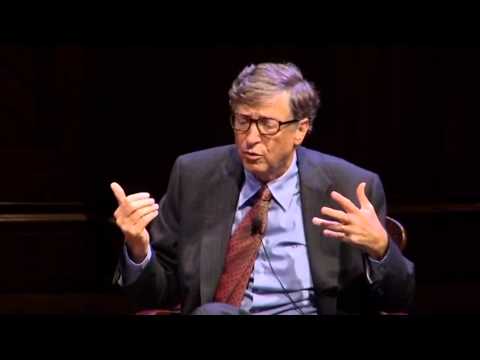
An interviewer moderates the Harvard Q&A while Gates answers throughout.
In his words
“I was having so much fun.”
“The idea of software companies wasn't around all that much.”
“I always wanted to have enough cash to pay everybody for a year.”
“If you're a poor child, you have fifty times more chance of dying before the age of five than a person in the rich world.”
“I think everybody worries about whether there's some match for that...”
Key points
- He says Harvard helped him find his niche, even if he did not stay to graduate.
- Microsoft succeeded because software economics let it scale without heavy capital needs.
- He saw global child mortality as the world's biggest inequity and chose global health as a foundation priority.
- He and Melinda selected U.S. education because it was a major missing piece in equity and economic growth.
- He values measurement, but warns that some education reform work is too complex for perfect metrics.
- He explains why the foundation will spend down rather than operate in perpetuity.
- He describes Warren Buffett as a close friend who asked the best questions and inspired the Giving Pledge.
Full transcript: Bill Gates, Harvard Campaign Launch Q&A (2007)
Bill GatesThank you.
InterviewerSo So Bill, thank you very much for doing this. You are very famous for among other things not having graduated from Harvard. Have you ever thought what you could have made of yourself had you actually actually stayed and got your degree? Well,
Bill Gatestwo times ago when I was last in this hall, was giving a speech and Mark Zuckerberg was in the audience. So I I got him to drop out. But truthfully, you know, I ended up going in total of three years and I took a lot of courses. So I'm not really a dropout in the sense that, you know, I fled the university. I had... I was having so much fun. It was just that it seemed like unless we got in on the ground floor, we were gonna miss the opportunity.
InterviewerWell, when you applied to college, you applied to Harvard, Yale, and Princeton. And suppose you hadn't gotten into Harvard and you only gotten into Yale and Princeton, do you think the value of being a dropout of Yale or a dropout of Princeton would have been as valuable?
Bill GatesWell, there's the prestige of turning Harvard down, which I don't have that. Right.
InterviewerYou've got famously, you've got did very well in standardized tests. You've got fifteen ninety out of 1,600. Have you ever thought what that question was that you've got wrong?
Bill GatesWell, the truth is I went... That was the verbal SAT. I got seven ninety the first time. I told my parents their vocabulary wasn't large enough. And I was criticizing them. So I did go back and take it and do better the next
InterviewerOh, see that? Okay. So when you were at Harvard, you did enjoy it, but you were famous for playing a lot of poker, famous for auditing a lot of courses, and famous for not attending the courses that you were supposed to be taking. So what would you say was the great experience you had and what you learned the most out of Harvard?
Bill GatesWell, you know, when you come to Harvard, there's so many brilliant people. And for a lot of people in your high school realm, and you probably have fairly key key positioning. You're one of the more studious, one of the better math or science. You have something that, you know, people, understand your your positioning. When I came to Harvard, in my freshman class, we had 80 people in one class, all of whom personal positioning was I am the best math person. And so we had 79 frauds. And so I thought, well, I'm probably not gonna be the best at this. In fact, a great guy, Andy Brayden, who's a lawyer in New York, was first in that class. So I decided I would be the guy who never attended any class he was signed up for. So within my first month, I figured out that was my unique positioning.
And I hope that 80 other people would steal that positioning, but it it turned out I... No one else imitated me.
InterviewerBut you you started out you were gonna be a math major and you finally realized there might be somebody better in math. You decided to be an applied math major. Is that true?
Bill GatesWell, there were certainly people better than me at math. I mean, I took the Putnam and scored well, but not at the top. The main reason I switched to applied math was that Harvard had the strange rule that you... If you were trying to get into a class like some movie class or political science class, it was very crowded, You could... If you were in applied math, could pretend to be applying math to that domain and be treated as though you were a student majoring in that field. But they never pinned you down, so you could use it as a kind of wild card. And there were a bunch of economics courses I wanted to get into including my expenses, microeconomics course that I would not have been able to get into unless I could say I was applying applied math to economics. So it was a great choice.
InterviewerOkay. So you... When you gave your... You received an honorary degree from Duke from from Harvard a few years ago. His his wife his wife went to Duke.
Bill GatesShe has a real degree. Actually, she has two, both from Duke.
InterviewerHis wife got the honorary degree from Duke this year and you got an honorary degree a few years ago from Harvard. And in that, you said that you wanted to be in Radcliffe, the dorms because you you concluded that there were more women than men there and you had a better chance of scoring a date if you were in Radcliffe.
Bill GatesWell, still a very, very low chance, but...
InterviewerSo it didn't work out.
Bill GatesThey had hamburgers too. You could get hamburgers for lunch no matter what they were serving. That was So...
InterviewerObviously, you famously left Harvard. Your parents, when you called your parents up and said, look, I'm gonna drop out of Harvard, what did they say?
Bill GatesWell, you never say that you're dropping out of Harvard. You know, I went on lead from Harvard. And so if things hadn't worked out for my company, for Microsoft, I could have always come back. Now eventually, changed the course catalog and requirements enough Right. Nobody would know what it would mean. And I was so close to graduating. So, you know, my parents probably thought within a year or so, the thing would would collapse and I'd it'd be like a a year off, like studying abroad or something.
InterviewerBut had... Truth is, had you graduated and stayed, would it have made a difference? In other words, would the world be different because you couldn't have started your company by graduate credit having not dropped out or not?
Bill GatesNo. It turns out that the urgency we felt that if we hadn't started in 1979, if we'd waited and started in 1980 or even 1981 because of the way we thought about the problem, because we, you know, we're so software oriented and thought... And and most companies weren't focused on software. People did software sort of a a side deal because they had to, but the hardware was what you paid all the money for. The software just came free. So the idea of software companies wasn't around all that much. So we, in fact, although we felt like we had to do it that day, an extra year would have would have been okay. Yeah. It wouldn't have changed the the course of history to to hang out another year.
InterviewerOkay. So when you started your company, you were the chief software engineer in effect architect and you were also the CEO. When you started it, to be realistic about it, did you actually ever think it could take off to the extent it did or what did you think the realistic goal was?
Bill GatesWell, I had what you might call an inconsistent view which worked out very well. One view was that there'll be a computer on every desk and in every home running our software. And so that would be, you know, billions of copies of our software and that our... We should do everything for that. But then when it came to spending money, renting things, I had a view that, okay, maybe we could triple in size. And I ought to do enough in terms of how I structured things to triple in size. So that was kind of my man... There was my vision which was grand, my management view which was to triple, and then there was my, okay, do we have enough cash if nobody pays us? So I always like to have... Because we had a few customers go bankrupt, because being in the personal computer hardware business was pretty chaotic.
I always wanted to have enough cash to pay everybody for a year. And still to this day, Microsoft has enough cash to pay everybody for a year.
InterviewerMore than a year, think.
Bill GatesYeah. More than a year.
InterviewerSo when you started, how did you avoid what so many other entrepreneurs are unable to avoid, which is taking venture capital money and diluting themselves? You didn't really take venture capital money. How did you avoid that?
Bill GatesYeah. We got software, if you can sell it in volume, has extremely favorable economics because the, you know, the costs are quite finite, and you can scale the volume up in our case to sell millions of copies. You know, every Apple two computer, Commodore PET, IBM PC have copies of our software. So our income went up a lot. So we we didn't have to build any factories. We were cash positive, and we didn't have a year where we lost money. You know, the first few years, okay, Paul and I worked for free, Paul Allen, was who was my cofounder. But after that, we were just generating cash.
InterviewerWe
Bill Gateseventually gave away or sold five percent of the company for a million dollars, so a 20,000,000 valuation just to get a venture capital company to join our board and give us some adult advice about various things, which actually was was quite helpful. We picked one in the Valley. A guy named Dave Markhart came on our board and did a fantastic job. That money sat in the bank. It's still in the bank today. So it was not for anything to do with capital, but rather just to join the team.
InterviewerAnd he's still on the board.
Bill GatesYep. He's still on the board of my stuff and is still extremely helpful as a lot of important So decisions get
Interviewerwhen you were starting, Steve Jobs was also starting his company not long after...
Bill GatesYeah. He was in India when we started. A year later. Yep.
InterviewerOkay. So, when his software was developed at one point, it was thought to be very good software, but he didn't want to license it. Was that helpful to you because his software was so good at that time that you're... If he had licensed it, there would have been no need for IBM or others to license your software?
Bill GatesYeah. It's a little complicated. So there's three phases of Apple. There's the Apple II era where Wozniak did... Steve Wozniak was a great engineer, did the Apple one software. Then he got kind of lazy or wasn't focused on it. So I got to do the Apple two basic and license that to Apple. Then there's the Mac era, where they did all their own system software and we were the big application provider for the Mac. And and because we were doing so well with our Mac application software, we kept telling Apple they should license their software to other people because it would have been better for Microsoft, although ironically, that would have competed with MS DOS and Windows. They, for a while, thought about doing it and then chose not to do that. And then then comes the era of sort of post Mac where they do all the the different things, and still keep it proprietary to them.
So truthfully, if they've done it in the Mac era, that would have been good for us because our application share was so so strong. And we totally believed in the licensing model. You know, today, Windows and Android follow the licensing model and have a very high share, although Apple's managed on a a reasonably modest share by our standards to make an amount of money.
InterviewerIBM decided to build a PC and they wanted to get somebody to provide the software. They thought, I guess, that hardware was the most important thing and they'll have some software provided by somebody. How did you manage to get that contract? And do you think IBM made a mistake by not buying the software from you as opposed to licensing it from you?
Bill GatesYeah. They certainly made a mistake. But they... Know, IBM is a great company that's done many, many great things. The actual project that did the IBM PC was started by the IBM management committee more to prove that they could do products quickly. They were seeing four year cycles between when they decided to do something and something shipped. So they had a facility in Florida, Boca Raton that had done a product systems have not... Hadn't done well. So they told them, you guys do a personal computer and try and do it in eighteen months and your strategy is gonna be to use third parties. So they went to Intel for the chip, ups for the software, a group called Computer Land for the distribution. And the goal was just to do it really quickly. And so we wrote the software for that. The volume projections they had for it were like two or 300,000 units over a three year period.
So they didn't view it as important. Ironically, then that thing was hyper successful. And so the divisions that did the dedicated work process for the small business machine, they got completely taken over by this tiny little group. And so the fact that they didn't know it was gonna be such high volume meant that the way they negotiated with us, we thought it was gonna be super high volume and they didn't. And, you know, then that can lead to them thinking they got a good deal, which they didn't. Okay. So in those days, you were a
Interviewerrival a bit, for Apple to some extent with Steve Jobs. But, at one point, he needed money and you put up some money to bail out Apple. What was that like when he had to come to you to get money? Well, yes.
Bill GatesSo the... So in the Apple two era, we did software for them and we were kind of friendly competitors. Then when they started the Mac, Steve came to us and we actually put more people on the Mac than Apple had because we wanna do all this application. So we're really very much partners. Then Steve gets kicked out of the company. He's not the CEO during that period at all, but he is the head of the Mac project and and so we're working closely. Then Scully comes in. He's gone. Then there's this management that wasn't doing so well that was negotiating with us on a bunch of things, and it was taking forever. I think it'd been a year of negotiation. And so when Steve comes and takes over the company, he sort of said, hey. Of the... I wanted this, this, and this, and I'm gonna give you this, this, and this. So we did the deal in three days, including putting money into the company.
We bought, I think, 6% of Apple, which our lawyers thought for antitrust reasons we shouldn't hold on to. It would have been nice if we had. But we mostly, besides the cash, we committed to do our Mac application software and really support the company. And then Steve, through great management, turned the company around first on the Mac and then did a bunch of new products that made it extremely valuable.
InterviewerBefore all that happened, you took your company public, think, in 1986
Bill Gatesor so.
InterviewerExactly. And you were 31, more or less. Right? So you're 31 years old and you're very, very wealthy, at least on paper. Did you think at the time that the company could actually get much bigger than it had been? And did you realize how wealthy you were? Did it change your life? Or you just kept working as hard as before? You didn't really pursue any outside activities after you realized how wealthy you'd become at 31?
Bill GatesWas very fanatical about the job. And so there wasn't any spare time. I mean, in my twenties, I didn't believe in vacation or weekends. In my thirties, I started believing in weekends. And then it wasn't until I met Melinda I started believing in vacations. Now I I believe in multiple vacations. I mean, I've completely given up fanaticism, but fanaticism is people in their twenties and thirties by
Interviewerby its own. And
Bill Gatesso it's very abstract that there was that value. I did start to read up about foundations because the idea that someday, maybe in my sixties, I thought at the time, I'd have some resources to give away and how would you do that? I remember seeing the Fortune magazine cover where Warren talked about... Warren Buffett talked about that it's not necessarily a favorite to your kids to leave huge sums of wealth to them. And I I read that thinking, oh, this might be relevant to me someday. That was before I'd met and become Right. Later got to be very good friends to Warren. I thought, this is pretty wise. I hadn't considered the distortionary effects of this. So it didn't change my life at the time, but...
InterviewerOh, okay. So you take the company public, you're still running running your tunnel vision and so forth. But one thing I wanted to ask you about with respect to the software that you created, which I've used for many years and many people here have as well. Why when I wanna turn on my software and computer, do I need to have three fingers? Control, alt, delete. What is that? Where is that from? What what... Where... Whose idea was that?
Bill GatesBasically, because when you turn your computer on, you're gonna see some screens and eventually type your password in, you wanna have something you do with the keyboard that is signaling to a very low level of the software, actually hard coded in the hardware, that it really is bringing in the operating system you expect instead of just a funny piece of software that puts up a screen that looks like a login screen, and then it listens to your password, and then it's able to do that. So we could have had a single button that the guy who did the IBM keyboard design didn't wanna give us our single button. And so we had... We programmed the low level that you had to do. It's... It was a mistake.
InterviewerAlright. So We
Bill Gatesdid some very clever things. The IBM keyboard... PC key character set, usually, you have a 128 characters like the lowercase and uppercase. But we took the upper ones, and we put, like, suit symbols in, and we were we were able to experiment with a lot of stuff, but more on the software side than the hardware.
InterviewerSo you're running the company and it's becoming very, very big and bigger and bigger and you're becoming wealthier and wealthier. At what point did you say, I've got so much money, I've got to do something with it. Was your father who came to you and said, Bill, you got to do something with this money and create a foundation. What what created your first foundation? What was the impetus behind it?
Bill GatesYeah. So, I get married in January 1994. My mom passes away that year. And then my dad is sort of saying to me, hey, you're getting all these requests. Why don't you just send them to me and I'll sort of sort through them and show them to you and you can decide, if you wanna fund some of them. So he's looking at any general request that came in. Then another... A really capable Microsoft executive, Patty Stonesifer, decided to retire and I wanted to put computers in libraries all over the world. And so she created vanity that was doing that. And so we went from like '94 to '97 where we have those two different things and it was a total of maybe 150,000,000 a year being given away.
Then because there were... They had complementary skills, we put it together into one foundation for Patty to be the CEO of in in 1997. So it built up from my dad sort of saying saying at night, you know, I told my dad, look, this money is still increasing in value and I'm pretty busy. But he said, no, I'll make it easy for you. And it was nice because then I I got down the learning curve a little bit.
InterviewerSo you... You're obviously a very smart, very driven person, very focused. Did you ever think it would be difficult to find a spouse that would be able to keep up with you?
Bill GatesYeah. I suppose so. Mean, not not keep up, but, you know, I I think everybody worries about whether there's some match for that... So how did
Intervieweryou happen to meet your wife? Was she she was working at... She graduated...
Bill GatesThere's an element of luck.
InterviewerShe graduated from Duke and she went work for Microsoft as I understand it. And then how did you happen to actually meet her? And was that complicated dating somebody who is working your own company?
Bill GatesYeah. I mean, there's... We were... She didn't work very directly for me. And and at first, we weren't serious at all. I mean, I was serious about work, and she was serious about work. And then it kinda surprised both of us that, like, wow. I actually might like to spend a lot of time with this this person. So it kind of snuck up on us, I'd say, in a in a good way.
InterviewerOkay. So now you... Your your foundation is now the Bill and Melinda Gates Foundation. And, you decided, you know, I think at the age of 50, more or less, to retire from Microsoft and to devote the rest of your life, more or less, to philanthropic things. So why did you decide to do it at, let's say, 50? And and was it difficult to withdraw from running a company you had built and and to really devote the rest of your life to something different than what you have been doing for twenty or thirty years?
Bill GatesWell, certainly in my twenties, Microsoft was everything. You know, every minute, every sense of, hey, am I doing good work? You know, I knew everybody's license plate. I could tell you when they drove into the parking lot when they left. You know, so it's kind of extreme. And so you're you're going from that to, you know, having a wife, having kids, having vacations. And, you know, that felt really good. It felt like it was appropriate. There comes a point where you feel like, okay, what I'm doing at the foundation has more of a unique ability to take pieces, take science, take economics, take systems change delivery, put those pieces together and get the story to the people who need to hear it.
It felt like it really was a ground floor opportunity. And and it was great that the foundation, you know, by the time I switched, which is five and a half years ago, it had by then, 250 employees and was running quite well. So I wasn't doing it from scratch. It just was beginning to grab my attention. And so I decided, okay, I'll make that my full time endeavor. And that it used the things that I enjoy about meeting with scientists and trying to do things that are high risk, but if they work might have a big impact. And at some point, you've got to flip from your primary thing is your business to your primary thing being the philanthropy. And so I made that change, which is a big change for me.
InterviewerSo you have famously decided that two major areas of the foundation, one is K-twelve education in The United States, another is healthcare in emerging markets, particularly in Africa. How did you come to those two areas as the ones you wanted to focus on? And was it difficult for you to actually come to an agreement among yourself and let's say, Melinda about what you wanted to focus on?
Bill GatesYeah. The global health thing was pretty straightforward. It's easy not to be aware of the the number of children who die in the ill health. You know, if you're a poor child, you have fifty times more chance of dying before the age of five than a person in the rich world. And that's partly because you're not getting the right medicines, partly because if you live in Equatorial areas, things like malaria are threatening you and not threatening the the rich countries. So the idea that that's the greatest inequity in the world, you know, jumped out at us both from a visiting Africa and parts of Asia and a numeric point of view. You know, many people think that, okay, Syria is terrible. Yes. It's incredibly terrible. But a few hundred thousand over several years is less than six million per year.
Now that's the number of, children under five who died. When the foundation got started, it was twelve million and, you know, so over period of about a decade, it's gone from 12,000,000 a year to about 6... A little more than 6,000,000 a year. And we'll get it down in our lifetime to under 1,000,000 a year. So the equity between the poor and the rich will largely be eliminated. So that one was clear. Then the question was, okay, given that we live in The United States, the framework of business law, education, Lakeside Harvard that allowed the fortune to be created was here in the essence. So what do you do to give back? And there we picked education because in terms of equity or economic growth, in our view, that's the big miss...
Missing piece because it... It's not operating very well and if it can operate well, it it has this monstrous effect. So... And that was pretty easy to agree on because we have a lot of chats about it. Neither of us really varied from that at all.
InterviewerOkay. So the foundation is called the Bill and Melinda Gates Foundation. Suppose you disagree on what to do, how how do you decide what to do?
Bill GatesIt's like raising kids. I mean, you talk and talk and...
InterviewerWork it out. Okay. You
Bill Gatesknow, there's quid pro quo. Somehow it always works out. It's never been that difficult because we're talking about what people should we pick and what organization structure we're going off on different trips and it's a lot of fun to talk about it. You know, in Microsoft, I had that relationship with Paul Allen for the first ten years or so. Then I had it with Steve where even though I was CEO for most of it, he was... Ran it together. Now the foundation... Okay. Melinda is amazing at playing that role.
InterviewerOkay. So, today, let's talk about Warren Buffett. You mentioned him. How did you actually get to meet Warren Buffett initially? And how did you develop such a close relationship with him?
Bill GatesWell, was a very strange thing. My mom said that she was having Kay Graham and Warren Buffett and a bunch of people to a party on July 4 and I needed to come. And I said, I'm working, mom. And she said, no. No. No. You have to come. So I said, okay. I'll take a helicopter out to this place, stay two hours, and then I'll go back. And that that seemed to satisfy her. So I went out and I met Warren. And I thought, hey, what I have in common with this guy? This guy buys and sells stocks. You know, what does that do to the world? It's just paper. And, you know, the fact that people look at, like, trends and volumes and they see things going on and those wiggling things, it's not that big value added, really. So he started to ask me questions that no one had asked me about the computer business, the software business, why IBM hadn't been able to do this, what we were good at, why other companies hadn't come along, what we were doing about growth, pricing, just all the questions that, you know, I sat and thought about.
And so then I thought, well, hey, this guy asked good questions. So I I was asking about banking and loans and why he invested in certain things. But not in terms of the prices of the stock, but the dynamics of the businesses, the people, the products, the pricing. And I, you know, you can basically say I fell in love with Warren that day. He was so interesting and we've been super close friends ever since.
InterviewerSo you played bridge a lot with him. And what is it like to have two of the smartest and maybe the two wealthiest people in The United States and you're playing bridge and you lose. Is that very humiliating? I mean, you're very wealthy guys, you're very smart and you play bridge and you don't win. Well,
Bill Gateswe put... Warren and I love to play bridge. It's very relaxing, you know, great game. You can play it online. There are thousands of of truly great bridge players that are way better than we are. You know, for amateurs, we're pretty good, but it's it's relaxation. And so we play with people who are way better who point out to us mistakes that we make. Know, it's it's a fun fun endeavor. We don't ever bet or anything.
InterviewerSo what did you... Well, I guess you don't need to make any more money, so you're right. So what do you what did you think when he called you up one day and said, guess what? I'm gonna give you the bulk of my fortune to your foundation. Were you shocked and why do you how do you think he came to that?
Bill GatesLet's say, when I... Most of the time I knew Warren from 1994 on, he was in the mode I'd been in for a while, which is that he felt his wealth was accumulating, and so it was probably best that it be given away later, or he just liked having the the capital to accumulate. He assumed that, he would die before his wife Susie, and, she was given the responsibility to run a foundation and give it all away. Tragically, she died before he did, and this is about seven and a half years ago now. And it was kind of unusual that a few months after that, he said to me, you know, the logical thing would be for me to give money to your foundation.
And that's all he said. Said that would be the logical thing, and I thought about it I thought, well, we are we are large. Okay. I guess that'd be logical. But it wasn't like he was gonna do it or anything. Then the next time I saw him, he said, you know, it really would be logical. And I thought, he he may be serious about this. So I I said to Melinda, he might actually be thinking about this, and it was completely out of the blue. And then a month after that, he talked to his kids, made, very generous, gifts for them to create foundations. Actually, they've had their smaller foundations, but but made them quite substantial. And so, and there was another foundation, focused on reproductive health things. So total of five foundations, got resources, but a large percentage came to us. So it was a fantastic thing and we were able to take our mission in health and add agriculture.
We were able to take our mission in K through 12 and add, some, college level stuff. So it's really enabled us to scale up what we do very dramatically.
InterviewerSo what are the assets now of the foundation?
Bill GatesYeah. The assets are 36,000,000,000, but the gift... Warren gives on a yearly basis stock that's now worth 2,300,000,000 a year to the foundation. Birch has had a particularly And good and so the the corpus that I'm saying, that's the the money I put in. So you actually have to almost double it in terms of the the yearly payout.
InterviewerSo how much are you giving away a year annually?
Bill GatesWe're just over 4,000,000,000 a year.
Interviewer4,000,000,000? Yeah. And how do you measure the success of the money that you give away? Do you have very good metrics or you just don't really have perfect metrics? I guess there are no perfect metrics, but how do you follow-up and make sure that's being used the way you want?
Bill GatesWell, some things are pretty straightforward to measure. The number of children who die every year, the way that number is measured, it's accurate to within certainly plus or minus five percent. And so if your goal is to drive that number from twelve million to six million, which where we are now and from six million to one million, you either succeed or you don't succeed. That one requires tons of partners. That's not just us. That's development aid budgets and delivery organizations, but we're part of that movement and and, you know, really pushed a lot of new science including new vaccines into it. So then you have more near term things like have you discovered a malaria vaccine or an AIDS vaccine or TB vaccine, and you look at the scientific progress there. And that is a little softer, but you you you can tell. In education, if you're giving scholarships, that's straightforward.
If you're putting computers in the libraries, that's straightforward. If you're trying to help improve the k through 12 personnel system so that the average quality of teaching is much better. That is the really good teachers share their secrets and certain incentives and professional development are put in so that the average, moves up to the the top quartile, from the... Today's average to the top quartile today. That because it's subject to so many uncertainties, including school boards, political processes, union negotiations, desire to maintain the status quo. If you said to me, are we making progress on that one or not, I could talk for a long time, but I wouldn't be able to give you a number. And so, you know, the very risk of it and the the complexity of the system change that's necessary makes that tougher to measure.
I'm a total fan of measurement, you know, where it can be done, but to the degree that would drive you to low risk things and steer you away from trying to improve k through 12 US education, then the fetish towards measurement measurement can be taken too far.
InterviewerSo your foundation is not to be a perpetual foundation. As I understand it, fifty years after the last spouse dies, it's supposed to be terminated. Is that more or less...
Bill GatesYeah. We lowered
Interviewerit from 50 to 20. 20. Okay. Sorry. So 20. So what is the theory behind doing it after just twenty years? Why not have it like the Ford or Rockefeller Foundation go on forever?
Bill GatesWell, those in perpetuity foundations are amazing and we partner with a lot of them. For us, the theory is that we pick some causes, education, you know, global health, and we can actually see childhood death, in our lifetime getting to be pretty small. So we have this very specialized org... Organization. You know, we have malaria experts. We have vaccine manufacturing experts. We are an institution. It's not just the amount of money we give. We are about global health. We have people who think, you know, have done twenty hours... Thousand hours of videotaping of good teachers, mediocre teachers, looked at what that is, thought about teacher training. So it's a purpose built organization. And we think that whatever our ideas are about change in our lifetime plus 20, you know, they'll they'll either work or not work.
And then it's up to rich people who are alive, who are looking at the current problems and politics and technology and understanding of learning to decide, you know, to give their money as opposed to picking, you know, some weird board who god knows what they would do. Alright. And and there will be plenty of money, but that's just our choice not to perpetuate some name because these missions don't... They're not... You know, they will be solved by someone, hopefully us, but by somebody within the next forty or fifty years.
InterviewerOkay. So today, have a large number of people working at the foundation. That's 800 people or something like that. So it's a bit of a bureaucracy. 800 people is a lot. So if you decide you want to do something, do they do what you want or do they kind of come back to you and argue and you have a hard time getting things done through your own foundation or that's not a problem?
Bill GatesWell, we get we get them to argue with each other. That's the... If you only have one person work for you, that can be very difficult. No. Seriously, it's it's as... It's like Microsoft was with about a thousand people where the understanding of the analytics, the bias towards action, the understanding the different mixes of skill sets that are required. It's pretty exciting to go in. I spent this morning discussing our pneumonia strategy because there's some partners here in Boston who are who are part of that strategy. It's really fun to go through the discussion about which paths we ought to take. So it's... Sure there's debate, but you have a lot of knowledge. You know, these... Many of the problems we work on, it's amazing how little has been put into them like malaria or pneumonia or diarrhea to signing new toilets.
It's amazing how little has been done.
InterviewerSo you spend a lot of time traveling the world as does Melinda, meeting with government officials. Is it ever hard to get a meeting with a government official for you or they always welcome you because they think you're gonna bring a lot of money?
Bill GatesThey've been very nice.
InterviewerOkay.
Bill GatesNo. It's it's it's great. The ability to take things like their child's death rate and get that higher on their priority, you know, to have them understand how they compare to other countries, what it is about the way they organize primary health care that's not working. They... You know, the way they normally pick a cabinet and the way democracy normally works, the gradient justice of ill health and the fact that that actually paradoxically means they have very high population growth and therefore feeding people and maintaining stability is gonna be very difficult. That's not, you know, part of their... People aren't coming in educating them that on on a day to day. But, yeah, the access has has been super good. Once I wanted to go see Qaddafi and Melinda made me hesitate, and then he got killed, so I never
InterviewerSo got to see how do you deal with the problem of wealth and your children? You have three children. So obviously growing up as the children of Bill and Melinda Gates obviously has some pluses and some non pluses, let's say. How do you deal with wealth and how do you get them interested in philanthropy as well?
Bill GatesWell, it's certainly distortionary to have parents who are well off and or just have parents who are well known. And, you know, we've said to the kids that the money's going to the foundation not to them. And so they won't be accepted...
InterviewerWhat was their reaction to that? They...
Bill GatesWell, every year they're, you know, thinking about that and get to ask about it. You know, I don't think kids want that... I mean, partly because they've they've been told that along, but I don't think a kid ever comes in and says, yeah, I should have, you know, $500,000,000. I I should be able to sit around. I should be able to buy a sports team. I mean, what the heck? It... In terms of your own contribution to society, what you learn, you know, go off, be a doctor, go off, be a scientist, go off, be a social worker. If you have this pile whose whose, you know, sort of leverage of it being used well kind of exceeds any individual contribution, I think that would be, you know, very strange thing. And it's not just you who sees that.
It's your friends, everybody around you, and, you know, you kinda stick out. You're not going to have to ever worry about certain things. So we've said that to them and and, you know, they know we're quite sincere. They've had a chance to travel the world and see these things, but we're not saying to them that they'll have any role at the foundation or they'll have their own foundations, nothing like that at all.
InterviewerBut now you've decided to leave them some money but a modest amount.
Bill GatesYeah. There's this thing about, you know, enough so they'll never Right. Leave anything but enough so they'll have to work. That number probably doesn't exist. So Okay. You know, we're probably leaving them a little too much for one of those goals and and Okay. Too little for the other one. But...
InterviewerSo how do you compare the emotional and intellectual excitement of building Microsoft with the intellectual and emotional excitement of solving the problems you're dealing with now? Are they different? And what is more rewarding for you or has been?
Bill GatesI think when you're young, a very hands on stuff where you're writing the code yourself. And you've just gotta prove, you know, do I understand this? Can I I get this done? I think that's just phenomenal. So I was very lucky to to have that experience. Then as Microsoft got larger, my role was more indirect, in terms of picking teams, backing teams, picking general directions. And so my role when I I left my full time work at Microsoft, and what I'm doing now at the foundation is very similar. Now the domains, I have to understand vaccines and Northern Nigeria dysfunction. So the problems... The specifics on the problems are are different. That's... Let me broaden the kind of science exposure that that I get, which I've enjoyed.
But it's pretty darn similar to my... What I was doing in my forties at Microsoft, what I'm doing in the foundation now.
InterviewerSo you meet a lot of very smart scientists now. Have you met some who say these people are so smart that I I... Even I can't keep up with them. There's no...
Bill GatesAbsolutely. They're... People... The world is very specialized. You know, it's like these people who play bridge. They are... You know, I don't I don't care how much general extra IQ you bring to the problem, you know, you are not going to catch up to that. And likewise, in all these areas, the foundation works. And, you know, there are some people who just, when it comes to the sciences, are are really unbelievable. Now it's very fun to have those people around. And part of the reason I'm willing to learn a lot of science is I know if I ever get confused, are people like Nathan Merovoldlow would... I can just send mail to and say, I'm a little confused about this. Straighten me out. So you don't you don't ever feel like you're gonna hit a dead end in terms of your understanding.
InterviewerSo do people come to you all the time and say, I'd like your advice about something, but they really want your money? Ever And had
Bill Gatesso... Yeah. You've probably done that to someone. I I... Not to me. You haven't. No. But... Yeah. Sure.
InterviewerSo how do you deal with requests that are not in your core areas of your foundation? People come to you, they might be friends of yours or they might be some other things that you might be interested in, but just not in your core areas. You just basically... How do you how do you learn to say no to all these requests? You must get an incessant amount of them.
Bill GatesWell, if it's coming from a stranger and it's not in an area the foundation works, then it's very easy to say no. You know, we don't do cancer. It's great that people do. It's very, important work, but we don't. And, you know, so that's easy. If it fits into the foundation, then because of our scale, we have a staff that can look at things and really evaluate, you know, if anybody has ideas about malaria, great. We look at every idea about malaria in in great depth. The tough thing is when it's people who you have relationships with, friends, or people that you've asked money for, then you have to consider it. And, you know, it's probably wise to set aside, you know, 10, 15% of your philanthropy for socially related...
And not... And they're not terrible things. Some of them are are gonna be things you kinda go, oh, jeez.
InterviewerOkay. So... Alright. So sometimes you you do make some exceptions, but let me ask you...
Bill GatesYeah. I'm not pure.
InterviewerWhat would you say is the most exciting thing you have done with your money in terms of giving away? What was... Is there some achievement that you're really particularly proud of? I know it's ongoing, but is there one or two things you would cite and one or two things you would say as a regret that you wish you hadn't done with your money?
Bill GatesOh, what we're doing to eradicate polio, which if we're lucky by 2018, it will become the second disease after smallpox be completely eradicated. That is really exciting. And, you know, it's down to three countries, Nigeria, Pakistan, Afghanistan, and, you know, it's complicated. I'll meet on Monday with the president of Nigeria, the president of Pakistan. You know, we're still very hopeful. That is pretty exciting because we've had to bring, you know, satellite mapping, using cell phones, better vaccines, and reaching out to religious leaders. A lot of of different things come together. I'd say in terms of what's measurably been done, the work on childhood death, and childhood sickness, that's what we're most proud of, and that's largely been done through vaccines.
It would be great if our education stuff worked, but that we won't know for probably a decade. If polio succeeds, then we'll take on malaria and measles in the same way, try to go in our lifetime for the eradication of those.
InterviewerSo, what would you like to see as ultimately your business legacy and your philanthropic legacy? Obviously, you've got a long way to go, but if today you were to say what this is what I accomplished in business I'm most proud of and this is what I've accomplished to date in philanthropy, what would you say they are? Well, business is hard because,
Bill Gatesyou know, Microsoft was a significant part of the creation of the software industry, the personal computer, which led to the Internet. And, you know, there were many other companies, some of whom... You know? Yes. Steve Jobs did important work, but there's, like, a lot of other people too. He and I were the most prominent, but history always kind of oversimplifies. You know, there were people who did things that completely failed, but were very suggestive of the right answer to things. The competitive dynamics, you know, leads to these... Some of these markets, winner take all, you know, type results, you know, where today you're seeing Google, Facebook, and certain elements benefit from those dynamics. So I can't really characterize, you know, personal computing, Internet software happened a little bit better, a little bit faster.
But you can't really pull out one individual's thing, you know, even if you took a company and you said Microsoft, then there's a much bigger contribution. But even so, you know, saying that trying to do some counterfactual on that is very hard. So I don't think you can ever sum up a contribution.
InterviewerWell, would you say take a look at your life? You have a life that most people would envy, a lot of money, a wonderful family, very well respected, successful in everything you've touched. Is there any regrets in your life? Can you make the rest of us feel okay that something isn't perfect in your life and you have some regrets so we can just feel we're more simpatico with you in that way?
Bill GatesNo. I'm super super lucky and and I wouldn't trade places with anyone close to my age. It's it's been a lot of fun. You know, there's tons of things that I'm not good at And so the question is always, can I get somebody involved in a in a certain day to day management things, negotiating things, political things, scientific experts who really do have the time to focus in on one thing like I did in in my twenties and just really, really see all the the possibilities? And, you know, I I'm I'm known for being fairly tough sometimes. I think I'm mellowing. I'm more, you know, trying to be more generative in these things. So I have work to do, on those, things. Know, my wife always gives me good feedback.
InterviewerSo... If you had not, if Microsoft hadn't really taken off, let's suppose, have you ever thought what you would be doing today or what would you would have done with your life? In other words, suppose Microsoft just turned out to be another software company that didn't make it, of which there were thousands in those days. What do you think you'd be doing now?
Bill GatesWell, software is pretty magical stuff. So even if I'd been consigned to a pretty modest role in the software game, software in the, you know, 1980 to even now, And we're just at the beginning because speech, vision, you know, software became really good. And some great holy grails of that industry that I sat and dreamed about as a freshman here at Harvard were finally making great progress on on those things. So even if I'd had to do a fairly small company, I don't think I would have ever felt like, I should go be a lawyer, which my dad was. And when I was very young, I I originally thought that's what I would do. Or mathematician, which, you know, has certain prestige, but very few people get to contribute to it.
So software... Either software research or even having a modest software company, I think that that there are eras where certain kinds of endeavors are having more impact. You know, it's not like I think, oh, I wish I'd been doing auto engineering in the nineteen eighties. I'm not trying to denigrate the people who are doing auto engineering, but it wasn't in a an exponential change the world type mode. You know, today, are certain things in biology, hopefully in energy, still in the software IT space. So there's more domains now that are changing the world. So, you know, young people have more choices where they could they could, and I'm not saying economics, just in in terms of their IQ having huge impact, there's more choices today than than when I was young.
InterviewerSo given the financial success you have and all the things you have today, would you give them up for ten additional years of your life? Let's suppose you could be ten years younger, we had to give away all your money, but you could know you're going to live ten years long and have good health in that. Or would you be happy with where you are?
Bill GatesFor twenty.
InterviewerTwenty. Okay. We can negotiate for fifteen.
Bill GatesYeah.
InterviewerNow, you're obviously the world's largest philanthropist, but you've also tried to proselytize a little bit on philanthropy by starting the Giving Pledge with Warren Buffett and Melinda. Can you explain what the Giving Pledge is supposed to do?
Bill GatesWell, it grew out of a dinners that Warren said, hey, let's go talk to people who are doing philanthropy and see how they got into it, what they like about it, you know, what do they think about staff or causes. And so we had actually four dinners and it and it was wonderful to hear people's passion and the different things they were working on. We were trying to convince them to give to our causes and except for very few cases they were trying to convince us to give theirs. It really was just sharing about giving. And at the end of each of those dinners, people said, hey. What should we do to maybe get other people to start younger or to feel less isolated that they could learn from each other about this thing and draw a bit more more people in because we think they... They'll feel good about it.
And we talked about a a few constructs. So this idea of a pledge to give more than half that the very most successful, could come together in a group that had done that and learn from each other, share experiences positive and negative with each other. That sort of came into being and amazingly when we first called around,
InterviewerI think
Bill Gateswe got about 35 people fairly quickly into it. You know, you joined very early on, and and now it has been. It's a yearly get together, although there's more special learning sessions that people go to, about three or four of those here. It... I've met a lot of interesting people. I've learned a lot. And, you know, I think people are a little smarter and starting a little earlier.
InterviewerSo you now have a long time to probably continue doing what you're doing. But do you think you'll ever slow down and really, let's say, relax in a traditional sense? Are you gonna be driven like this for another ten, twenty, thirty years?
Bill GatesHopefully, I I can stay, you know, at a high level of intensity, into my eighties. I'd like to. I I don't... You know, I'm not very good at golf.
InterviewerDid you... You did take up golf, right?
Bill GatesNot really. I I mean, I I I was out there hitting the ball, but I never... Should try what I do
InterviewerYou should try what I do, which is miniature golf. It's a lot easier. So have you ever thought when you do slow down, if you ever do slow down, maybe in your eighties, you might come back to Harvard to complete your degree? A couple credits left?
Bill GatesWell, I don't know. I I take a lot of college courses. The online free stuff has gotten very good in these new MOOCs where Harvard's doing edX and there's Coursera, Udacity. But the The Learning Company DVDs, now they have streaming, finally. But, you know, meteorology, biology, geology, I highly recommend, you know, I just took oceanography, last month. These are really, really good courses. So it's kind of ironic that I'm a dropout because I love college courses probably as much as anyone around.
InterviewerWell, you've had a remarkable life and, you're obviously a very famous person who's attended Harvard and, Harvard is very proud of you and, we very much appreciate your giving us this time today. Thank you, Bill.
Bill GatesWell, thanks.
Transcribed from the audio by speech recognition (Deepgram); speaker labels are automatic. Timestamps link to the video above. Errors are possible.
Cite this recording
Bill Gates, “Harvard Campaign Launch Q&A (2007)”, Harvard University, June 7, 2007. Transcript and video: Thinkers Archive, https://thinkersarchive.com/bill-gates/philanthropy-global-health-harvard-qa-2007/
Quoting a passage? Link to its exact moment: every timestamp above has its own anchor (for example https://thinkersarchive.com/bill-gates/philanthropy-global-health-harvard-qa-2007/#t-79).