Bill Gates on Reading & Curiosity
Bill Gates treats curiosity as an active discipline: read widely, keep learning like a student, and use facts and empathy to update your view of the world.
- Curiosity is a core habit behind better learning and judgment.
- Reading is not just intake; it is how he keeps being a student.
- He values facts highly and wants beliefs updated by evidence, not noise.
- Curiosity should point toward important problems, especially health and education.
- Long-term progress comes from sustained learning and patience, not short-term expectations.

“I have a fear that, you know, I eventually I'll lose, you know, I won't want to pick up a 500-page book.”Raj Shamani interview, 2025 · 30:32
Curiosity is the engine of learning and judgment
For Gates, curiosity is not a personality extra. It is a practical advantage that drives learning, better decisions, and progress. He connects constant questioning with the ability to improve your understanding over time rather than getting stuck with first impressions.
That helps explain why he keeps returning to the stance of a learner. He describes the ideal as reading a lot and staying a student, which suggests that curiosity is less about having answers and more about maintaining an active relationship with new ideas.
Reading is how he keeps his mind in motion
Gates treats reading as a continuing practice of self-education. He pairs reading with deeper study and ongoing learning, including online courses, as ways to sharpen his grasp of science, economics, health, and other fields.
What stands out is that he talks about reading as part of identity, not just productivity. He wants to remain someone who can still pick up demanding books, which shows that serious reading matters to him as a way of preserving intellectual range and stamina.1
“I have a fear that, you know, I eventually I'll lose, you know, I won't want to pick up a 500-page book.”Raj Shamani interview, 2025 · full transcript →
Good curiosity follows facts, not vibes
Gates's version of curiosity is not random browsing. It is disciplined by evidence. When he talks about vaccines, for example, he stresses that the facts are clear and strong, showing that curiosity should lead to firmer understanding when the data are overwhelming.2
This is one reason he can stay optimistic without becoming naive. He looks for measurable reality, whether in disease, education, or technology, and then asks what can actually be improved. His approach is to learn enough about a problem that action becomes more intelligent.23
The best reading widens your moral field of view
For Gates, learning is not only about becoming smarter. It should also help you see important suffering and inequity more clearly. His focus on global health comes from recognizing how extreme the gap is between poor children and children in rich countries, and that recognition changed what he thought deserved attention.
This is where curiosity meets empathy. Change begins when you truly see a problem and let that understanding redirect your effort. Reading and learning matter because they can move your attention toward the lives most affected by bad health, weak education, or lack of access to useful technology.7
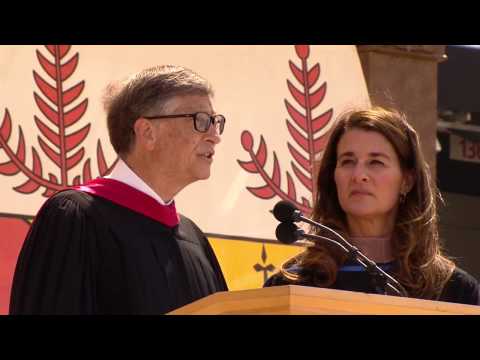
“That's the moment that change is born.”Stanford commencement address, 2014 · full transcript →
Stay patient: deep learning pays off over time
Gates repeatedly frames progress in long horizons. He warns against overrating what can happen in a year and underrating what can happen in a decade, which is also a good rule for reading and self-education. Big understanding compounds.9
His own path reflects that combination of intensity and long-term vision. He followed the areas where learning could have outsized impact, first in software and later in health and education, and he still sees new waves like AI as major chances to learn and build. Curiosity, in this view, is not passive interest but sustained engagement with fields that are changing fast.101112

“We overestimate what we can do in 1 year, and we underestimate what we can do in 10 years.”Jay Shetty Podcast interview, February 2025 · full transcript →
Gates on reading & curiosity, in his own words
“I have a fear that, you know, I eventually I'll lose, you know, I won't want to pick up a 500-page book.”
“We overestimate what we can do in 1 year, and we underestimate what we can do in 10 years.”
“That's the moment that change is born.”
Where to watch
 Bill Gates on Curiosity and Optimism: Reading, Health, and the Future2017 · 80 min · full transcriptBest single conversation for how Gates links curiosity, reading, and updating his worldview.
 Bill Gates on India, Philanthropy, and AI: Reading, Health, and the Future2025 · 44 min · full transcriptUseful for seeing how he describes reading as part of staying a student and relating that habit to AI and the future.
 Bill Gates on Optimism and Empathy: Change the World2014 · 25 min · full transcriptShows why curiosity must be joined to empathy so learning points toward meaningful human problems.
 Bill Gates on Education and Health: Technology Can Lift Lives2007 · 33 min · full transcriptExplains how broad learning connects to software, education, health, and practical progress.
 Bill Gates on Philanthropy and Global Health: Harvard Q&A2007 · 55 min · full transcriptAdds context on how his curiosity expanded from software opportunity to global health and education.
Questions people ask
- What did Bill Gates say about measuring better teaching?
- What did Bill Gates say about polio eradication and vaccines?
- Why did Bill Gates choose global health for his philanthropy?
- What did Bill Gates say about choosing a career with the biggest impact?
- What did Bill Gates say about education being important?
- Why did Bill Gates say he would not have left software to become a lawyer or mathematician?
Sources
Every quote above, word for word from the transcripts. Numbers match the text.
“I have a fear that, you know, I eventually I'll lose, you know, I won't want to pick up a 500-page book.”
“The facts about vaccines are very clear and very strong.”
“You can spend less than $1,000 and you can save a life.”
“That's the moment that change is born.”
“We overestimate what we can do in 1 year, and we underestimate what we can do in 10 years.”
“AI is sort of today's equivalent of what I did when I was young…”
“So software... Either software research or even having a modest software company, I think that that there are eras where certain kinds of endeavors are having more impact. You know, it's not like I think, oh, I wish I'd been doing auto engineering in the nineteen eighties. I'm not trying to denigrate the people who are doing auto engineering, but it wasn't in a an exponential change the world type mode. You know, today, are certain things in biology, hopefully in energy, still in the software IT space. So there's more domains now that are changing the world. So, you know, young people have more choices where they could they could, and I'm not saying economics, just in in terms of their IQ having huge impact, there's more choices today than than when I was young.”
“Well, software is pretty magical stuff. So even if I'd been consigned to a pretty modest role in the software game, software in the, you know, 1980 to even now, And we're just at the beginning because speech, vision, you know, software became really good. And some great holy grails of that industry that I sat and dreamed about as a freshman here at Harvard were finally making great progress on on those things. So even if I'd had to do a fairly small company, I don't think I would have ever felt like, I should go be a lawyer, which my dad was. And when I was very young, I I originally thought that's what I would do. Or mathematician, which, you know, has certain prestige, but very few people get to contribute to it.”
How this guide was made: drafted with AI from the full transcripts of the recordings cited, then checked: every quotation must match a transcript word for word and be the speaker's own words, and an independent review gates accuracy. Methodology and corrections.
