Bill Gates on The Gates Foundation
Bill Gates sees the Gates Foundation as a time-limited, highly data-driven philanthropy that tackles the biggest inequities by funding new tools, making them affordable, and partnering to deliver them at scale.
- The foundation exists to give wealth back to society and focus it on major inequities, especially global health.
- Gates says its model is to fund R&D, drive down costs, and work with governments and partners on delivery.
- He wants clear outcome measurement, including cost per life saved and progress toward concrete goals like eradication.
- He believes philanthropy can do far more in poor countries because needs are underfunded and the impact per dollar is much higher.
- He plans to spend the foundation down over 20 years rather than preserve it indefinitely, because urgent problems should be attacked faster.
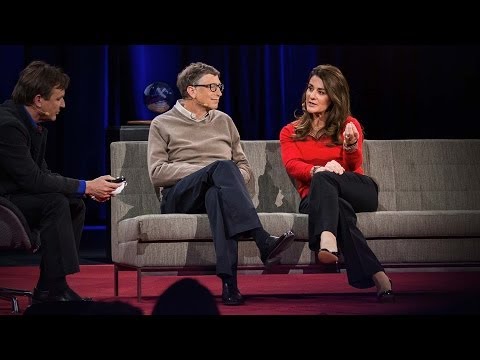
“…the wealth that had come from Microsoft would be given back to society…”TED2013, Long Beach · 0:59
The foundation starts from a moral choice: use great wealth to reduce the biggest inequities
Gates describes the foundation as an effort to return wealth to society rather than preserve it for its own sake. He connects that choice to a direct view of avoidable suffering and to the belief that philanthropy should address problems that markets and governments often neglect.12
His clearest example is global child survival. He says the odds facing a poor child are dramatically worse than those facing a child in a rich country, and that this disparity made global health an obvious priority for the foundation.3
He also frames the work as deeply personal and meaningful, not as a side project. The foundation’s mission grew from seeing extreme poverty up close and deciding that wealth should be put to work on behalf of people who have the least access to life-saving tools.5
“…the wealth that had come from Microsoft would be given back to society…”TED2013, Long Beach · full transcript →
Gates chooses problems where philanthropy can move the world, not just fund nice projects
Gates’s pattern is to focus on areas where the suffering is large, the need is neglected, and extra money can produce outsized gains. He says philanthropy is especially powerful when it is not constrained by profit and can back problems affecting the poorest people, where public goods are underfunded and each dollar can do far more good.6
That is why global health sits at the center of his thinking. He repeatedly returns to diseases and conditions that kill or disable large numbers of poor people, including malaria, TB, polio, HIV, malnutrition, and unmet health needs for women and children.78
He also keeps a second major lane in U.S. education, but his own explanation of the foundation’s global health focus is unusually direct: this is where the inequity is starkest and where the opportunity to save lives is most immediate.
The operating model is research, affordability, and delivery through partners
Gates does not describe the foundation mainly as a grantmaker that writes checks and steps back. He says it is fairly operational, with expert teams that work on specific problems such as malaria, malnutrition, and contraception.7
Its model has three linked steps. First, fund research to create better tools. Second, help make those tools very inexpensive. Third, partner with governments and other organizations so the tools actually reach the people who need them.7
Partnership is essential because the foundation is not large enough to solve these problems alone. Gates is explicit that they cannot do it by themselves, which is why institutions that pool money, logistics, and political commitment matter so much in his account of progress.10

“Well, the Gates Foundation is fairly operational. That is, you know, we built teams that are experts on malnutrition, malaria, contraception, and we fund both the research to create new products and get them to be very inexpensive. And then we partner with governments and other philanthropies to actually deliver those, uh, to where they're most needed. Uh, likewise, in our education work, we fund a lot of R&D and then go work partner with the schools to actually try those things out. And, you know, by spending the money sooner than later,…”FT interview, 2024 · full transcript →
He wants hard measurement: define outcomes, compare options, and track whether the goal is real
Gates thinks philanthropy should begin with a practical question: what outcomes are you trying to achieve, and how will you measure them. That means choosing specific targets instead of vague good intentions.11
He often talks about impact in concrete terms such as lives saved per dollar. In global health, he says the foundation uses a threshold based on whether it can save lives for less than a certain cost per life saved, which reflects his preference for interventions that are both humane and cost-effective.12
He also likes goals that are unambiguous. Eradication is his strongest example, because in his view there is a sharp difference between almost solved and solved: getting to zero matters.13
At the same time, he recognizes that not every area is equally measurable. His comments on education show that he sees some systems problems as much harder to judge cleanly because many institutions and political forces affect the outcome.14
Spending down the foundation is part of the strategy, not an afterthought
Gates now says the foundation will spend all its resources over a fixed 20-year period and then close. He gives this timetable plainly and pairs it with a plan to spend more than $200 billion over that span.1516
The logic is that urgent problems should be attacked with more intensity now, when better science, stronger partnerships, and clearer opportunities exist. In his broader view, living donors should make active choices based on current problems, technology, and politics, rather than preserve wealth indefinitely under distant control.17
This fits his general belief that these missions are solvable and should not become permanent monuments. The point of the foundation is not to exist forever, but to help push specific human problems much closer to solution while concentrated resources can still accelerate progress.177
“…we've actually now made it specifically, uh, 20 years…”FT interview, 2024 · full transcript →
The biggest test is whether the work changes trajectories in global health
When Gates explains the foundation’s work, he returns again and again to global health because he thinks this is where large-scale progress is both possible and necessary. He highlights childhood survival, vaccines, and infectious disease control as areas where sustained investment has already changed outcomes.818
He is especially concerned about problems that punish delay. For HIV treatment, stopping support can mean death; for infectious disease more broadly, standing still lets the disease move ahead. That is why he sees continuity of funding as a practical necessity, not just generosity.1920
He also extends this logic to epidemic preparedness. If outbreaks can cause enormous mortality and the world remains underprepared, then surveillance, vaccine platforms, and coordination become part of the foundation’s broader goal of preventing avoidable mass death.2122
Gates on the gates foundation, in his own words
“…the wealth that had come from Microsoft would be given back to society…”
“If you're a poor child, you have fifty times more chance of dying before the age of five than a person in the rich world.”
“…zero is very much a magic number in, in eradication…”
“Our basic criteria is that we can save lives for less than $1,000 per life saved.”
“When I shift, the beauty of philanthropy is that it's not constrained by this profit motive. And I have to say, I was shocked at how little resources were going into helping the poorest countries. And philanthropic money spent there, if it's spent decently at all, you're always going to have at least 20 times more impact than you can have in rich countries. I mean, there's lots of rich-country philanthropy, you know, we do a lot in education, but the resources are so limited and the key public goods are so underfunded that, you know, in terms of helping all humans, that money is going to go the…”
Where to watch
 Bill Gates on Global Health Philanthropy: Spending Down the Foundation2024 · 61 min · full transcriptBest single overview of why Gates wants the foundation to spend down, how it operates, and how he thinks about impact.
 Bill Gates on Philanthropy and Global Health: Harvard Q&A2007 · 55 min · full transcriptShows the original logic for choosing global health and education, including the inequality that made child survival central.
 Bill Gates on Philanthropy: Giving Away Wealth and Changing Systems2013 · 25 min · full transcriptGives the personal and philosophical roots of the foundation, including why wealth should be given back to society.
 Bill Gates on Global Health Funding: Why Aid Still Matters2019 · 15 min · full transcriptBest short explanation of how Gates evaluates global health funding and why he thinks sustained aid still matters.
 Bill Gates on Epidemic Preparedness: Why the World Is Underprepared2017 · 15 min · full transcriptAdds Gates’s view that epidemic preparedness belongs in the foundation’s mission because underpreparedness can be catastrophic.
Questions people ask
- What did Bill Gates say about measuring better teaching?
- What did Bill Gates say about polio eradication and vaccines?
- Why did Bill Gates choose global health for his philanthropy?
- Why is Bill Gates spending down the Gates Foundation instead of making it last forever?
- What did Bill Gates say about philanthropy in poor countries?
- Why did Bill Gates say the Gates Foundation should spend down instead of lasting forever?
Sources
Every quote above, word for word from the transcripts. Numbers match the text.
“…the wealth that had come from Microsoft would be given back to society…”
“…you can't take it with you…”
“If you're a poor child, you have fifty times more chance of dying before the age of five than a person in the rich world.”
“It's the most fulfilling thing we've ever done…”
“When I shift, the beauty of philanthropy is that it's not constrained by this profit motive. And I have to say, I was shocked at how little resources were going into helping the poorest countries. And philanthropic money spent there, if it's spent decently at all, you're always going to have at least 20 times more impact than you can have in rich countries. I mean, there's lots of rich-country philanthropy, you know, we do a lot in education, but the resources are so limited and the key public goods are so underfunded that, you know, in terms of helping all humans, that money is going to go the…”
“Well, the Gates Foundation is fairly operational. That is, you know, we built teams that are experts on malnutrition, malaria, contraception, and we fund both the research to create new products and get them to be very inexpensive. And then we partner with governments and other philanthropies to actually deliver those, uh, to where they're most needed. Uh, likewise, in our education work, we fund a lot of R&D and then go work partner with the schools to actually try those things out. And, you know, by spending the money sooner than later,…”
“…a crucial time in global health…”
“…we can't do it ourselves…”
“…what outcomes are you going for, how are you going to measure that?”
“Our basic criteria is that we can save lives for less than $1,000 per life saved.”
“…zero is very much a magic number in, in eradication…”
“If you're putting computers in the libraries, that's straightforward. If you're trying to help improve the k through 12 personnel system so that the average quality of teaching is much better. That is the really good teachers share their secrets and certain incentives and professional development are put in so that the average, moves up to the the top quartile, from the... Today's average to the top quartile today. That because it's subject to so many uncertainties, including school boards, political processes, union negotiations, desire to maintain the status quo. If you said to me, are we making progress on that one or not, I could talk for a long time, but I wouldn't be able to give you a number.”
“…we've actually now made it specifically, uh, 20 years…”
“…we'll spend, uh, a bit over 200 billion…”
“And then it's up to rich people who are alive, who are looking at the current problems and politics and technology and understanding of learning to decide, you know, to give their money as opposed to picking, you know, some weird board who god knows what they would do. Alright. And and there will be plenty of money, but that's just our choice not to perpetuate some name because these missions don't... They're not... You know, they will be solved by someone, hopefully us, but by somebody within the next forty or fifty years.”
“We need to keep doing that.”
“If you stop taking the medicines, it's a, it's a death sentence.”
“So if you stand still, the disease will get out ahead of you.”
“I think an epidemic, either naturally caused or intentionally caused, is the most likely thing to cause, say, 10 million excess deaths…”
“You're absolutely right, and I should have mentioned surveillance as another area where the needs are quite dramatic.”
How this guide was made: drafted with AI from the full transcripts of the recordings cited, then checked: every quotation must match a transcript word for word and be the speaker's own words, and an independent review gates accuracy. Methodology and corrections.


