Bill Gates on Innovation
Bill Gates sees innovation as the practical engine of progress: it solves hard problems when talent, long-term investment, and market-shaping policy are aimed at what matters most.
- Innovation matters most when it tackles big human problems, not just profitable ones.
- Breakthroughs usually need patient research, scale, and public policy to create markets.
- Incremental improvement helps, but some challenges require near-zero or step-change solutions.
- Quality, usability, and connection matter too: innovation has to work reliably for real people.
- Gates is optimistic about progress when effort is sustained and directed toward the people left behind.

“Yeah, so the, um, if something costs a lot more right now, you know, how do we even get started? And there, we did have some governments, Germany and Japan, who bought solar power even when it cost more. And so they got the industry going. There was lots of competition, and with that volume, the price came down. And that is such good news. You know, the lithium-ion batteries that are used in electric cars have come down in price. Not like chips, but still pretty good. Solar and wind—land-based wind—have come down a lot. So, those are components of the solution.”Trevor Noah interview at Temple Emanu-El Streicker Center, 2021 · 22:42
Innovation should be aimed at the world’s hardest problems
Gates does not treat innovation as novelty for its own sake. He repeatedly connects it to concrete human outcomes: cutting emissions to zero, reducing disease, improving education, and ending extreme poverty. In his view, the biggest breakthroughs matter because they change what is possible for people whose lives are most constrained by poverty, illness, or weak infrastructure.123
That focus leads him to a simple test: are talented people working on the most important problems, or only on the most rewarded ones? He argues that some urgent problems are neglected because normal market incentives do not naturally pull scientists, governments, and communicators toward them. That is why malaria, climate, and other public-good challenges need deliberate attention and leadership.456
He is hopeful rather than fatalistic. Gates says he sees not only the scale of the problem but the chance to solve it, and he treats innovation as the strongest force for turning that possibility into reality.72
Big breakthroughs need more than markets alone
A central Gates idea is that innovation often stalls when society waits for the market to do everything by itself. In malaria, he points out the mismatch between human importance and commercial attention. In climate, he says the path to zero depends on technologies that are still too expensive or not yet mature enough to win on current prices alone.468
That is why he puts so much weight on public action. He calls for more research funding and argues that governments can help new technologies move from lab to market by buying early, setting standards, and helping create volume. His example is solar: when governments were willing to support early demand despite higher costs, scale and competition drove prices down.910
For Gates, this is not anti-market. It is how markets get built for solutions the world urgently needs. Innovation succeeds faster when research, policy, procurement, and entrepreneurship reinforce each other instead of waiting passively for a perfect business case to appear.91011
“Yeah, so the, um, if something costs a lot more right now, you know, how do we even get started? And there, we did have some governments, Germany and Japan, who bought solar power even when it cost more. And so they got the industry going. There was lots of competition, and with that volume, the price came down. And that is such good news. You know, the lithium-ion batteries that are used in electric cars have come down in price. Not like chips, but still pretty good. Solar and wind—land-based wind—have come down a lot. So, those are components of the solution.”Trevor Noah interview at Temple Emanu-El Streicker Center, 2021 · full transcript →
Some problems require step-change innovation, not partial progress
Gates often distinguishes between improvement and adequacy. On climate, he argues that the goal is not to cut emissions somewhat but to drive them to zero or near zero. Efficiency helps, but it cannot solve the whole problem if the underlying system still emits carbon.112
This is why he talks so much about breakthrough technologies. In energy storage, for example, he argues that existing batteries are nowhere close to what a fully reliable zero-carbon system would require, so the world needs advances that are far better, not merely a little cheaper. He makes the same point more broadly: some sectors can progress with existing tools, but others need genuine invention.1314
His malaria comments show the same logic from another angle. If effort is half-hearted or temporary, early gains can fade and tools can lose effectiveness. Gates favors sustained, aggressive pushes because the toughest problems punish complacency and reward persistence.15
Innovation has to become usable, reliable, and connected
Gates does not define innovation only as scientific discovery. He also sees it in product design, software architecture, compatibility, and user experience. At the Windows 95 launch, he emphasizes that the team delayed release to test thoroughly and meet high quality standards, showing that making something dependable is part of invention, not an afterthought.1617
He also cares about whether technology becomes simpler and more helpful in daily life. The point of new computing platforms, in his telling, is to make tools faster, easier, and more useful so adoption can spread broadly. Innovation counts when ordinary people can actually use it.18
That same view appears in his later comments on connected digital experiences. Better devices alone are not enough; the missing value often comes from the links between devices, content, and services. Innovation, then, includes integration: making separate capabilities work together in ways that feel seamless to users.
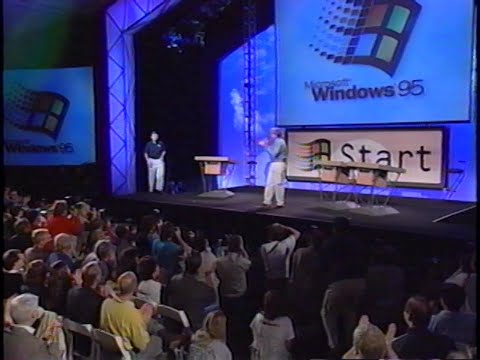
“…we decided to take the extra nine months in order to test Windows 95 thoroughly…”Microsoft Windows 95 launch event, Redmond, 1995 · full transcript →
Talent and empathy determine where innovation goes
Gates thinks progress depends heavily on getting brilliant people to work on the right things. He says he wanted to draw more people into important problems that do not get enough natural attention, because breakthroughs accelerate when talented scientists, thinkers, and communicators rally others to the cause.5
But talent alone is not enough. Gates argues that empathy changes what innovators choose to notice and what they choose to solve. The turning point is often the moment someone truly sees suffering or exclusion clearly and decides that technology should reach the people left behind, not only the already advantaged.
He also presents learning intensity as part of the innovator’s mindset. He describes himself as a reader and student, and he compares today’s AI wave to the software revolution of his youth. The implication is that innovation demands curiosity, immersion, and the willingness to retool as new fields emerge.
Gates on innovation, in his own words
“…we decided to take the extra nine months in order to test Windows 95 thoroughly…”
Where to watch
 Bill Gates on Climate Disaster: How to Cut Emissions to Zero2021 · 60 min · full transcriptBest overview of how Gates thinks innovation works in practice: R&D, policy, scaling, and cost reduction for a global problem.
 Bill Gates on Zero Emissions Energy: Innovating to Zero2010 · 30 min · full transcriptShows his clearest framework for breakthrough innovation: define the goal precisely and push for technologies that can truly get to zero.
 Bill Gates on Malaria and Education: Two Solvable Problems2009 · 20 min · full transcriptExplains why markets miss major problems and why talent, funding, and sustained commitment are needed to solve them.
 Bill Gates on Windows 95 Launch: Faster, Easier, More Fun1995 · 92 min · full transcriptUseful for seeing Gates’s product-side view of innovation: quality, integration, usability, and patience before release.
 Bill Gates on Optimism and Empathy: Change the World2014 · 25 min · full transcriptAdds the moral dimension: empathy directs innovation toward people who are usually overlooked.
Questions people ask
- How did Bill Gates explain the main factors behind carbon emissions?
- What did Bill Gates say about energy breakthroughs and smaller cuts?
- What did Bill Gates say he would wish for to fight climate change?
- Why did Bill Gates say some important problems get ignored?
- Why did Bill Gates write How to Avoid a Climate Disaster?
- How does Bill Gates think climate solutions get cheaper?
Sources
Every quote above, word for word from the transcripts. Numbers match the text.
“…this is something that has to get to zero…”
“With the right innovation, which is the most powerful force in the world, I really believe it's possible.”
“The world we want, a world in which every person can dream of a better future and make it come true, is a world without extreme poverty.”
“There's more money put into baldness drugs than are put into malaria.”
“A goal I had there was to draw more people in to work on those problems because I think there are some very important problems that don't get worked on naturally. That is the market does not drive the scientists, the communicators, the thinkers, the governments to do the right things. And only by paying attention to these things and having brilliant people who care and draw other people in can we make as much progress as we need to.”
“We owe the world the innovation.”
“I don't just see the problem. I also see an opportunity to solve it.”
“But the thing that triggered me to write this book was that the interest level of the younger generation has gotten very high. We saw that in the political discussions on the Democratic side. And so you've got this enthusiasm, and you've got this goal to get to zero by 2050, but there really isn't a plan. You know, people aren't aware of all the sources. They aren't aware of the need for innovations, although in different domains. I thought this was a good time to lay out some of the key metrics and how you get in that 30-year time period all these innovations scaled out.”
“If you gave me only one wish for the next 50, I can pick who's president, I can pick the vaccine, which is something I love, or I could pick that this thing that's half the cost with no c o two gets invented. This is the wish I would pick. This is the one with the greatest impact. If we don't get this wish, the division between the people who think short term and long term will be terrible, between US and China, between poor countries and rich, and most of all, the lives of those 2,000,000,000 will be far worse. So what do we have to do? What am I appealing, to you to step forward and and drive? We need to to go for more research funding.”
“Yeah, so the, um, if something costs a lot more right now, you know, how do we even get started? And there, we did have some governments, Germany and Japan, who bought solar power even when it cost more. And so they got the industry going. There was lots of competition, and with that volume, the price came down. And that is such good news. You know, the lithium-ion batteries that are used in electric cars have come down in price. Not like chips, but still pretty good. Solar and wind—land-based wind—have come down a lot. So, those are components of the solution.”
“The first is your political voice.”
“This equation has four factors, a little bit of multiplication. So you've got a thing on the left, c o two, that you wanna get to zero, and that's gonna be based on the number of people, the services each person's using on average, the energy on average for each service, and the c o two being put out per unit of energy. So let's look at each one of these and see how we can get this down to zero. Probably one of these numbers is gonna have to get pretty near to zero. Now that's back from high school algebra, but let's let's take a look. First, we've got population. The world today has 6,800,000,000 people. That's headed up to about 9,000,000,000.”
“And what I found is that all the batteries we make now could store less than ten minutes of all the energy. And so in fact, we need a big breakthrough here, something that's going to be a factor of a 100 better than the approaches we have now. It's not it's not impossible, but it's not a very easy thing. Now this shows up when you try to get the the intermittent source to be above, say, 20 to 30% of what you're using. If you're counting on it for a 100%, you need a... An incredible miracle battery. Now how we're gonna go forward on this? What's what's the right approach? Is it a Manhattan project? What's the the thing that can get us there? Well, we need lots of companies working on this. Hundreds. In each of these five paths, we need at least a 100 people.”
“The less we emit, the less that sum will be of c o two and therefore the less the temperature. But in some ways, the grade we get there, doing things that don't get us all the way to the big reductions is only equally or maybe even slightly less important than the other, which is the piece of innovation on these breakthroughs. These breakthroughs, we need to move those at full speed, and we can measure that in terms of companies, pilot projects, regulatory things that have been changed. There's a lot of great books that have been written about this. The Al Gore book, our choice, and the David Mackay book, sustainable energy without the hot air. They really go through it and I think can create a a framework that this can be discussed broadly because we need broad backing for this. There's a lot that has to come together. So this is a wish. It's a very concrete wish that we invent this technology.”
“If you go in kind of half heartedly for a period of time, you'll reduce the disease burden, but eventually, those tools will become ineffective.”
“…we decided to take the extra nine months in order to test Windows 95 thoroughly…”
“…make sure it met the highest quality standards…”
“…the original vision of "a computer on every desk and in every home" is slowly but surely coming true…”
How this guide was made: drafted with AI from the full transcripts of the recordings cited, then checked: every quotation must match a transcript word for word and be the speaker's own words, and an independent review gates accuracy. Methodology and corrections.


