Bill Gates: Innovating to zero!
On Zero Emissions Energy: Innovating to Zero

What Gates talks about
Bill Gates gave this TED2010 lecture in Long Beach in February 2010 on getting carbon emissions near zero through major clean-energy innovation.
Also known as: Innovating to zero; TED2010 talk on zero emissions energy; TED talk on zero emissions energy.
Bill Gates explains why energy and climate matter deeply to the world’s poorest people, and why simply making energy cheaper is not enough if it still emits carbon dioxide. He frames the challenge as one that requires getting emissions to near zero, not just reducing them partway.
He breaks the problem into four factors—population, services, energy efficiency, and carbon per unit of energy—and argues that only a major breakthrough in clean energy can solve the last one at global scale. Gates highlights several paths, including carbon capture, nuclear, and renewables, and stresses that all will need serious research and many companies working in parallel.
In the Q&A, he discusses TerraPower, the timeline for deploying new energy technologies, the role of geoengineering as insurance, and why he believes more R&D funding and market incentives are essential. His core message is that innovation, not sacrifice alone, is the route to both climate action and poverty reduction.
Gates speaks in a TED talk followed by interviewer questions and a few audience remarks.
In his words
“We need energy miracles”
“This is something that has to get to zero”
“The climate getting worse means that many years, their crops won't grow.”
“If you gave me only one wish for the next 50, I can pick who's president, I can pick the vaccine...”
Key points
- Energy is crucial to poverty reduction, especially for the poorest 2 billion people.
- Climate change will hit poor countries hardest through crop loss, starvation, and unrest.
- The world must drive CO2 emissions to near zero, not just cut them in half.
- Efficiency can help, but it cannot solve the problem by itself.
- A major energy breakthrough is needed in low- or zero-carbon power generation.
- Gates surveys five promising paths and argues that all deserve serious work.
- He calls for more R&D funding, market incentives, and broad public discussion.
Full transcript: Bill Gates, Innovating to zero! (2010)
Bill GatesI'm gonna talk today about energy and climate. And that might seem a bit surprising because my full time work at the foundation is mostly about vaccines and seeds, about the things that we need to invent and deliver to help the poorest 2,000,000,000 live better lives. But energy and climate are extremely important to these people. In fact, more important than to anyone else on the planet. The climate getting worse means that many years, their crops won't grow. There'll be too much rain, not enough rain. Things will change in ways that their fragile environment simply can't support. And that leads to starvation. It leads to uncertainty. It leads to unrest. So the the climate changes will be terrible for them.
Also, the price of energy is very important to them. In fact, if you could pick just one thing to lower the price of to reduce poverty, by far, you would pick energy. Now the price of energy has come down over time. Really, advanced civilization is based on advances in in energy. The coal revolution fueled the industrial revolution. And even in the nineteen hundreds, we've seen a very rapid decline in the price of electricity. And that's why we have refrigerators, air conditioning. We can make, modern materials and do so many things. And so we're in a wonderful situation with, electricity in the rich world. But as we make it cheaper, and let's say, let's go for making it, twice as cheap, we need to meet a new constraint, and that constraint has to do with c o two.
C o two is warming the planet, and the equation on c o two is actually a a very straightforward one. If you sum up the c o two that gets emitted, that leads to a temperature increase, And that temperature increase leads to some very negative effects. The effects on the weather, perhaps worse, the indirect effects in that, the natural ecosystems can't adjust to these rapid changes, and so you get ecosystem collapses. Now the exact amount of how you map from a a certain increase in of c o two to what temperature will be and where the positive feedbacks are, there's some uncertainty there, but not very much. And there's certainly uncertainty about how bad those effects will be, but they will be extremely bad. I asked the top scientists in this several times, do we really have to get down to near zero?
Can't we just, you know, cut it in half or a quarter? And the answer is that until we get near to zero, the temperature will continue to rise. And so that's that's a big challenge. It's very different than saying, you know, we're a 12 foot high truck trying to get under a 10 foot bridge and we can just sort of squeeze under, this is something that has to get to zero. Now we put out a lot of carbon dioxide every year, over 26,000,000,000 tons. For each American, it's about 20 tons. For people in poor countries, it's less than one ton. It's an average about five tons for everyone on the planet. And somehow we have to make changes that will bring that down to zero. It's been constantly going up. It's only various economic changes that have even flattened it at all.
So we have to go from rapidly rising to falling and falling all the way to zero. This equation has four factors, a little bit of multiplication. So you've got a thing on the left, c o two, that you wanna get to zero, and that's gonna be based on the number of people, the services each person's using on average, the energy on average for each service, and the c o two being put out per unit of energy. So let's look at each one of these and see how we can get this down to zero. Probably one of these numbers is gonna have to get pretty near to zero. Now that's back from high school algebra, but let's let's take a look. First, we've got population. The world today has 6,800,000,000 people. That's headed up to about 9,000,000,000. Now if we do a really great job on new vaccines, health care, reproductive health services, we could lower that by perhaps 10 or 15%.
But there we see an increase of, about 1.3. The second factor is the services we use. This encompasses everything. The food we eat, clothing, TV, heating. These are very good things. Getting rid of poverty means providing these services to almost everyone on the planet, and it's a great thing for this number to go up. In the rich world, perhaps the top 1,000,000,000, we probably could cut back and use less. But every year, this number on average is going to go up, and so overall, that will more than double the services delivered per person. Here we have a very basic service. Do you have lighting in your house to be able to read your homework? And in fact, these kids don't. So they're going out and reading their schoolwork under the street labs.
Now efficiency, e, the energy for each service. Here, finally, have some good news. We have something that's not going up through various inventions and new ways of doing lighting, through, different types of cars, different ways of building buildings. There are a lot of services where you can bring the energy for that service down quite substantially. Some individual services even bring it down by 90%. There are other services like how we make fertilizer, how we do air transport, where the rooms for improvement are far, far less. And so overall here, if we're optimistic, we may get a reduction of a a factor of three to even perhaps a factor of six. But for these first three factors now, we've gone from 26,000,000,000 to at best, maybe 13,000,000,000 tons, and that just won't cut it.
So let's look at this fourth factor. This is gonna be a key one, and this is the amount of c o two put out for each unit of energy. And so the question is, can you actually get that to zero? If you burn coal, no. If you burn natural gas, no. Almost every way we make electricity today, except, for the emerging renewables and nuclear, puts out c o two. And so we're going to have to do at a global scale is create a new system. And so we need energy miracles. Now when I use the term miracle, I don't mean something that's impossible. You know, the the microprocessor is a miracle. The personal computer is a miracle. The Internet and its services are a miracle. So the people here have participated in the creation of many miracles.
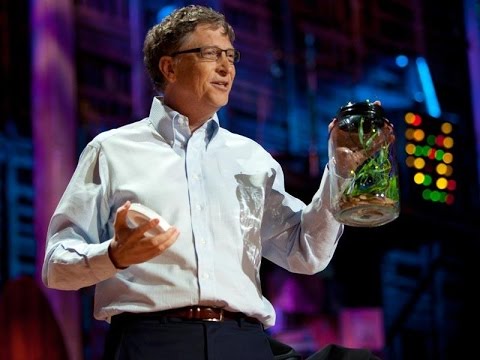
Usually, don't have a deadline where you have to get the miracle by a certain date. Usually, you just kinda stand by and some come along, some don't. This is a case where we actually have to drive at full speed and get a miracle in a a pretty tight timeline. Now I thought how could I really capture this? Is there some kind of natural illustration, some demonstration that would grab people's imagination here? I thought back to a year ago when I brought mosquitoes and somehow people enjoyed that. It it really got them involved in the idea of, you know, other people who live with mosquitoes. So with energy, all I could come up with is this. I decided that releasing fireflies would be my contribution to the environment here this year.
So here we have something after fireflies. I'm told they don't bite. In fact, they might even not even leave that jar. Now there's all sorts of gimmicky solutions like that one, but they don't really add up too much. We need solutions, either one or several that have unbelievable scale and unbelievable reliability. And although there's many directions are people seeking, I really only see five that can achieve the big numbers. I've left out tide, geothermal, fusion, biofuels. Those may make some contribution. And if they can do better than I expect, so much the better. But my key point here is that we're going to have to work on each of these five and we can't give up any of them, because they they look daunting because they all have significant challenges.
Let's look first at the burning fossil fuels, either burning coal or burning natural gas. What you need to do there, seems like it might be simple, but it's not. And that's to take all the c o two after you burn it, going out the flu, pressurize it, create a liquid, put it somewhere, and hope it stays there. Now we have some pilot things that do this at the 60 to 80% level, but getting up to that full percentage, that will be very tricky. And agreeing on where these c o two quantities should be put will be hard. But the toughest one here is this long term issue. Who's gonna be sure? Who's going to guarantee, something that is literally billions of times larger than any type of waste you think of in in terms of nuclear or other things. This is a lot of volume. So that's a tough one.
Next would be nuclear. It also has three big problems. Cost, particularly in highly regulated countries, is high. The issue of the safety, really feeling good about nothing can go wrong that even though you have these human operators, that the fuel doesn't get used for weapons. And then what what do you do with the waste? Although it's not very large, there are lot of concerns about that. People need to feel good about it. So three very tough problems, that might be, solvable and so should be worked on. The last three of the five I've grouped together, these are what people often refer to as the renewable sources. And they actually... Although it's great they don't require fuel, they have some disadvantages. One is that the density of energy gather in these technologies is dramatically less than a power plant.
This is energy farming. So you're talking about many square miles, thousands of times more area than than you think of as a normal energy plant. Also, these are intermittent sources. The sun doesn't shine all day. It doesn't shine every day and likewise, the wind doesn't blow all the time. And so if you depend on these sources, you have to have some way of getting energy during those time periods that it's not available. So we've got big cost challenges here. We have transmission challenges. For example, say this energy source is outside your country, you not only need the technology, but you have to, deal with the risk of the energy coming from elsewhere. And finally, this storage problem. And to dimensionalize this, I went through and looked at all the types of batteries that get made for cars, for computers, for phones, for flashlights, for everything, and compared that to the amount of electrical energy the world uses.
And what I found is that all the batteries we make now could store less than ten minutes of all the energy. And so in fact, we need a big breakthrough here, something that's going to be a factor of a 100 better than the approaches we have now. It's not it's not impossible, but it's not a very easy thing. Now this shows up when you try to get the the intermittent source to be above, say, 20 to 30% of what you're using. If you're counting on it for a 100%, you need a... An incredible miracle battery. Now how we're gonna go forward on this? What's what's the right approach? Is it a Manhattan project? What's the the thing that can get us there? Well, we need lots of companies working on this. Hundreds. In each of these five paths, we need at least a 100 people.
And a lot of them you'll look at and say they're crazy. That's good. And I think here in the TED group, have many people who are already pursuing this. Bill Gross has several companies including one called eSolar that has some great solar thermal technology. Vinod Khalsa is investing in dozens of companies that are doing great things and have interesting possibilities, and I'm I'm trying to help back that. Nathan Mirveld and I actually are backing a company that perhaps surprisingly is actually taking the nuclear approach. There are some innovations in nuclear, modular, liquid, and innovation really stopped in this industry quite some time ago. So the idea that there's some good ideas laying around is not all that surprising. The idea of a terror power is that instead of burning the part of uranium, the 1%, which is the u two thirty five, we decided, well, let's burn the 99%, the u two thirty eight.
It is kind of a crazy idea. In fact, people had talked about it for a long time, but they could never simulate properly whether it would work or not. And so it's through the advent of modern supercomputers that now you can simulate and see that, yes, with the right materials approach, this, looks like it would work. And because you're burning that 99%, you have greatly improved cost profile. You actually burn up the waste, and you can actually use as fuel all the leftover waste from today's reactors. And so instead of worrying about them, you just take that. It's a great thing. It breeds this uranium as it goes along. So it's kinda like a candle. You can see it's it's a log there often referred to as a traveling wave reactor. In terms of fuel, this really solves the problem.
I've got a picture here of a place in Kentucky. This is the leftover, the 99% where they've taken out the part they burn now, so it's called depleted uranium. That would power The US for hundreds of years. And simply by filtering seawater in an inexpensive process, you'd have enough fuel for the entire lifetime of the rest of the planet. So, you know, it's got lots lots of challenges ahead, but it is an example of the many hundreds and hundreds of ideas that we need to move forward. So let's think how should we measure ourselves? What should our report card, look like? Well, let's go out to where we really need to get and and then, look at the intermediate. For 2050, you've heard many people talk about this 80% reduction. That really is very important that we get there.
And that 20% will be used up by things going on in poor countries, still some agriculture. Hopefully, we will have cleaned up forestry cement. So to get to that 80%, the developed countries, including countries like China, will have had to switch their electric... Electricity generation altogether. So the other grade is, are we deploying this zero emission technology? Have we deployed it in all the developed countries and we're in the process of of getting it out elsewhere? That's super important. That's a key element of making that report card. So backing up from there, what should the 2020 report card look like? Well, it... Again, it should have the two elements. We should go through these efficiency measures to start getting reductions.
The less we emit, the less that sum will be of c o two and therefore the less the temperature. But in some ways, the grade we get there, doing things that don't get us all the way to the big reductions is only equally or maybe even slightly less important than the other, which is the piece of innovation on these breakthroughs. These breakthroughs, we need to move those at full speed, and we can measure that in terms of companies, pilot projects, regulatory things that have been changed. There's a lot of great books that have been written about this. The Al Gore book, our choice, and the David Mackay book, sustainable energy without the hot air. They really go through it and I think can create a a framework that this can be discussed broadly because we need broad backing for this. There's a lot that has to come together. So this is a wish. It's a very concrete wish that we invent this technology.
If you gave me only one wish for the next 50, I can pick who's president, I can pick the vaccine, which is something I love, or I could pick that this thing that's half the cost with no c o two gets invented. This is the wish I would pick. This is the one with the greatest impact. If we don't get this wish, the division between the people who think short term and long term will be terrible, between US and China, between poor countries and rich, and most of all, the lives of those 2,000,000,000 will be far worse. So what do we have to do? What am I appealing, to you to step forward and and drive? We need to to go for more research funding. You know, when countries get together at places like Copenhagen, they shouldn't just discuss the c o two. They should discuss this innovation agenda, and you'd be stunned at the ridiculously low levels of spending on these innovative approaches.
We do need the market incentives, c o two tax, cap and trade, something that gets that price signal out there. We need to get the message out. We need to have this dialogue be a more rational, more understandable dialogue, including the steps that the government takes. This is an important wish, but it is one I think we can achieve. Thank you.
InterviewerThank you. Thank you. Thank you. So thank you. So to understand more about about, TerraPower. Right? I mean, first of all, what... Can you give a sense of what sort of scale of investment this is?
Bill GatesWell, to to actually do this software, buy the supercomputer, hire all the great scientists, which we've done, that's only tens of millions. And even once we test our materials out, in a Russian reactor to make sure that our materials work properly, then you'll only be up in hundreds of millions. The tough thing is building the pilot reactor, finding the several billion, finding the the regulator, the location that will actually build the first one of these. Once you get the first one built, if it works as advertised, then it's just clear as day because the economics, the energy density are so different than nuclear as we know it.
InterviewerAnd so to understand it right, this involves building deep into the ground, almost like like a vertical kind of column of nuclear fuel of this sort of spent uranium. And then and then and then the process starts at the top and kinda works down?
Bill GatesThat's right. Today, you're always refueling the reactors. You have lots of people and lots of controls that can go wrong. That thing where you're opening it up and moving things in and out, that's that's not good. So if you have very, very cheap fuel, then you can put sixty years in. Just think of it as a log, put it down, and not have those same complexities. And it just sits there and burns for the sixty years, and and then it's done.
InterviewerIt's a it's a nuclear power plant that is its own waste disposal solution.
Bill GatesYeah. Well, what happens with the waste, you can you can let it sit there. There's a lot less waste under this approach. Then you can actually take that and put it into another one and burn that. And and we start out actually by taking the waste that exists today that's sitting in these cooling pools or dry casing by reactors. That's our fuel to begin with. So the thing that's been a problem from those reactors is actually what gets fed into ours, and you're reducing the volume of the waste quite dramatically as you're going through this process.
InterviewerI mean, you're talking to different people around the world about the possibilities here. Where where is their most interest in actually doing something with this?
Bill GatesWell, we haven't, picked a particular place, but, and there's all these, interesting disclosure rules, about anything that's called nuclear. So we... We've got a lot of interest. The people from the company have been in Russia, India, China. I've been back seeing the secretary of energy here talking about how this, fits into the the energy agenda. So I'm optimistic. You know, the French and Japanese have done some work. This is a a variant on something that has been done. It's an important advance, but it's like a fast reactor, and a lot
Interviewerof countries have built them. So anybody who's done a fast reactor is a candidate to to be where the first one gets built. So in in your mind, timescale and likelihood of actually taking something like this live?
Bill GatesWhat we need for one of these high scale electric... Electrical generation things that's very cheap, we have twenty years to invent and then twenty years to deploy. That's sort of the deadline that the environment models... Environmental models have have have shown us that we have to meet. And, you know, TerraPower, if things go well, which is wishing for a lot, could easily meet that. And there are, fortunately now, dozens of companies. We need it to be hundreds who, likewise, if their science goes well, if the funding for their plant... Pilot plants goes well, that they they can compete for this. And it's best if multiple succeed because then you can use a mix a mix of these things. We certainly need one to succeed.
InterviewerI mean, in terms of big scale possible game changers, this is the biggest that you're aware about there?
Bill GatesAn energy breakthrough is the the most important thing. It would have been even without the environmental constraint, but the environmental constraint just makes it so much so much greater. In the nuclear space, there are other innovators. You know, we don't know their work as well as we know this one. But the modular people, that's a different approach. There's a liquid type reactor, which seems a little hard, but maybe they say that about us. And so there there are different ones, but the the beauty of this is that molecule of uranium has a million times as much energy as a molecule of, say, coal. And so if you can deal with the negatives, which are essentially the radiation, the footprint and cost, the potential in terms of effect on land and various things is in almost in a class of its own.
InterviewerIf this doesn't work, then what? Do we have to start taking emergency measures to try and keep the temperature of the earth stable?
Bill GatesYeah. If you get into that situation, it's like if you're... You've been overeating and you're about to have a heart attack, you know, then then then where do you go? You may need heart surgery or something. There is a line of research on what's called geoengineering, which are various techniques that would delay the heating to buy us twenty or thirty years to get our act together. Now you hope... That's just an insurance policy. You hope you don't need to do that. Some people say you shouldn't even work on the insurance policy because it might make you lazy that you'll keep eating because you know heart surgery will be there to save you. I'm not sure that's wise given the importance of the problem, but, there's... Now that the geoengineering discussion about should that be in the back pocket in case things happen faster or this innovation goes a lot slower than we expect.
InterviewerClimate skeptics. If you had, a sentence or two to say to them, how how might you persuade them that they're wrong?
Bill GatesWell, unfortunately, the skeptics come in different camps. I mean, the ones who make scientific arguments are very few. You know? Are they saying that there's negative feedback effects that have to do with clouds that offset things? There are very, very few things that they can even say, you know, there's a chance in a million of those things. The main problem you have here, it's kinda like AIDS. You make the mistake now and you pay for it a lot later. And so when you have all sorts of urgent problems, the idea of taking pain now that has to do with the gain later and a somewhat uncertain, pain thing. In fact, the IPCC report, you know, that that's not necessarily the worst case. And there are people in the rich world who look at IPCC and say, okay. You know, that that isn't that big a deal. The fact is it's the... That uncertain part that should move us towards this.
But my dream here is that if you can make it economic and meet the c o two constraint, then the skeptics say, okay. I don't care that it doesn't put out c o two. I kinda wish it did put out c o two, but I guess I'll accept it because it's cheaper
Interviewerthan Right. Right.
Bill GatesWhat's come before. So...
InterviewerAnd so that would be your response to the the the Bjorn Lomborg argument that basically if you if you spend all this energy trying to solve the c o two problem, it's gonna take away all your other goals of trying to rid the world of poverty and malaria and so forth. It's it's a it's a it's a stupid waste of the earth's resources to put money towards that when there are better things we can do.
Bill GatesYeah. Well, the actual spending on the r and d piece, you know, say The US should spend 10,000,000,000 a year more than it is right now. It's not that dramatic. It shouldn't take away from other things. The thing you get into big money on, and this reasonable people can disagree, is when you have something that's noneconomic and you're trying to fund that, that to me mostly is a waste. Unless you're very close and you're just funding the learning curve and it's gonna get very cheap, I believe we should try, you know, more, things that have a potential to be far less expensive. If the trade off you get into is, let's make energy super super, expensive, then the rich can afford that. I mean, all of us here could pay five times as much for our energy and not change our lifestyle. The disaster is for that 2,000,000,000. And even Lomborg has changed. His stick now is why isn't the r and d, getting more discussed?
He... He's still, because of his earlier stuff, of associated with the skeptic camp, but he's realized that's that's a pretty lonely camp. And and so, he's making the r and d point, and and so there is a a threat of something that, I think is appropriate. The r and d piece, it's crazy how little it's funded.
InterviewerWell, Bill, I suspect I speak on behalf of most people here, to say I really hope your wish comes true. Thank you so much.
Bill GatesThank you.
Audience memberMy name is Sonia Nathal from the Young Zen Foundation. How does change happen? You raise the awareness and you inspire the change. You come to TED. You do TEDx. You build a community. You find solutions. And at Urban Zen, that's what we do. And that's why we come to TED. Thank you.
People are playing with words. It's it's true. All week long, people have been putting words together in very unique ways. I've been thinking about how food and wine are paired by experts who really understand the flavors. And here at Ted, people are putting words together in pairs because they understand the meaning. Reckless creativity. What a pairing that is. Just thinking about words that don't go together, where one and one equal three, I think that's what Ted's all about is, and it's just putting things together we don't normally think of.
Transcribed from the audio by speech recognition (Deepgram); speaker labels are automatic. Timestamps link to the video above. Errors are possible.
Cite this recording
Bill Gates, “Innovating to zero! (2010)”, TED2010, Long Beach, February 2010. Transcript and video: Thinkers Archive, https://thinkersarchive.com/bill-gates/zero-emissions-energy-ted-talk-2010/
Quoting a passage? Link to its exact moment: every timestamp above has its own anchor (for example https://thinkersarchive.com/bill-gates/zero-emissions-energy-ted-talk-2010/#t-179).