How did Bill Gates explain the main factors behind carbon emissions?
Bill Gates broke emissions into four factors: population, the services people use, the energy required for each service, and the carbon emitted per unit of energy. He said the first three factors may move in the wrong direction overall, so the crucial challenge is driving the fourth factor toward zero. That is why he focused so heavily on clean energy innovation.
“This equation has four factors, a little bit of multiplication. So you've got a thing on the left, c o two, that you wanna get to zero, and that's gonna be based on the number of people, the services each person's using on average, the energy on average for each service, and the c o two being put out per unit of energy. So let's look at each one of these and see how we can get this down to zero. Probably one of these numbers is gonna have to get pretty near to zero. Now that's back from high school algebra, but let's let's take a look. First, we've got population. The world today has 6,800,000,000 people. That's headed up to about 9,000,000,000.”
Key takeaways
- Break big problems into measurable factors
- Expect some variables to improve while others worsen
- Focus on the one factor that must reach zero
Context
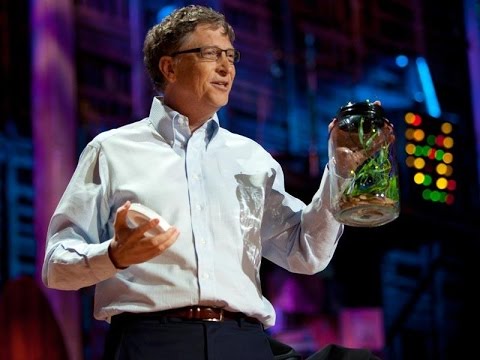
TED2010 in Long Beach, as Gates laid out the math of decarbonizing the world economy. The quote above is taken word for word from the recording's transcript.
In the transcript
…out a lot of carbon dioxide every year, over 26,000,000,000 tons. For each American, it's about 20 tons. For people in poor countries, it's less than one ton. It's an average about five tons for everyone on the planet. And somehow we have to make changes that will bring that down to zero. It's been constantly going up. It's only various economic changes that have even flattened it at all.
This equation has four factors, a little bit of multiplication. So you've got a thing on the left, c o two, that you wanna get to zero, and that's gonna be based on the number of people, the services each person's using on average, the energy on average for each service, and the c o two being put out per unit of energy. So let's look at each one of these and see how we can get this down to zero. Probably one of these numbers is gonna have to get pretty near to zero. Now that's back from high school algebra, but let's let's take a look. First, we've got population. The world today has 6,800,000,000 people. That's headed up to about 9,000,000,000.
But there we see an increase of, about 1.3. The second factor is the services we use. This encompasses everything. The food we eat, clothing, TV, heating. These are very good things. Getting rid of poverty means providing these services to almost everyone on the planet, and it's a great thing for this number to go up. In the rich world, perhaps the top 1,000,000,000, we probably could cut back…
Topics
More questions about Bill Gates
- What did Bill Gates say he would wish for to fight climate change?
- What did Bill Gates say about energy breakthroughs and smaller cuts?
- What did Bill Gates say about deploying zero-emission energy?
- What did Bill Gates say about the scale of the clean energy breakthrough the world needs?
- Why did Bill Gates write How to Avoid a Climate Disaster?
- What did Bill Gates say about Steve Jobs and Apple’s innovation?
How this answer was made: the quote is checked word for word against the transcript of the recording and confirmed as the speaker's own words; the summary above it was drafted with AI from that transcript and quality-checked. Methodology and corrections.