Bill Gates on Philanthropy
Bill Gates sees philanthropy as a duty to reduce extreme inequity by using money, data, innovation, and partnerships where markets and governments leave the poorest behind.
- Philanthropy should target the world’s biggest inequities, especially preventable suffering among the poorest.
- The main obstacle is not apathy but complexity, so giving must make problems, solutions, and results visible.
- He favors areas where markets fail, public goods are underfunded, and each dollar can do far more good.
- He treats philanthropy as practical problem-solving: fund R&D, cut costs, partner for delivery, and measure outcomes.
- He believes wealth should be given back to society rather than preserved as a dynasty or permanent institution.
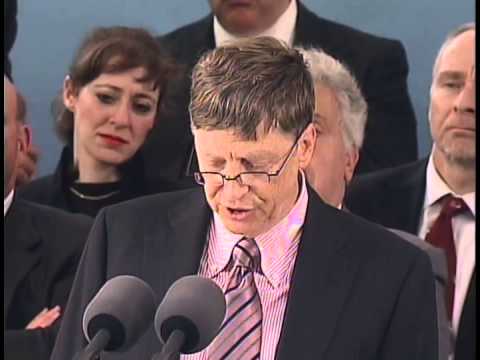
“For under a dollar, there were interventions that could save lives that just weren't being delivered. If you believe that every life has equal value, it's revolting to learn that some lives are seen as worth saving and others are not. We said to ourselves, this can't be true, but if it is true, it deserves to be the priority of our giving. So we began began our work in the same way anyone here would begin it. We asked how could the world let these children die? The answer is simple and harsh. The market did not reward saving the lives of these children, and governments did not subsidize it. So the children died because their mothers and fathers had no power in the market and no voice in the system.”Harvard Commencement, 2007 · 10:36
Philanthropy starts with confronting inequity
Gates’s philanthropic view begins with a moral awakening: he came to see global inequity, not just personal success or technological progress, as the central human problem worth acting on. He argues that the highest use of human effort is to reduce unfair gaps in health, wealth, and opportunity.12
That moral focus led him toward the lives of poor children, where the inequity is starkest. He points to the huge difference in child survival between rich and poor countries and treats that gap as an obvious priority for serious giving.45
His standard is simple but demanding: every life has equal value. Once he concluded that preventable deaths were happening mainly because the people affected had no market power and little political voice, philanthropy became a way to correct that neglect.67
Give where markets and governments leave people behind
Gates does not describe philanthropy as a general act of kindness spread evenly across causes. He sees its strongest role where normal incentives fail—especially when poor populations need medicines, vaccines, or health tools that do not attract enough commercial investment and are not adequately subsidized by governments.68
That is why global health became such a major focus for him and Melinda. He says helping the poorest countries can create far more impact than comparable spending in rich countries because needs are more severe, public goods are more underfunded, and relatively modest interventions can save lives.89
He applies the same logic to education, though he presents it as a harder systems problem. In health, the path from intervention to outcome can often be measured more clearly; in education, institutional and political complexity makes progress slower and less legible.1011
“For under a dollar, there were interventions that could save lives that just weren't being delivered. If you believe that every life has equal value, it's revolting to learn that some lives are seen as worth saving and others are not. We said to ourselves, this can't be true, but if it is true, it deserves to be the priority of our giving. So we began began our work in the same way anyone here would begin it. We asked how could the world let these children die? The answer is simple and harsh. The market did not reward saving the lives of these children, and governments did not subsidize it. So the children died because their mothers and fathers had no power in the market and no voice in the system.”Harvard Commencement, 2007 · full transcript →
The real challenge is turning caring into action
A core Gates idea is that people usually do care, but caring stalls when problems feel too complicated. He argues that the biggest barrier to change is complexity, not indifference, so effective philanthropy has to break big problems into visible needs, plausible solutions, and trackable results.12131415
That is why he repeatedly pushes against paralysis. His advice is to take on a major inequity, learn enough to understand the barriers, and stay engaged rather than backing away because the system looks messy.1613
He pairs that urgency with optimism. New tools in science, computing, and the internet make it more possible than before to understand problems, coordinate action, and scale solutions against extreme poverty and preventable disease.1718
Good philanthropy is disciplined, measurable, and partnered
Gates thinks philanthropy should be run with clear goals, not vague good intentions. He asks what outcomes a funder is trying to achieve and how those outcomes will be measured, because without that discipline it is too easy to confuse activity with impact.1920
In practice, his model is to support the full chain: fund research to create better tools, help make those tools inexpensive, and then work with governments and other organizations to deliver them at scale. He is explicit that no foundation can do this alone.2122
This approach also explains his attraction to eradication and long campaigns in global health. Some problems reward persistence and coordinated execution, and standing still lets disease regain ground.232425
Wealth should be spent for impact, not preserved forever
Gates treats large-scale giving as an obligation attached to great fortune. He and Melinda decided that the wealth created by Microsoft should go back to society, and he rejects the idea that accumulated wealth should mainly serve inheritance or family dynasty.2627
That belief shapes how he thinks about philanthropic time horizons. Rather than preserving capital indefinitely, he prefers having living decision-makers deploy resources against urgent current problems, using the best available understanding of politics, technology, and learning.2930
He also sees this work as deeply meaningful, not merely responsible. For him, philanthropy is both a moral duty and one of life’s most fulfilling forms of problem-solving.317
Gates on philanthropy, in his own words
“From those to whom much is given, much is expected.”
“…you can't take it with you…”
Where to watch
 Bill Gates on Global Health Philanthropy: Spending Down the Foundation2024 · 61 min · full transcriptBest single overview of how Gates thinks philanthropy should work: spend urgently, partner broadly, and measure outcomes.
 Bill Gates on Global Inequity: Don’t Let Complexity Stop You2007 · 36 min · full transcriptBest statement of the moral case: philanthropy should confront inequity and not be scared off by complexity.
 Bill Gates on Philanthropy and Global Health: Harvard Q&A2007 · 55 min · full transcriptBest for why global child mortality and education became his core priorities.
 Bill Gates on Philanthropy: Giving Away Wealth and Changing Systems2013 · 25 min · full transcriptBest for the personal logic of giving away Microsoft wealth and focusing on systems change.
 Bill Gates on Global Health Funding: Why Aid Still Matters2019 · 15 min · full transcriptBest for how he evaluates high-impact global health funding in practical terms.
Questions people ask
- What advice did Bill Gates give Harvard graduates about making a difference?
- What did Bill Gates say about giving up on malaria and tuberculosis?
- What did Bill Gates say about measuring better teaching?
- What did Bill Gates say about new tools and extreme poverty?
- Why did Bill Gates choose global health for his philanthropy?
- Why did Bill Gates say the Gates Foundation should spend down instead of lasting forever?
Sources
Every quote above, word for word from the transcripts. Numbers match the text.
“I left Harvard with no real awareness of the awful inequities in the world…”
“Reducing inequity is the highest human achievement.”
“If you're a poor child, you have fifty times more chance of dying before the age of five than a person in the rich world.”
“Yeah. The global health thing was pretty straightforward. It's easy not to be aware of the the number of children who die in the ill health. You know, if you're a poor child, you have fifty times more chance of dying before the age of five than a person in the rich world. And that's partly because you're not getting the right medicines, partly because if you live in Equatorial areas, things like malaria are threatening you and not threatening the the rich countries. So the idea that that's the greatest inequity in the world, you know, jumped out at us both from a visiting Africa and parts of Asia and a numeric point of view. You know, many people think that, okay, Syria is terrible. Yes. It's incredibly terrible. But a few hundred thousand over several years is less than six million per year.”
“For under a dollar, there were interventions that could save lives that just weren't being delivered. If you believe that every life has equal value, it's revolting to learn that some lives are seen as worth saving and others are not. We said to ourselves, this can't be true, but if it is true, it deserves to be the priority of our giving. So we began began our work in the same way anyone here would begin it. We asked how could the world let these children die? The answer is simple and harsh. The market did not reward saving the lives of these children, and governments did not subsidize it. So the children died because their mothers and fathers had no power in the market and no voice in the system.”
“From those to whom much is given, much is expected.”
“When I shift, the beauty of philanthropy is that it's not constrained by this profit motive. And I have to say, I was shocked at how little resources were going into helping the poorest countries. And philanthropic money spent there, if it's spent decently at all, you're always going to have at least 20 times more impact than you can have in rich countries. I mean, there's lots of rich-country philanthropy, you know, we do a lot in education, but the resources are so limited and the key public goods are so underfunded that, you know, in terms of helping all humans, that money is going to go the…”
“Our basic criteria is that we can save lives for less than $1,000 per life saved.”
“If you're putting computers in the libraries, that's straightforward. If you're trying to help improve the k through 12 personnel system so that the average quality of teaching is much better. That is the really good teachers share their secrets and certain incentives and professional development are put in so that the average, moves up to the the top quartile, from the... Today's average to the top quartile today. That because it's subject to so many uncertainties, including school boards, political processes, union negotiations, desire to maintain the status quo. If you said to me, are we making progress on that one or not, I could talk for a long time, but I wouldn't be able to give you a number.”
“If you don't have an effective teacher in the front of the classroom, I don't care how big or small the building is, you're not going to change the trajectory…”
“The barrier to change is not too little caring. It is too much complexity.”
“Don't let complexity stop you.”
“If we had known how to help, we would have acted. The barrier to change is not too little caring. It is too much complexity. To turn caring into action, we need to see a problem, see a solution, and see the impact. But complexity blocks all three steps. Even with the advent of the Internet and twenty four hour news, it is still a complex enterprise to get people to truly see the problems. When an airplane crashes, officials immediately call a press conference. They promise to investigate, determine the cause, and prevent similar crashes in the future. But if the officials were brutally honest, they would say, of all the people in the world who die today from preventable causes, one half of one percent were on this plane.”
“Now this task is open ended. It can never be finished. But a conscious effort to answer this challenge can change the world. I'm optimistic that we can do this. But I talked to skeptics who claim there is no hope. They say, inequity has been with us since the beginning and will be with us until the end because people just don't care. I completely disagree. I believe we have more caring than we know what to do with. All of us here in this yard, at one time or another, have seen human tragedies that broke our heart. And yet we did nothing, not because we didn't care, but because we didn't know what to do.”
“In line with the promise of this age, I wanna exhort each of the graduates here to take on an issue, a complex problem, a deep inequity, and become a specialist on it. If you make it the focus of your career, that would be phenomenal. But you don't have to do that to make an impact. For a few hours every week, you can use the growing power of the Internet to get informed, find others with the same interests, see the barriers, and find ways to cut through them. Don't let complexity stop you. Be active... Activists. Take on big inequities. I feel sure it will be one of the great experiences of your lives. You graduates are coming of age in an amazing time.”
“Still, I'm optimistic. Yes, inequity has been with us forever. But the new tools we have to cut through complexity have not been with us forever. They are new. They can help us make the most of our caring, and that's why the future can be different from the past. The defining and ongoing innovations of this age, biotechnology, the personal computer, and the Internet give us a chance we've never had before to end extreme poverty and end death from preventable disease.”
“That's the moment that change is born.”
“…what outcomes are you going for, how are you going to measure that?”
“The crucial thing is to never stop thinking and working and never do what we did with malaria and tuberculosis in the twentieth century, which is to surrender to complexity and quit. The final step after seeing the problem and finding an approach is to measure the impact of the work and to share that success or failure so that others can learn from the efforts. You have to have the statistics, of course. You have to be able to show, for example, that a program is vaccinating million more... Millions more children. You have to be able to show, for example, a decline in the number of children dying from the diseases.”
“Well, the Gates Foundation is fairly operational. That is, you know, we built teams that are experts on malnutrition, malaria, contraception, and we fund both the research to create new products and get them to be very inexpensive. And then we partner with governments and other philanthropies to actually deliver those, uh, to where they're most needed. Uh, likewise, in our education work, we fund a lot of R&D and then go work partner with the schools to actually try those things out. And, you know, by spending the money sooner than later,…”
“…we can't do it ourselves…”
“…zero is very much a magic number in, in eradication…”
“So if you stand still, the disease will get out ahead of you.”
“We need to keep doing that.”
“…the wealth that had come from Microsoft would be given back to society…”
“…you can't take it with you…”
“…we'll spend, uh, a bit over 200 billion…”
“And then it's up to rich people who are alive, who are looking at the current problems and politics and technology and understanding of learning to decide, you know, to give their money as opposed to picking, you know, some weird board who god knows what they would do. Alright. And and there will be plenty of money, but that's just our choice not to perpetuate some name because these missions don't... They're not... You know, they will be solved by someone, hopefully us, but by somebody within the next forty or fifty years.”
“It's the most fulfilling thing we've ever done…”
How this guide was made: drafted with AI from the full transcripts of the recordings cited, then checked: every quotation must match a transcript word for word and be the speaker's own words, and an independent review gates accuracy. Methodology and corrections.


