Education and Feedback
Teachers improve when systems give them useful, specific evidence.
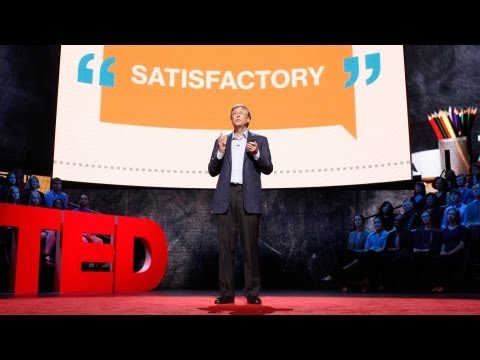
“I'm talking about teachers. When Melinda and I learned how little useful feedback most teachers get, we were blown away. Until recently, over 98 percent of teachers just got one word of feedback: Satisfactory. If all my bridge coach ever told me was that I was "satisfactory," I would have no hope of ever getting better. How would I know who was the best? How would I know what I was doing differently? Today, districts are revamping the way they evaluate teachers, but we still give them almost no feedback that actually helps them improve their practice. Our teachers deserve better.”TED2013, Long Beach · 0:57
The lesson
Gates argues that education improves when teachers get the kind of feedback most professionals expect: specific, actionable, and frequent. In his account, the old pattern of giving nearly everyone a generic rating did little to help teachers grow, which made the system unfair both to teachers and to students12. The core idea is simple: improvement depends on evidence that shows what is working and what is not.
He points to stronger systems that make teacher learning part of the job, not an occasional event. In those systems, teachers watch excellent teaching, meet regularly to discuss what works, and observe one another, because teaching quality varies a great deal and that variation matters for student outcomes3. That means evaluation should not just sort teachers; it should spread effective practices across the profession.
For Gates, better feedback requires better measurement. In the Measures of Effective Teaching project, observers looked at concrete classroom practices and students gave input on whether instruction was clear, challenging, and responsive4. This reflects his broader belief that data systems matter in education and can improve millions of lives when they are used to understand real performance rather than protect the status quo5.
But diagnosis alone is not enough. Gates says improvement only happens when teachers also get tools and support: examples of great instruction, usable video, and a process teachers can help manage themselves so feedback feels practical rather than imposed6. The goal is not surveillance; it is to make it easier for an average teacher to move toward top-quartile practice over time, even though changing the personnel system is hard and politically uncertain7.
He also adds an important constraint on what technology can and cannot do. Computers and online tools can make learning more adaptable and effective, but motivation remains a bottleneck, so better systems for teachers still matter8. In other words, Gates's view of education is not that software replaces teaching; it is that measurement, feedback, tools, and human support have to work together.
5 principles from Bill Gates
Give feedback that is specific enough to change practice
A label or overall rating does not tell someone what to do differently next time. If you want improvement, identify concrete behaviors and decisions that can be strengthened, then revisit them with evidence.
“I'm talking about teachers. When Melinda and I learned how little useful feedback most teachers get, we were blown away. Until recently, over 98 percent of teachers just got one word of feedback: Satisfactory. If all my bridge coach ever told me was that I was "satisfactory," I would have no hope of ever getting better. How would I know who was the best? How would I know what I was doing differently? Today, districts are revamping the way they evaluate teachers, but we still give them almost no feedback that actually helps them improve their practice. Our teachers deserve better.”
Build peer learning into the system
Teachers improve faster when they can see strong practice, discuss what works, and observe colleagues regularly. Make improvement a shared routine, not a private struggle.
“They made sure that younger teachers get a chance to watch master teachers at work. They have weekly study groups, where teachers get together and talk about what's working. They even require each teacher to observe and give feedback to their colleagues. You might ask, why is a system like this so important? It's because there's so much variation in the teaching profession. Some teachers are far more effective than others. In fact, there are teachers throughout the country who are helping their students make extraordinary gains. If today's average teacher could become as good as those teachers, our students would be blowing away the rest of the world.”
Measure teaching with multiple sources
Use more than one signal to understand effectiveness, such as classroom observation and student experience. Combining sources makes feedback more diagnostic and more useful than a single top-down judgment.
“So we need a system that helps all our teachers be as good as the best. What would that system look like? Well, to find out, our foundation has been working with 3,000 teachers in districts across the country on a project called Measures of Effective Teaching. We had observers watch videos of teachers in the classroom and rate how they did on a range of practices. For example, did they ask their students challenging questions? Did they find multiple ways to explain an idea? We also had students fill out surveys with questions like, "Does your teacher know when the class understands a lesson?" "Do you learn to correct your mistakes?”
Pair evaluation with tools and support
Finding a weakness is only useful if people can act on it. After evaluation, provide models, examples, and practical resources so the person can improve in the exact area identified.
“Diagnosing areas where a teacher needs to improve is only half the battle.”
Use technology to assist learning, not to ignore motivation
Digital tools can expand access and adaptation, but they do not eliminate the human challenge of motivation. Design systems that support both better instruction and student engagement.
“If you have a kid who's super motivated, then yes, going to the Khan website and doing, you know, hours of math problems, that's great.”
In his own words
The quotes behind the lesson, word for word from the transcripts. Numbers match the lesson above.
“I'm talking about teachers. When Melinda and I learned how little useful feedback most teachers get, we were blown away. Until recently, over 98 percent of teachers just got one word of feedback: Satisfactory. If all my bridge coach ever told me was that I was "satisfactory," I would have no hope of ever getting better. How would I know who was the best? How would I know what I was doing differently? Today, districts are revamping the way they evaluate teachers, but we still give them almost no feedback that actually helps them improve their practice. Our teachers deserve better.”
“We all need people who will give us feedback.”
“They made sure that younger teachers get a chance to watch master teachers at work. They have weekly study groups, where teachers get together and talk about what's working. They even require each teacher to observe and give feedback to their colleagues. You might ask, why is a system like this so important? It's because there's so much variation in the teaching profession. Some teachers are far more effective than others. In fact, there are teachers throughout the country who are helping their students make extraordinary gains. If today's average teacher could become as good as those teachers, our students would be blowing away the rest of the world.”
“So we need a system that helps all our teachers be as good as the best. What would that system look like? Well, to find out, our foundation has been working with 3,000 teachers in districts across the country on a project called Measures of Effective Teaching. We had observers watch videos of teachers in the classroom and rate how they did on a range of practices. For example, did they ask their students challenging questions? Did they find multiple ways to explain an idea? We also had students fill out surveys with questions like, "Does your teacher know when the class understands a lesson?" "Do you learn to correct your mistakes?”
“Now we put a lot of money into education, and I really think that education is the most important thing to get right, for the country to have as strong a future as it should have. In fact, we have in the stimulus bill, it's interesting, the house version actually had money in it for these data systems and, was taken out in the senate because their their people are threatened by these things. But I... I'm optimistic. I think, people are beginning to recognize, how important this is, and it really can make a difference for millions of lives if we get it right.”
“Diagnosing areas where a teacher needs to improve is only half the battle.”
“If you're putting computers in the libraries, that's straightforward. If you're trying to help improve the k through 12 personnel system so that the average quality of teaching is much better. That is the really good teachers share their secrets and certain incentives and professional development are put in so that the average, moves up to the the top quartile, from the... Today's average to the top quartile today. That because it's subject to so many uncertainties, including school boards, political processes, union negotiations, desire to maintain the status quo. If you said to me, are we making progress on that one or not, I could talk for a long time, but I wouldn't be able to give you a number.”
“If you have a kid who's super motivated, then yes, going to the Khan website and doing, you know, hours of math problems, that's great.”
Reflect
- Where in your own work do you receive a verdict instead of useful feedback, and what specific evidence would help you improve?
- If you lead others, how could you build regular peer observation or sharing of best practices into the workflow?
- Think of a skill you are trying to improve. What would the equivalent of classroom video, observation, and learner feedback look like for that skill?
Check your understanding
Go deeper
 Bill Gates on Teacher Feedback: How to Help Teachers Improve2013 · 10 min · full transcript
 Bill Gates on Education and Health: Technology Can Lift Lives2007 · 33 min · full transcript
 Bill Gates on Malaria and Education: Two Solvable Problems2009 · 20 min · full transcript
 Bill Gates on Philanthropy and Global Health: Harvard Q&A2007 · 55 min · full transcript
 Bill Gates on Success and Parenting: Lessons from His Parents2025 · 81 min · full transcript